Longest and Shortest Dart Barrels
The World’s Longest and Shortest Dart Barrels – A History of Extreme Dart Design
Darts have changed dramatically over the history of the game. Early darts were relatively large and heavy, but improvements in metals—particularly the introduction of dense tungsten barrels—allowed manufacturers to produce much thinner and more compact darts. Today, most competition darts look fairly conventional, but manufacturers have also experimented with extremely long and extremely short designs.
The Longest Darts
There does not appear to be an official Guinness record for the longest normal playable competition dart, so claims of a single “world’s longest dart” need some qualification.
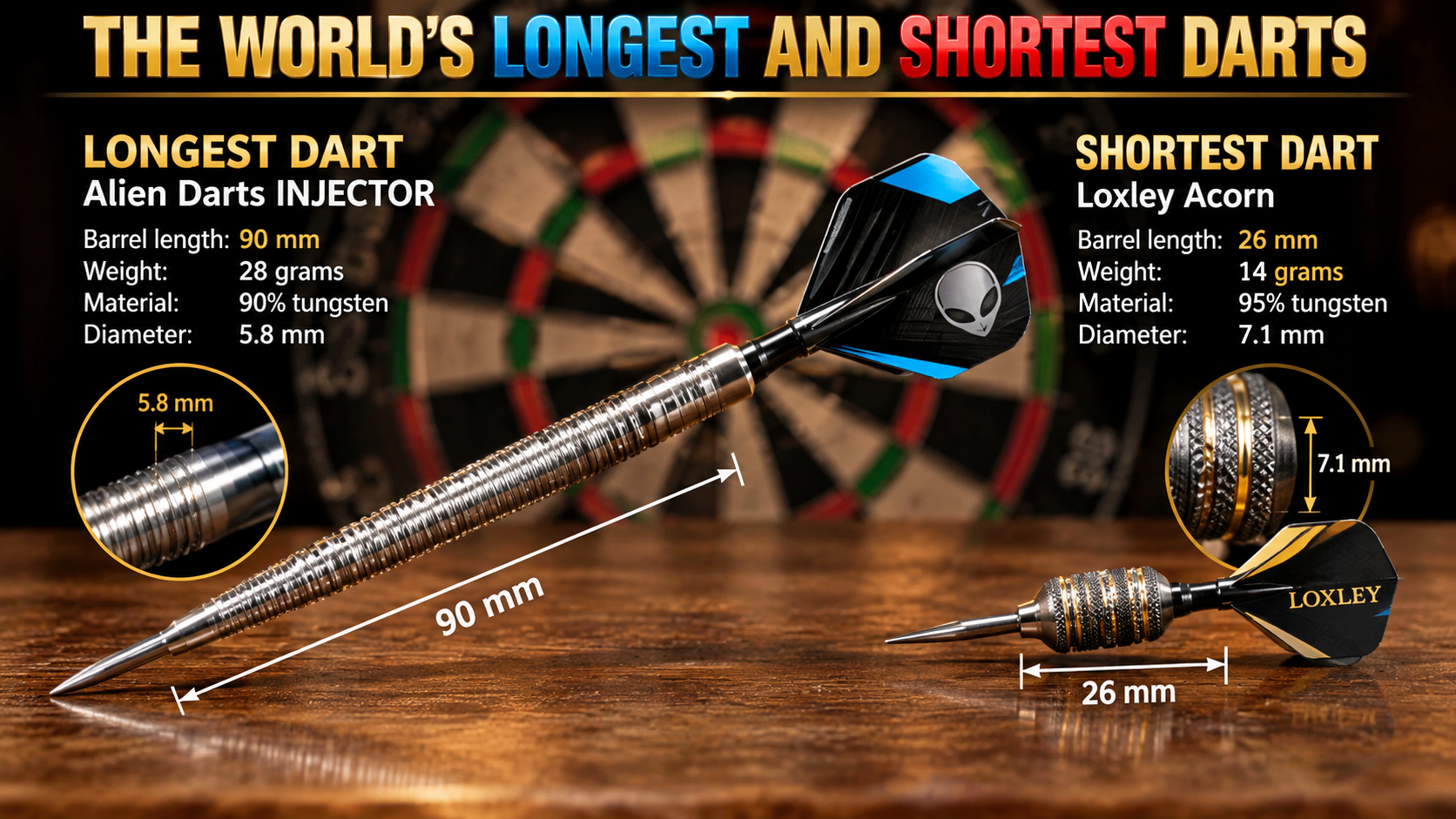
One particularly extreme commercial example is the Alien Darts INJECTOR. Its tungsten barrel measures an extraordinary 90 mm long, far beyond the roughly 40–55 mm barrels commonly seen in modern darts. It is made from 90% tungsten, weighs 28 grams and is only 5.8 mm wide. Alien Darts describes it as probably the longest tungsten dart commercially available rather than claiming a formally certified world record.
Professional darts provide another interesting benchmark. Belgian professional Mike De Decker uses unusually long 60 mm barrels. Manufacturer Mission describes these as the longest darts used on the professional tour. His signature steel-tip models are made from 95% tungsten and are available in several weights.
This shows how dart design has evolved: a long barrel gives a player considerably more room to position the fingers and can suit players who use a stretched-out grip.
The Shortest Darts
At the opposite extreme are the Loxley Acorn darts. These have been marketed as the “world’s shortest tungsten darts.” Their barrels are just 26 mm long, weigh 14 grams and are made from 95% tungsten. The maximum barrel diameter is 7.1 mm.
Again, this is a manufacturer’s/commercial claim rather than a Guinness-certified world record, but the dimensions are remarkable. A 26 mm barrel is less than half the length of Mike De Decker’s 60 mm professional barrel and less than one-third the length of the 90 mm INJECTOR.
From Big Brass Darts to Compact Tungsten
The history behind these extremes is closely connected to tungsten. Traditional darts were commonly made from materials such as wood and brass. Brass is relatively inexpensive and easy to manufacture, but because it is less dense than tungsten, a brass dart needs a comparatively thick barrel to achieve the desired weight.
Tungsten changed dart design. Its high density allows manufacturers to concentrate substantial weight into a much smaller diameter. This is especially useful because thin darts can be grouped more closely together in scoring areas such as the treble 20.
Modern manufacturers have taken that advantage in completely different directions. Some create exceptionally long, thin barrels, while others create extremely short, chunky barrels.
The contrast is striking: the 26 mm Loxley Acorn represents the ultra-short end of tungsten design, while the 90 mm Alien Darts INJECTOR represents an extreme long-barrel experiment. Professional darts generally remain somewhere between such extremes, although Mike De Decker’s 60 mm barrels demonstrate that unusually long darts can work successfully at the highest level.
Ultimately, neither the longest nor shortest dart is automatically better. Their history illustrates one of the fascinating things about darts: the basic game stays the same, but the equipment can be adapted enormously to suit the player’s hand, grip and throwing style.