The History of Darts
From a traditional British pastime to an international professional sport
Darts is one of the most recognizable pub games in the world, but behind its apparently simple combination of a dart and a circular board lies a fascinating history. Over generations, darts developed from an informal pastime into an organized competitive game with standardized equipment, governing bodies, professional players, major tournaments and large television audiences.
The exact origins of darts are difficult to establish with certainty. Like many traditional games, it developed gradually rather than being invented by one identifiable person. Stories about soldiers throwing shortened arrows at targets are frequently associated with its beginnings, while the recognizable modern game emerged much later in Britain.
What is certain is that by the late nineteenth and early twentieth centuries, darts was becoming increasingly established as a popular indoor game. From British pubs to enormous professional arenas, its development is one of the most interesting stories in competitive games.
Early Origins of Darts
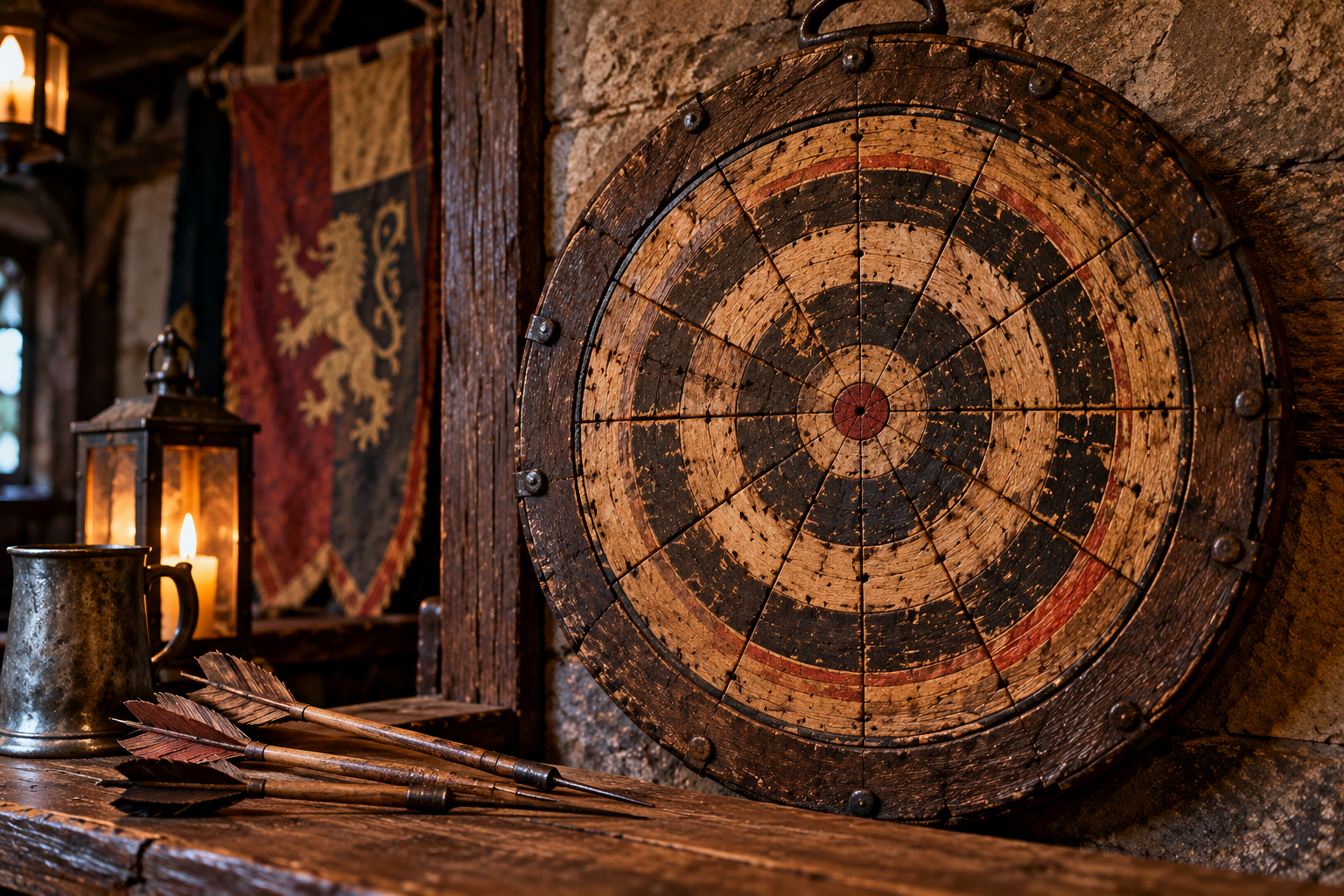
Many accounts of darts history connect the game with medieval England and soldiers practicing their throwing skills. According to the traditional story, soldiers threw shortened arrows, bolts or similar objects at targets such as sections of tree trunks.
The natural rings and cracks in wood could provide convenient scoring areas. As a tree trunk dried, cracks spreading outward from the center could also create natural sections resembling the divided areas found on later dartboards.
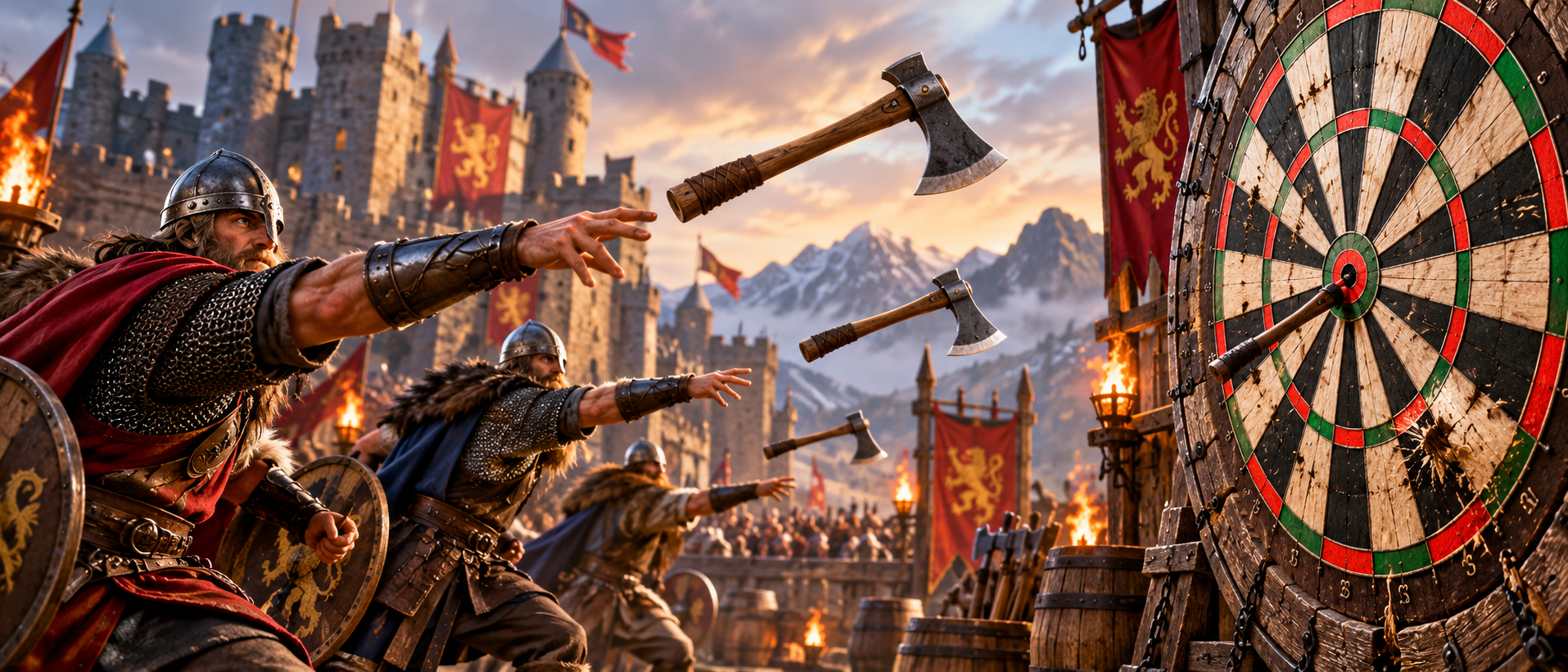
These stories provide an attractive explanation for the basic concept behind darts, although the direct historical connection between medieval military training and the modern pub game is difficult to prove. Games involving thrown objects and targets have existed in many societies, so darts probably developed through a combination of influences.
Eventually, specially manufactured targets replaced improvised pieces of wood. This allowed scoring systems to become more consistent and helped darts develop into an organized game.
Darts Moves Indoors
Whatever its distant origins, darts became strongly associated with Britain. As the game developed, it proved particularly suitable for indoor recreation.
Unlike many sports, darts required very little space. Players needed only a board, a throwing line and a set of darts. This made the game particularly suitable for public houses.
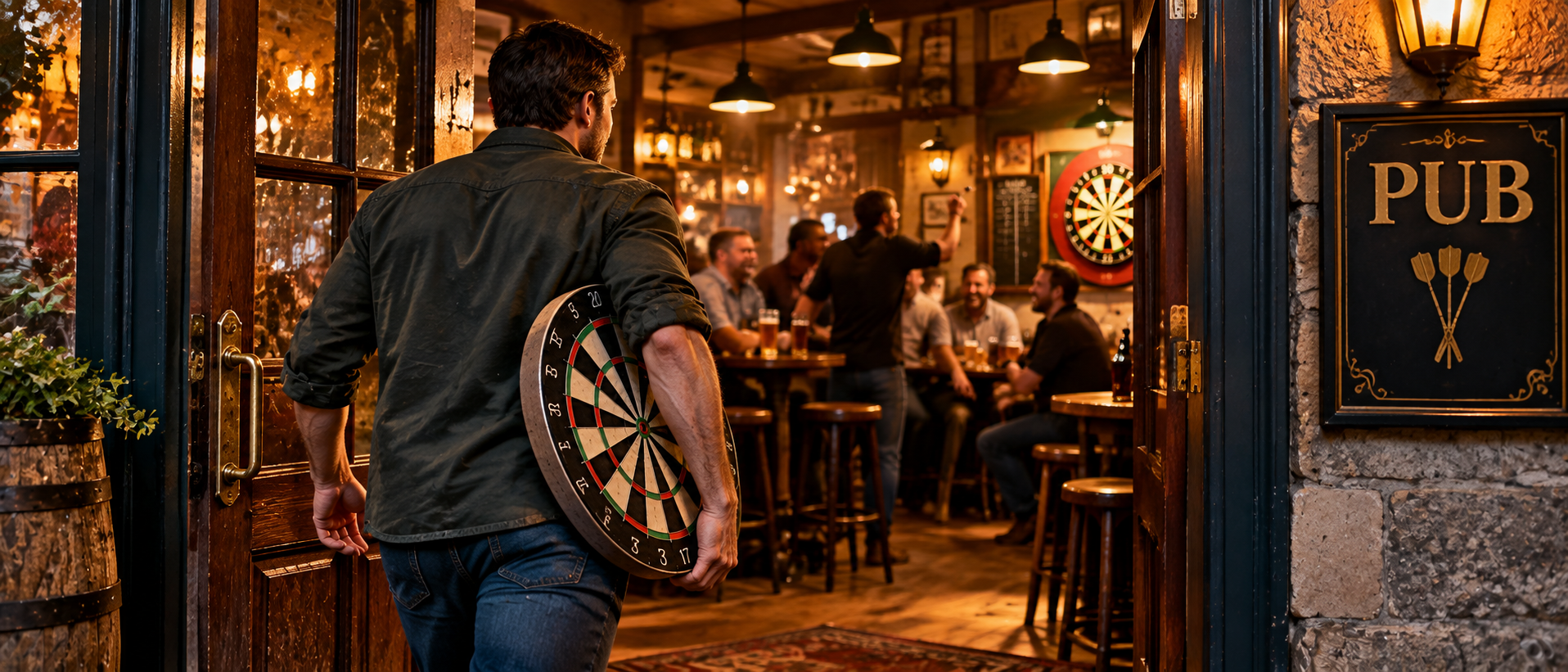
British pubs provided a social environment where people could meet, drink, talk and compete in games. Darts joined other traditional pub activities and gradually became one of the most popular.
Early darts were quite different from the precision equipment used today. Players experimented with different designs, while dartboards could vary considerably from one area to another.
Local variations were an important part of early darts. Different communities developed their own boards, scoring systems and rules. Some regional dartboards have survived into the modern era.
The Development of the Modern Dartboard
One of the most important developments in darts history was the emergence of the familiar numbered dartboard containing twenty segments.
The numbers are deliberately arranged so that large numbers are frequently positioned beside much smaller ones. This design punishes inaccurate throwing and rewards precision.
A player aiming for the 20, for example, risks hitting 1 or 5 if the dart travels too far to either side.
The standard dartboard contains twenty numbered wedges. Each segment contains a large single-scoring area together with narrow double and treble rings. At the center of the board are the outer bull and inner bullseye.
The treble 20 became particularly important because hitting it with all three darts produces a score of 180 — the highest possible score during a standard three-dart visit.
A score of 180 is achieved by hitting treble 20 with all three darts. It is the highest possible score during a normal three-dart visit.
Brian Gamlin and the Numbering System
The origins of the standard dartboard numbering sequence are surrounded by uncertainty. The name Brian Gamlin is frequently associated with the arrangement and is often said to have devised it in Lancashire during the nineteenth century.
However, firm documentary evidence proving this story is limited, and the exact inventor of the familiar numbering arrangement remains uncertain.
Regardless of who created it, the arrangement is remarkably effective. High-value numbers are positioned near low-value numbers, meaning that even a small error can be severely punished.
This simple but clever design helps separate accurate players from inaccurate players and remains one of the fundamental challenges of darts.
Darts in the Early Twentieth Century
By the early twentieth century, darts had become firmly established in British pub culture. Competitions between individuals, pubs and local teams became increasingly common.
The game’s reputation was not always straightforward. Because darts was associated with pubs and sometimes betting, questions arose about whether it was primarily a game of chance or a genuine game of skill.
A famous story from darts history concerns a legal case in Leeds in 1908. According to widely repeated accounts, a skilled darts player demonstrated his accuracy in court to help establish that darts depended upon skill rather than chance.
Although details of the story have been repeated in different forms over the years, it became an important part of darts folklore.
The basic principle is easy to understand. Experienced players can consistently perform actions that beginners cannot. Accurate throwing, grouping, finishing and tactical decision-making all improve through practice.
The Rise of Organized Competition
As the number of darts players increased, organized competitions became increasingly important. Local leagues allowed pubs and clubs to compete against one another, while larger tournaments brought together talented players from different regions.
Standardization was essential to this development. Competitive darts required agreement about board dimensions, throwing distances, scoring procedures and equipment.
One historically important competition was the News of the World Individual Darts Championship. It grew into one of the most prestigious darts competitions of its era.
Large competitions demonstrated that darts could attract interest far beyond individual pubs. Successful competitors could become recognized champions, while spectators increasingly followed the achievements of leading players.
The Standard Throwing Distance
Modern steel-tip darts is normally played with the center of the bullseye positioned 1.73 metres above the floor.
The horizontal distance from the face of the dartboard to the throwing line, known as the oche, is 2.37 metres.
These standardized measurements are important because even relatively small differences in distance can affect throwing technique.
Players develop their stance, balance and throwing action through thousands of repetitions, making consistent playing conditions essential for competitive darts.
The Popularity of 501
Numerous darts games exist, but 501 became the dominant format in professional competition.
Each player begins with 501 points and attempts to reduce the score to exactly zero. Players normally throw three darts during each visit, with the total score being deducted from the player’s remaining total.
In standard professional competition, the final dart must land in a double. The inner bullseye, worth 50 points, can also count as a double for finishing purposes.
This requirement introduces an important strategic element. A player cannot simply score as heavily as possible. The remaining total must also be managed so that a suitable finishing combination is available.
Experienced players therefore memorize common checkout combinations and quickly calculate possible routes while standing at the oche.
Darts and Television
Television transformed darts from a traditional pub game into a spectator sport capable of reaching millions of people.
Darts proved particularly suitable for television because viewers could easily understand the basic objective while cameras could provide close-up images of the board.
During the 1970s and 1980s, televised darts became extremely popular in Britain. Players developed recognizable personalities, and successful competitors became sporting celebrities.
Commentary, close-up cameras and enthusiastic crowds created an entertaining television product. Viewers could see the player’s preparation, watch the throw and immediately see where the dart landed.
Television introduced professional darts to a much larger audience and helped create some of the sport’s first internationally recognizable stars.
Eric Bristow, John Lowe and Jocky Wilson
Several players became synonymous with the classic television era of darts.
Eric Bristow was one of the game’s biggest stars and won multiple world championships. His confidence, personality and competitive success made him one of the most recognizable darts players of his generation.
John Lowe was another enormously influential player. Known for his controlled throwing style and long career, Lowe achieved one of darts’ great television milestones when he recorded a televised nine-dart finish in 1984.
Scotland’s Jocky Wilson was another major figure. A two-time world champion, Wilson became famous for his distinctive personality and determination at the oche.
Players such as Bristow, Lowe and Wilson helped establish the idea of the professional darts star, and their famous matches remain an important part of darts history.
The Nine-Dart Finish
A nine-dart finish is one of the greatest achievements in darts. In a standard game of 501, nine darts is the minimum number required to reduce a player’s score from 501 to exactly zero.
Several routes are possible, but perhaps the most famous begins with two consecutive scores of 180.
That leaves 141 points, which can be completed with three darts. One well-known route is treble 20, treble 19 and double 12.
Even elite professional players cannot produce nine-dart finishes routinely. The combination of accuracy, consistency and pressure makes a televised nine-darter one of the sport’s most celebrated moments.
180 + 180 + 141 = 501. Completing a leg of 501 in only nine darts is commonly described as the perfect leg.
The Split in Professional Darts
Professional darts experienced a major transformation during the early 1990s.
A group of leading players became dissatisfied with aspects of the existing professional structure and formed a new organization, initially known as the World Darts Council.
Following a period of dispute, the organization became the Professional Darts Corporation (PDC).
The British Darts Organisation continued separately, meaning that professional darts operated with two major competitive structures for many years.
The split had a lasting influence on the sport. Separate world championships were staged, and players competed within different tournament systems.
The Modern Professional Era
The professional era saw darts grow dramatically in commercial scale. Larger venues, improved television coverage, sponsorship and increased prize money helped transform the game.
Major tournaments developed an atmosphere combining serious sporting competition with crowd entertainment.
Walk-on music, colorful player identities, costumes in the audience and enthusiastic chanting became familiar features of major professional events.
At the same time, standards of play continued to rise. Leading professionals regularly produce extremely high averages, heavy scoring and impressive checkout percentages.
Phil Taylor and a New Standard
No history of modern darts would be complete without mentioning Phil Taylor.
His extraordinary record of tournament success changed expectations about what could be achieved in professional darts.
Taylor won sixteen world championships across his career and dominated long periods of professional competition.
His consistency, scoring ability and finishing established benchmarks that later generations of professional players attempted to match.
His career also coincided with a period when professional darts was becoming increasingly commercial, international and popular with television audiences.
Darts Around the World
Although darts remains deeply connected with Britain, it is now an international sport.
Strong darts traditions have developed in countries including the Netherlands, Germany, Belgium, Australia, Canada and many others.
Major tournaments are staged in numerous countries, while players from around the world compete at the highest professional level.
The Netherlands in particular became an important center for professional darts, producing major champions and developing a large and enthusiastic fan base.
The international expansion of professional tournaments has introduced darts to audiences far beyond its traditional British roots.
The Evolution of Dart Equipment
Dart equipment has changed enormously throughout the history of the game.
Early darts were comparatively simple, while modern competition darts are precision products available in countless configurations.
One particularly important development was the widespread use of tungsten for dart barrels.
Tungsten’s high density allows manufacturers to create relatively slim barrels without sacrificing weight. Slim darts can help with tight grouping because more room remains available in crowded scoring areas such as the treble 20.
Modern players can choose from an enormous range of barrel shapes, weights, grips, shafts and flights. Small differences can affect how a dart feels in the hand and travels through the air.
Electronic and Soft-Tip Darts
Another important development was the growth of electronic darts.
Soft-tip darts are thrown at electronic boards containing many small holes and scoring sensors. The board automatically records and calculates the score.
This makes casual games easier to organize and removes the need for players to calculate every score manually.
Soft-tip darts became particularly popular in parts of Asia, Europe and North America.
Although steel-tip and soft-tip darts use different equipment, they share the same fundamental challenge: accurately throwing darts at small targets from a fixed distance.
Darts in the Digital Age
Technology has changed how people watch, practice and play darts.
Matches can now be followed through television broadcasts, streaming services, websites and social media.
Electronic scoring systems and smartphone applications allow amateur players to record averages, checkout percentages, first-nine averages and other statistics that were once difficult to calculate.
Online darts systems can even allow players in different locations to compete against one another using cameras and electronic scoring.
Training has also become more analytical. Players can examine detailed performance statistics and identify weaknesses in their scoring, doubles and finishing.
Why Darts Has Survived
Part of the enduring appeal of darts is its accessibility.
The basic rules can be learned quickly, equipment is relatively affordable and a dartboard requires far less space than most sporting facilities.
At beginner level, almost anyone can participate. At professional level, however, darts demands remarkable precision, concentration, consistency and mental control.
Darts also combines individual competition with a strong social tradition. A match can be intensely competitive while still taking place in a friendly pub, club or home environment.
This combination has allowed darts to retain its traditional character even while developing into a major professional sport.
From Pub Game to Global Sport
The history of darts is a story of gradual transformation. What developed as a traditional throwing pastime became closely associated with British pubs before progressing into organized leagues, national competitions and professional championships.
Standardized boards and rules made widespread competition possible. Television transformed successful players into recognizable sporting personalities. Professional organizations and increasingly valuable tournaments eventually created opportunities for the best competitors to make darts their full-time career.
Yet the essential challenge of darts has remained remarkably unchanged.
A player still stands behind the oche, focuses on a small section of the board and attempts to repeat the same accurate throwing action again and again.
That simplicity is perhaps the greatest reason for the game’s longevity. The basic rules are easy to understand, but mastering darts can take a lifetime.
Whether played casually between friends in a local pub or professionally under bright lights in front of thousands of spectators, darts continues to combine precision, mathematics, concentration, strategy and competition.
From uncertain historical beginnings to packed professional arenas, darts has traveled an extraordinary distance. Today it stands as both a traditional social game and a modern international sport, while the dartboard itself remains one of the most instantly recognizable sporting targets in the world.
Discover More About Darts
Learn about dart games, professional players, equipment, techniques, records and the fascinating history of the sport at Wizard of Darts.
Remember to bookmark my site, this page might be updated in the future!