Improve your dart game
Improving your dart game requires a combination of good technique, regular practice, concentration, and confidence. The first thing to work on is your stance. Stand comfortably at the oche with your body balanced and stable. Keep unnecessary movement to a minimum because a consistent body position makes it easier to repeat the same throw.
Your grip should feel natural and relaxed. Avoid squeezing the dart too tightly, as tension in your fingers, hand, and forearm can affect accuracy. Experiment with finger positions until you find a grip that allows you to release the dart smoothly. Once you find something comfortable, try to use the same grip every time.
A consistent throwing action is extremely important. Keep your shoulder relatively still and allow most of the movement to come from your forearm. Develop a smooth backswing, controlled acceleration, clean release, and natural follow-through. Your throwing hand should continue toward the target after the dart leaves your fingers.
Practice with a purpose instead of simply throwing at the treble 20 for hours. Spend time on doubles, trebles, scoring combinations, and common checkouts. Games such as Around the Clock can improve accuracy across the entire board. You can also challenge yourself by setting specific targets, such as hitting 20 doubles before finishing a practice session.
Your mental approach matters too. Develop a simple routine before every throw. Focus on the target rather than worrying about your previous dart. When you miss, stay calm and concentrate on the next opportunity.
Finally, track your progress. Record your averages, checkout percentage, and practice results. This helps you identify weaknesses and see improvement over time. Regular, focused practice is more valuable than occasional marathon sessions. Build a repeatable technique, remain patient, and concentrate on small improvements. With consistency and confidence, your overall dart game can steadily become stronger.
You can watch the video below on how to improve your dart game, or go below the video and see the details on how to get a better dart player!
Improve Your Dart Game with Your Stand
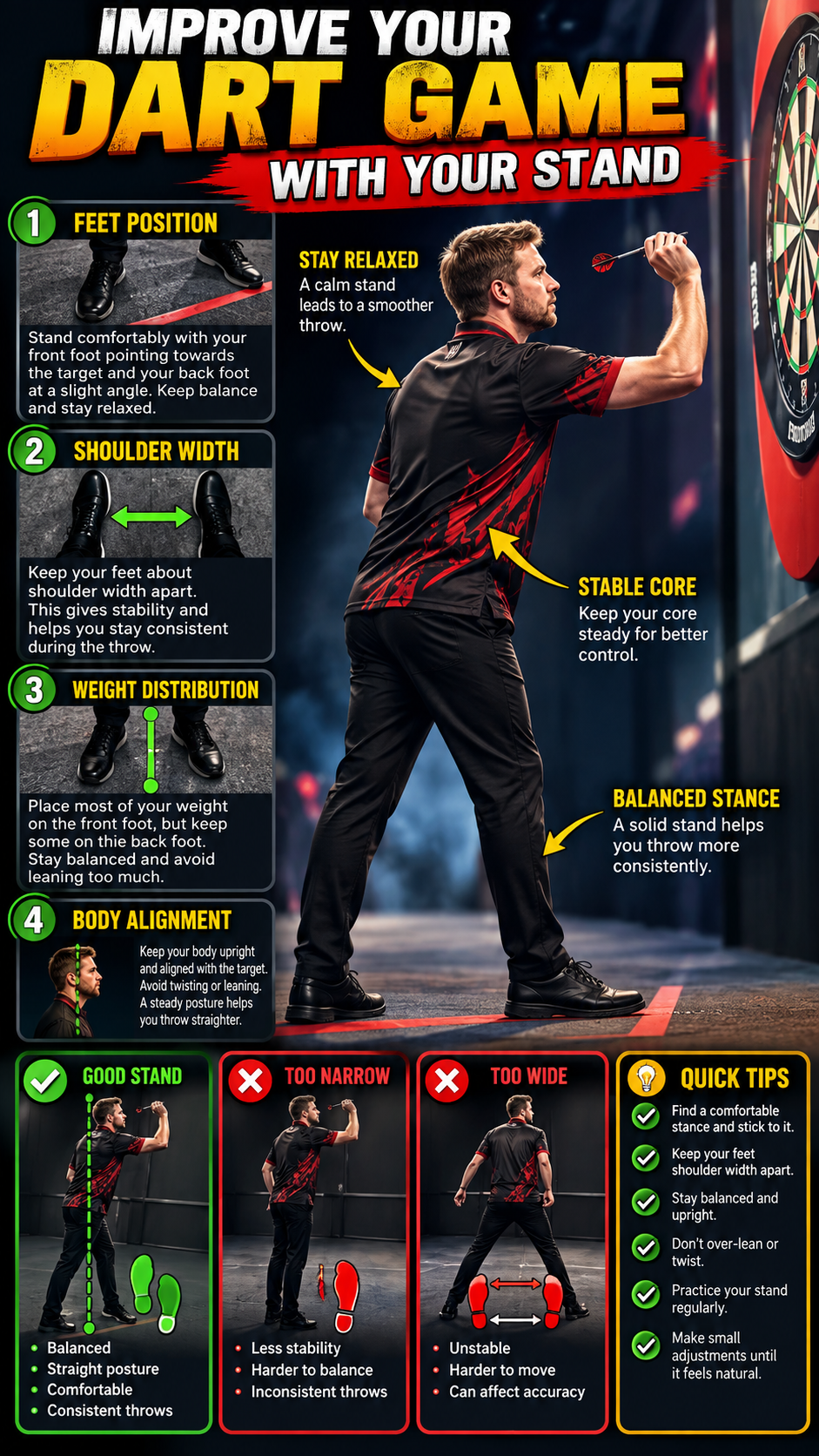
A strong and consistent stance is one of the foundations of accurate dart throwing. Your stance provides the stability needed to keep your body controlled while allowing your throwing arm to move smoothly. Improving the way you stand at the oche can therefore make a noticeable difference to your accuracy and consistency.
Start by finding a comfortable position at the throwing line. Most players place their dominant foot forward, with the side of the foot close to or against the oche. Your front foot should remain firmly planted during the entire throw. The rear foot provides additional balance and should stay in a natural position behind you.
Try to keep your body stable. Excessive movement makes it harder to repeat the same throwing action. Avoid rocking forward, lifting your feet, or moving your shoulders unnecessarily. Your throwing arm should perform most of the movement while the rest of your body provides a steady platform.
You can lean slightly toward the dartboard if this feels comfortable, but do not lean so far that you lose balance. A controlled lean can reduce the distance between your hand and the target, but stability is more important than gaining a few extra centimeters.
Consistency is the key. Try to place your feet in exactly the same position every time you approach the oche. You can practice your stance without even throwing darts. Stand at the line, find your position, check your balance, step away, and repeat.
Pay attention to tension as well. Your legs, hips, and shoulders should feel relaxed rather than rigid. A comfortable stance allows you to concentrate on aiming and delivering the dart smoothly.
Find a stance that feels natural, balanced, and repeatable. Once you have found it, practice it until standing correctly at the oche becomes automatic. A stable foundation can help turn a good throwing technique into consistently better darts.
Improve Your Dart Game with Your Shoulders
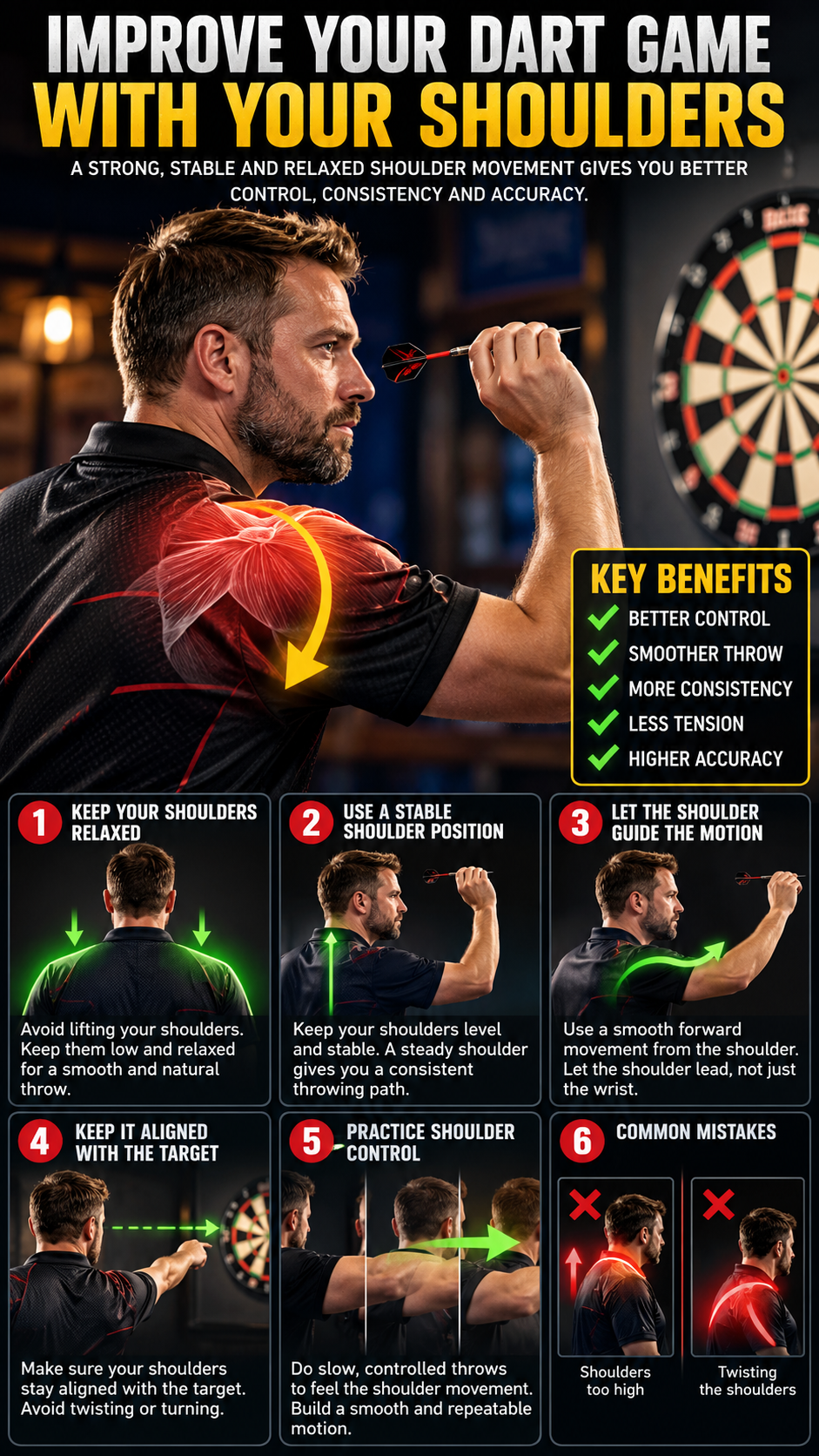
Your shoulders play an important role in creating a smooth, accurate, and repeatable dart throw. While most players concentrate on their hand, wrist, and elbow, poor shoulder position can easily affect accuracy and consistency. Learning to control your shoulders can therefore make a noticeable difference to your dart game.
Start by keeping your throwing shoulder relaxed. Tension in the shoulder can travel down your arm and make your throwing motion stiff. Before throwing, allow your shoulder to settle naturally and avoid lifting it toward your ear. A relaxed shoulder helps your arm move smoothly and makes it easier to repeat the same throwing action.
Your shoulder should also remain relatively stable throughout the throw. Excessive shoulder movement can cause your arm to move away from its intended line. Try to keep your shoulder in approximately the same position while allowing your forearm and hand to perform most of the throwing movement.
Body alignment is equally important. Position your throwing shoulder comfortably toward the dartboard and find an angle that allows your arm to move naturally toward your target. Avoid twisting your upper body excessively, because this can create unnecessary tension and make your throw harder to reproduce.
During practice, pay attention to what your shoulder is doing. Throw several darts while deliberately focusing on keeping it relaxed and stable. You can also record yourself from the side to see whether your shoulder rises, drops, or moves forward during your throwing action.
Finally, remember that consistency is more important than forcing yourself into a supposedly perfect position. Every player has a slightly different throwing style. Find a shoulder position that feels comfortable, balanced, and repeatable.
Relax your shoulder, keep it stable, maintain good alignment, and let your arm work naturally. A quieter shoulder can help produce a smoother throw—and smoother throws can lead to better grouping and improved scoring.
Improve Your Dart Game with Your Mind
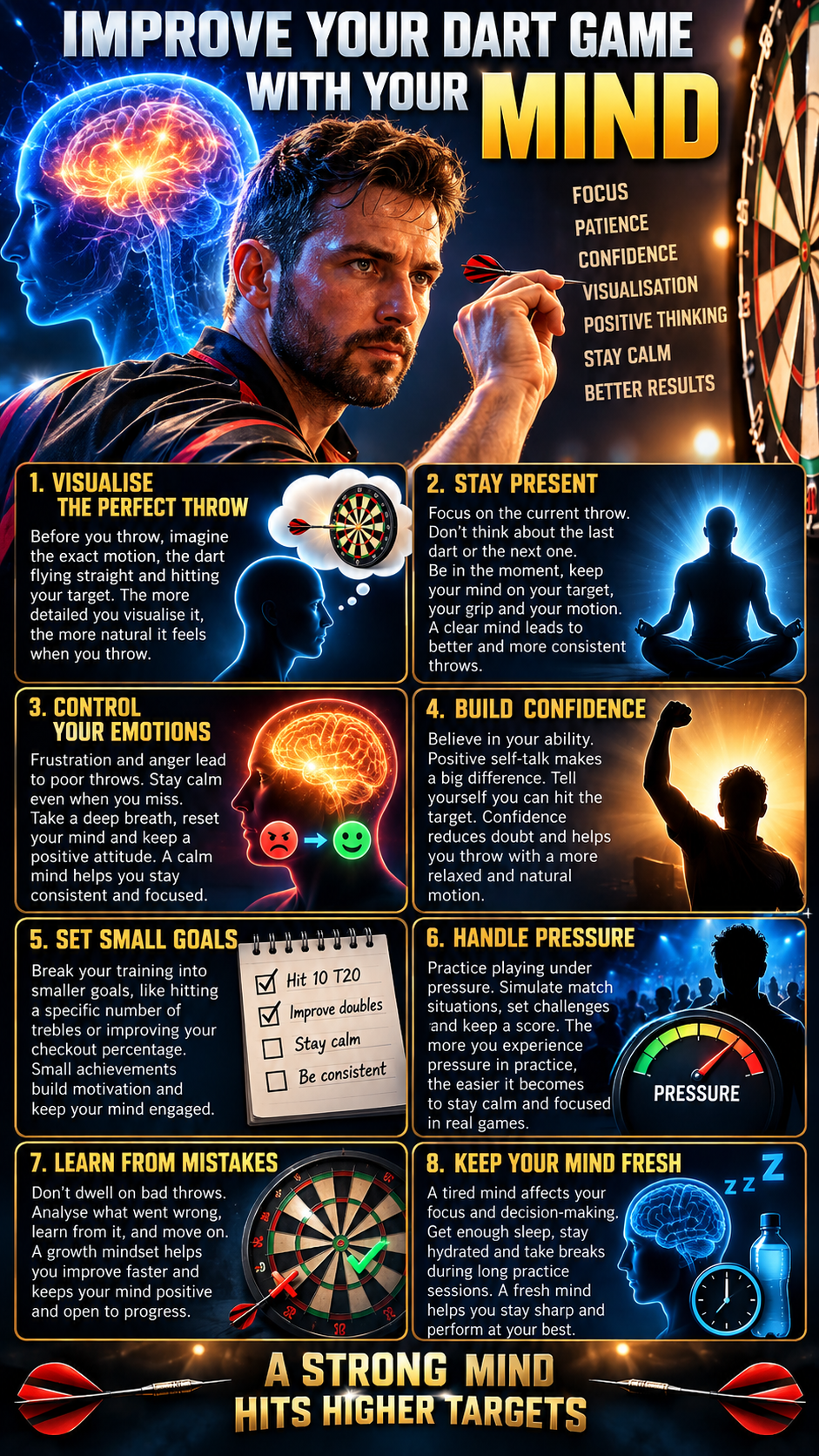
Darts is not only a game of physical skill. Your mind plays a huge role in how well you perform. Good technique is important, but concentration, confidence, patience, and mental control can often make the difference between an average throw and a great one.
Start by improving your focus. Before throwing each dart, concentrate on one specific target. Ignore your previous throw, the score, your opponent, and anything happening around you. Give your full attention to the segment you want to hit. A simple pre-throw routine can help your brain enter the same focused state every time.
Confidence is equally important. If you stand at the oche thinking, “I’m going to miss,” you create unnecessary tension. Instead, visualize the dart traveling smoothly toward the target. Picture yourself hitting the treble 20, double 16, bullseye, or whatever target you need. Positive visualization can help you approach each throw with greater confidence.
You should also learn to control your emotions. Missing an important double can be frustrating, but anger rarely improves the next dart. Accept the miss, reset your mind, and concentrate on the next opportunity. The best players understand that mistakes are part of darts.
Pressure can also change the way you throw. During practice, create situations that imitate competition. Give yourself three darts to finish a checkout or set targets you must complete before ending your session. This teaches your mind to stay calm when every dart matters.
Finally, develop patience. Improvement does not happen overnight. Concentrate on consistent practice rather than expecting perfection.
A strong dart player needs more than a steady arm. Train your concentration, confidence, visualization, emotional control, and patience. When your mind remains calm and focused, your natural throwing technique has a much better chance to perform at its best.
Improve Your Dart Game with Your Knees
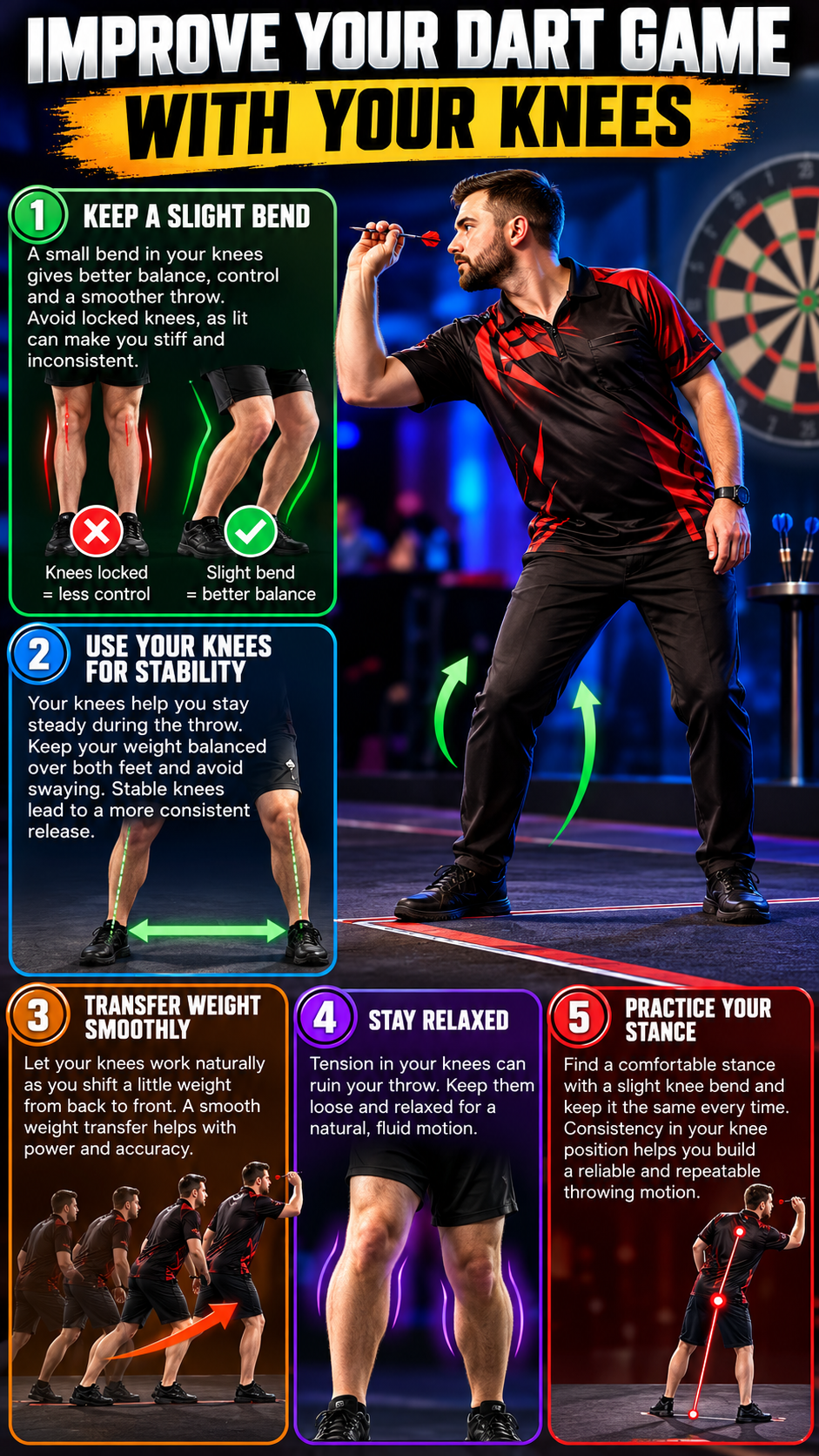
Your knees may not seem like an important part of throwing darts, but they play a valuable role in creating a stable, comfortable, and repeatable stance. Good knee positioning can improve your balance and help keep unnecessary body movement out of your throw.
When you step up to the oche, avoid completely locking your knees. Instead, keep them relaxed and natural. Your front leg will normally carry much of your body weight, while your back leg provides additional support and balance. A slightly relaxed knee position allows you to remain comfortable without becoming unstable.
One of the biggest mistakes is allowing the knees to move during the throwing action. Your throwing arm should create most of the movement while the rest of your body remains as still as possible. If your knees bend, straighten, or shift with every dart, your release point can change. Even a small movement can affect where the dart lands.
Try concentrating on keeping your knees in exactly the same position throughout all three darts. Find a stance that feels comfortable, establish your balance, and then maintain that position until your visit is finished.
Your knees can also help you manage your weight distribution. Avoid leaning so far forward that your front knee becomes uncomfortable or strained. A controlled forward lean is useful, but stability is more important than gaining a few extra centimetres toward the dartboard.
During practice, pay attention to your knees and lower body. Throw several sets while deliberately keeping your legs quiet and relaxed. You can even record yourself from the side to see whether your knees move during the throw.
The goal is simple: relaxed knees, solid balance, and minimal movement. When your lower body provides a stable foundation, your upper body and throwing arm can work more consistently. Build a repeatable stance, keep your knees steady, and give every dart the same stable platform.
Improve Your Dart Game with Your Hips
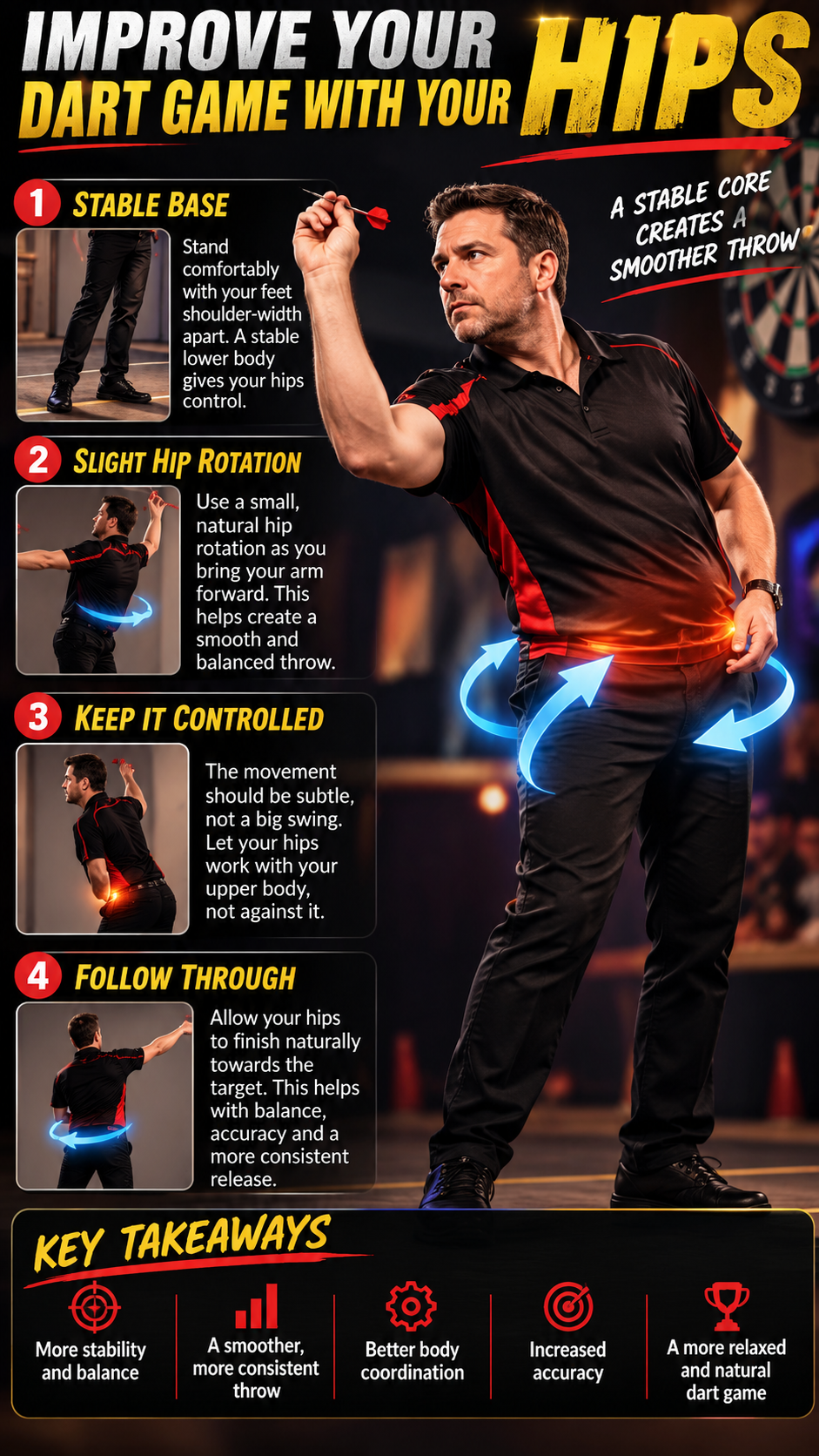
Your hips may not seem like an important part of throwing darts, but they play a major role in keeping your body stable, balanced, and consistent. Good hip positioning can help create a solid foundation for your throw and reduce unnecessary movement.
When you approach the oche, position your body comfortably and allow your hips to settle naturally. Depending on your preferred stance, your hips may be slightly turned toward the dartboard rather than facing it directly. The important thing is to find a position that feels comfortable and can be repeated every time you throw.
During the actual throwing motion, try to keep your hips as still as possible. Darts is very different from sports where power comes from rotating the hips. You do not need hip rotation to generate force. The dart is light, and accuracy is far more important than power. Excessive hip movement can cause your upper body to move, changing the direction of your throw.
Your hips also help control your balance. If you lean toward the dartboard, make sure the movement comes from a stable position rather than pushing your hips too far forward. Your weight should feel controlled, and you should be able to maintain your stance throughout all three darts.
Practice standing at the oche without throwing. Get into your normal position and notice how your hips feel. Then make several slow throwing motions while concentrating on keeping your hips steady. This simple exercise can help you identify unnecessary body movement.
Consistency is one of the biggest secrets to better darts. When your feet, legs, hips, shoulders, arm, and hand work from the same stable position, repeating your throwing action becomes easier.
Keep your hips comfortable, balanced, and quiet. A stable lower body gives your throwing arm a dependable platform, helping you improve accuracy, grouping, and confidence at the dartboard.
Improve Your Dart Game with Your Head
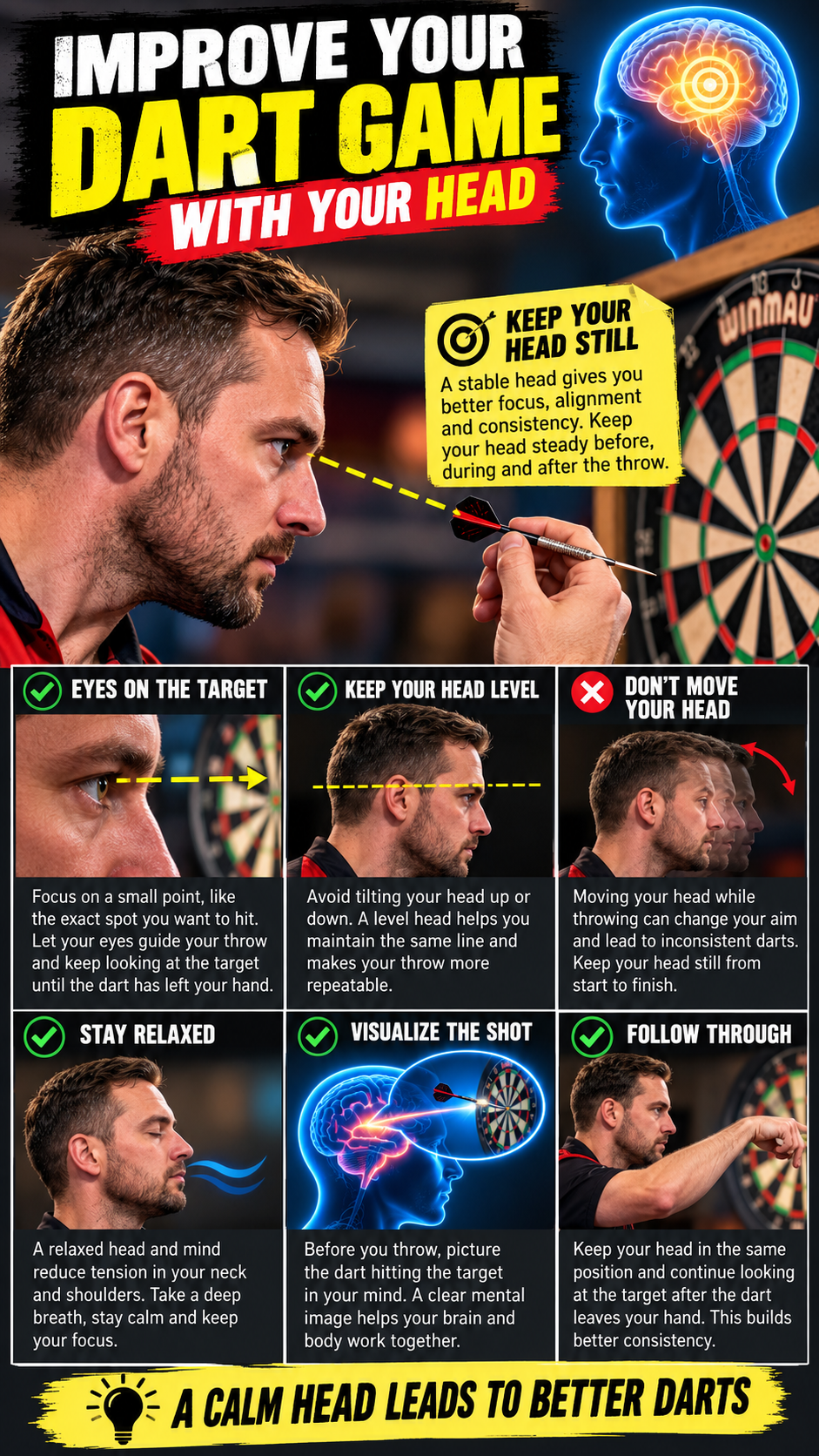
Darts is not only about having a good throwing technique. Your mental approach can have a huge influence on how well you play. Learning to control your thoughts, concentration, and emotions can help you become a more consistent and confident dart player.
Start by developing a strong pre-throw routine. Before every throw, focus on the target, take a comfortable breath, and picture the dart landing exactly where you want it. Repeating the same mental and physical routine can help remove unnecessary thoughts and keep your attention on the board.
Confidence is also important. Missing a treble or double does not mean your next dart will miss. Treat every dart as a completely new opportunity. Avoid thinking too much about previous mistakes. Instead, concentrate on what you can control: your stance, aim, rhythm, and release.
Visualization can be a powerful training technique. Before throwing, imagine the correct movement and see the dart hitting your chosen target. This can help create a clearer purpose behind each throw and encourage you to maintain a smooth, controlled action.
Pressure management becomes especially important during matches. When you reach an important checkout, avoid rushing. Keep your normal rhythm and concentrate on one dart at a time. Thinking about winning or losing can distract you from the shot directly in front of you.
You should also practice concentration during training. Try playing sessions where every dart has a specific purpose instead of throwing without a goal. Checkout routines, scoring challenges, and accuracy exercises can make practice more mentally demanding.
Finally, stay patient. Improvement in darts takes time, and even excellent players have bad games. A calm, focused mind allows you to learn from mistakes without becoming frustrated.
Train your head alongside your throwing arm, and you can become a more confident, disciplined, and consistent dart player.
Improve Your Dart Game with Your Hands
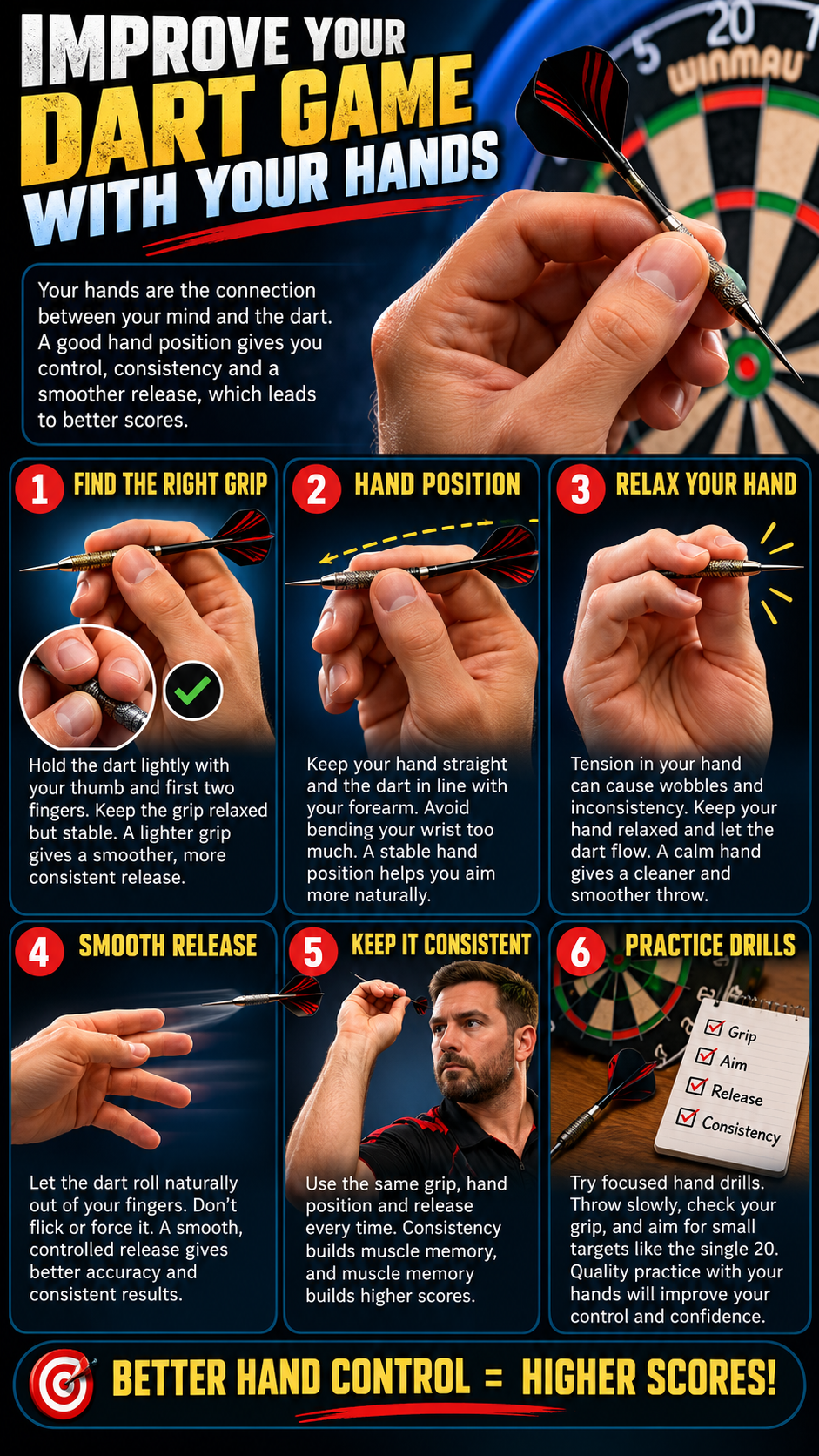
Your hands play a major role in how accurately and consistently you throw darts. Developing good hand control can improve your aim, release, and overall confidence at the dartboard. The goal is to create a smooth, repeatable movement that feels natural every time you throw.
Start with your grip. Hold the dart firmly enough to control it, but avoid squeezing too tightly. A tense grip can make your throwing action stiff and cause the dart to leave your hand inconsistently. Experiment with two, three, or four fingers until you find a grip that feels comfortable and allows the dart to remain stable.
Your wrist should stay relaxed throughout the throwing motion. Some players use a small amount of wrist movement to add speed, while others keep the wrist relatively steady. Whichever technique you prefer, consistency is more important than generating maximum power. Darts require accuracy, not strength.
Pay special attention to your release. Your fingers should open naturally and allow the dart to leave your hand cleanly. Avoid deliberately flicking or forcing the dart forward. A smooth release reduces unwanted sideways movement and helps the dart follow the direction of your throwing arm.
After releasing the dart, continue with a natural follow-through. Your throwing hand should finish pointing toward the target rather than suddenly stopping. This encourages a smooth throwing action and can improve accuracy.
You can improve hand control by practicing without worrying about your score. Throw groups of three darts while concentrating entirely on grip, release, and follow-through. Notice whether each throw feels the same.
The best dart players develop a repeatable routine. Keep your hand relaxed, use the same grip, release smoothly, and follow through naturally. With regular practice, better hand control can produce tighter groups, greater consistency, and more confidence when aiming for those important doubles and trebles.
Improve Your Dart Game with Your Fingers
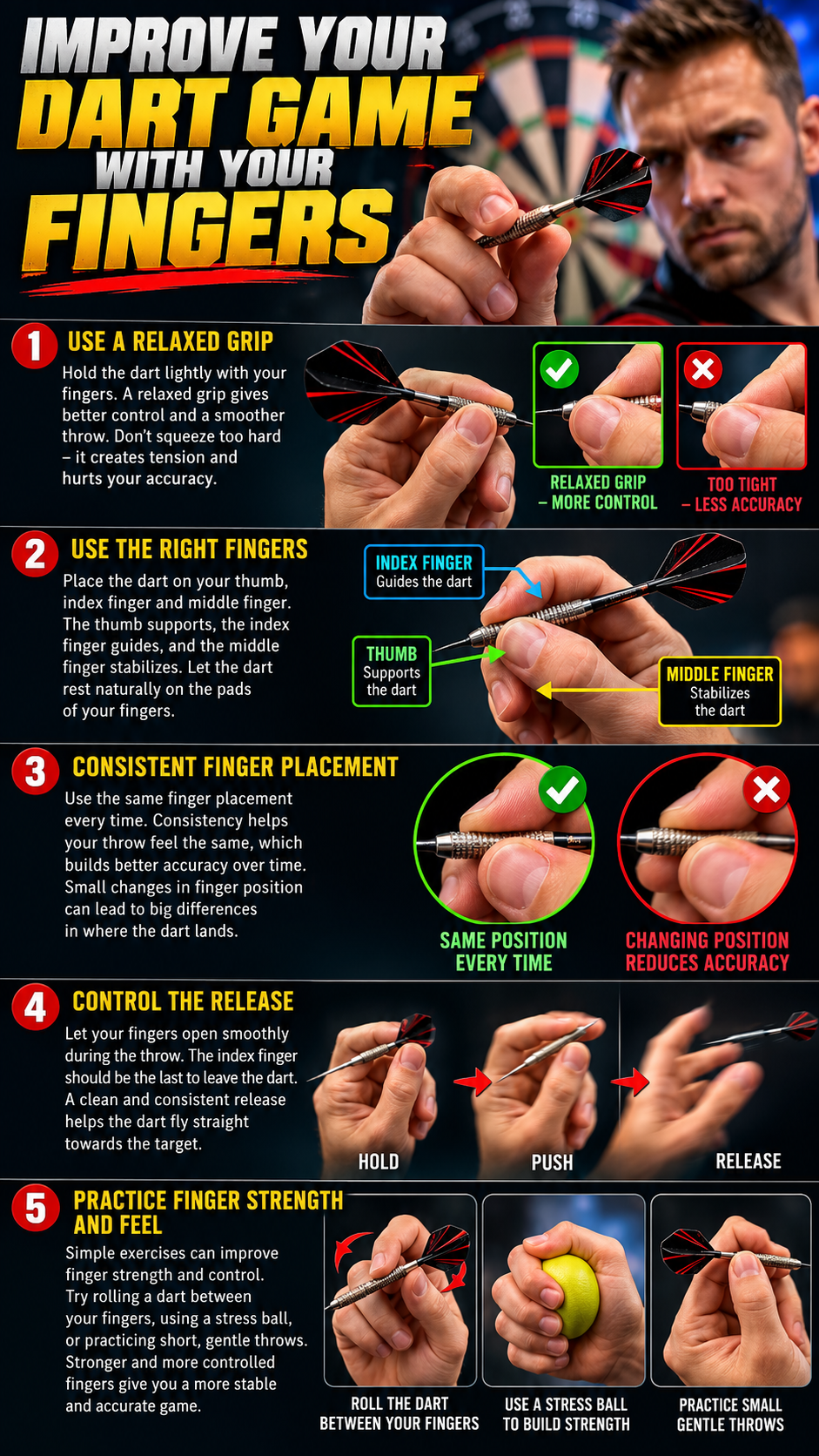
Your fingers play a major role in how accurately and consistently you throw darts. Even small changes in your grip, finger pressure, and release can make a noticeable difference. Developing better finger control can help you produce a smoother throw and keep your darts flying toward the target consistently.
Start by finding a comfortable grip. Most players use three fingers—the thumb, index finger, and middle finger—but there is no single grip that works for everyone. The important thing is to hold the dart securely without squeezing it too tightly. Excessive pressure creates tension in your fingers, hand, and wrist, which can interfere with a smooth release.
Try to use approximately the same finger position on the dart for every throw. Consistency is essential. If your fingers move to different positions on the barrel each time, the dart may leave your hand at slightly different angles. Use grooves, rings, or other features on the barrel as reference points.
The release is equally important. Your fingers should open naturally and allow the dart to leave your hand cleanly. Avoid deliberately flicking the dart with your fingers or holding on to it for too long. A relaxed release generally produces a more predictable flight.
You can improve finger control through simple practice. Stand at the oche and throw slowly without worrying about your score. Concentrate entirely on how the dart feels between your fingers. Notice your grip pressure, finger placement, and the moment of release.
Finally, keep your fingers relaxed between throws. Constant tension can reduce control and make your throwing action inconsistent. With regular practice, your grip and release should become automatic.
Better darts are not always about throwing harder. Develop soft hands, consistent finger placement, and a clean release, and your accuracy and grouping can gradually improve.
Improve Your Dart Game with Your Feet
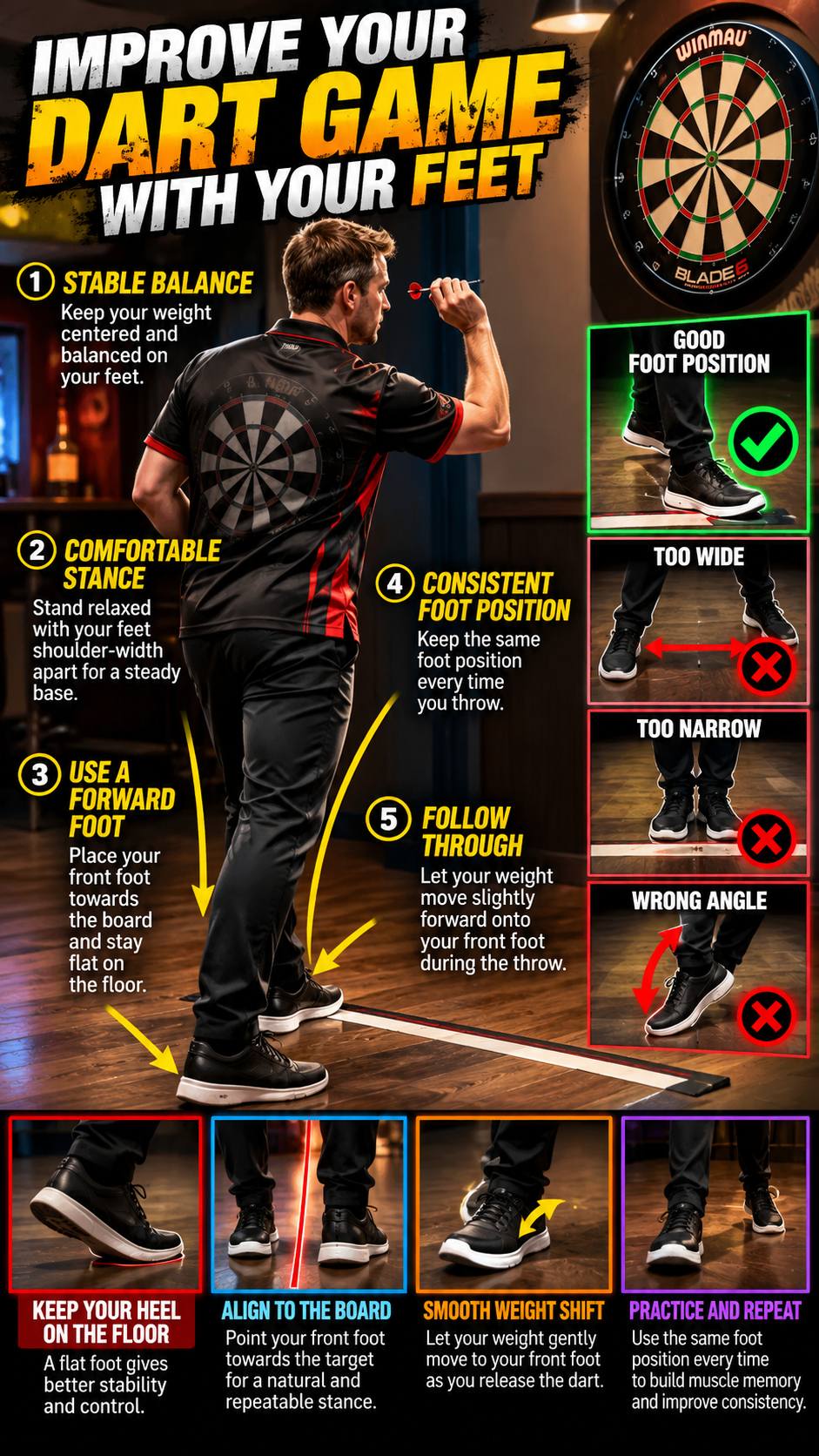
Your feet play a much bigger role in darts than many players realize. A stable and comfortable foot position creates the foundation for your entire throw. If your feet move or your balance changes during the throwing motion, it becomes much harder to produce consistent and accurate darts.
Start by finding a comfortable position at the oche. Most players place their leading foot close to the throwing line, often with the foot turned slightly sideways. Experiment with the angle until you find a position that allows you to face the dartboard naturally without putting unnecessary strain on your ankle, knee, hip, or back.
Your leading foot should remain firmly planted during the throw. Avoid lifting your heel, rocking forward, or changing your foot position between darts. The goal is to create a solid base so your upper body can perform the throwing motion consistently.
Balance is equally important. Although you may lean slightly toward the dartboard, you should always feel in control. Leaning too far forward can make your body unstable and cause your throwing arm to compensate. Keep enough weight on your feet to maintain a comfortable, repeatable stance.
Your rear foot also contributes to stability. Depending on your throwing style, it may rest flat or with the heel slightly raised. What matters most is that it remains consistent from throw to throw.
During practice, pay attention to exactly where you place your feet. Try using the same position every time you approach the oche. Creating a repeatable routine removes another variable from your game.
Good darts begin from the ground up. When your feet provide a stable, balanced foundation, your body moves less, your throwing action becomes smoother, and aiming becomes easier. Find a comfortable stance, stay balanced, keep your feet consistent, and give your throwing arm the stable platform it needs to perform.
Improve Your Dart Game With Your Darts
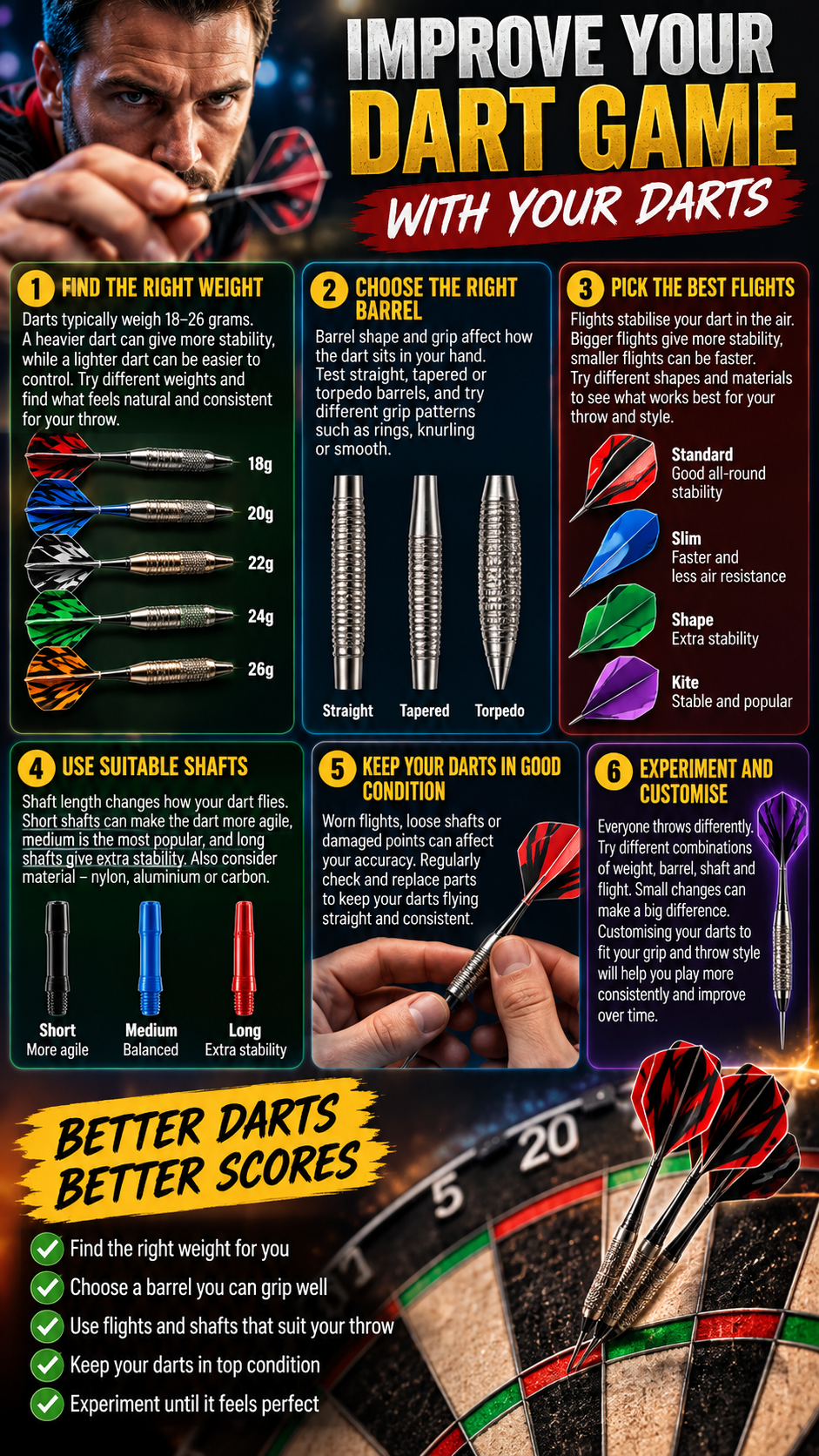
Improving your dart game is not only about practicing your throwing technique. Choosing the right darts and learning exactly how they behave can make a big difference to your consistency, accuracy, and confidence.
Start by finding a dart weight that feels comfortable. Darts are available in many different weights, and even a small change can affect your throw. Heavier darts can feel more stable, while lighter darts may require a faster and more controlled throwing action. Experiment with different weights until you find one that matches your natural throwing style.
The barrel is equally important. Different barrels have different shapes, thicknesses, and grip patterns. Your fingers should comfortably find the same position every time you pick up a dart. A consistent grip makes it easier to repeat your throwing motion. Avoid gripping the dart too tightly, as unnecessary tension can reduce accuracy.
You should also experiment with shafts and flights. Longer or shorter shafts can change the balance and angle of your dart, while different flight shapes affect how the dart travels through the air. Make one adjustment at a time and practice with it before deciding whether it improves your game.
Once you have found a setup that works, try to stick with it. Constantly changing darts can make developing consistency more difficult. Learn how your darts react when aiming at different areas of the board, especially important targets such as treble 20, treble 19, bullseye, and your favourite doubles.
Finally, take care of your equipment. Check your points, flights, shafts, and barrels regularly. Replace damaged flights and bent shafts when necessary.
Your darts should eventually feel like a natural extension of your hand. Find a comfortable setup, understand how it flies, practice consistently, and build confidence through repetition. The better you know your darts, the easier it becomes to concentrate completely on your target and throw.