The History of Dart arrows
From Simple Missiles to Precision Sports Equipment
The dart arrow, usually simply called a dart, is a small piece of sporting equipment with a surprisingly long and fascinating history. Modern darts are carefully engineered for balance, grip and accuracy, but the earliest objects associated with the game were far simpler. Over generations, darts developed from improvised throwing objects into precision equipment manufactured from brass, tungsten, steel, plastic and other modern materials.
The history of the dart is closely connected with the history of the game itself. As dartboards changed and competitive darts became increasingly organised, players demanded better equipment. Manufacturers responded with new barrel shapes, improved flights, replaceable shafts and different point designs.
Today, choosing the right darts can become almost as personal as developing your throwing technique. To understand how we reached that point, we need to travel back to the early roots of throwing games.
The Early Origins of Throwing Darts
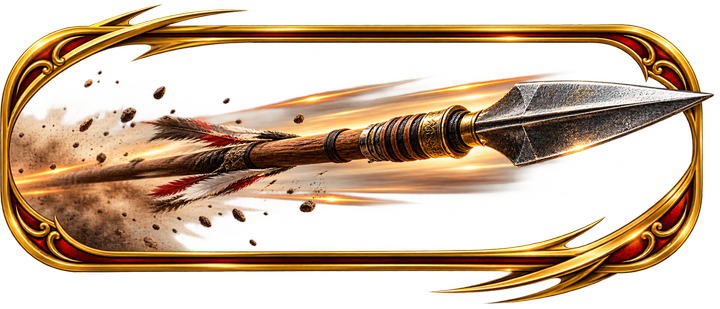
Humans have thrown pointed objects for thousands of years. Spears, throwing knives, arrows and other projectiles were originally developed for hunting and warfare rather than entertainment. It is therefore difficult to identify one particular moment when somebody first decided to throw a small pointed object purely as a game.
The direct origins of modern darts are much more recent. Popular histories of the game frequently associate its development with Britain, where soldiers and ordinary people are said to have practised throwing shortened arrows, crossbow bolts or similar objects at targets.
Stories about soldiers throwing objects at sections of tree trunks are an important part of darts folklore. The natural cracks and rings in wood provided convenient target areas, and competitive throwing could easily develop around such targets.
Exactly how much of this early history can be documented is debated, but the basic idea makes sense: a small projectile, a target and a group of competitive people are all that is needed to create a simple throwing game.
From Arrows to Purpose-Made Darts
The word dart existed long before the modern pub game. Historically, it could describe a small pointed missile or weapon. The equipment eventually used for recreational darts became increasingly specialised as the game grew in popularity.
Instead of using whatever pointed objects happened to be available, darts could be made specifically for throwing at a target. This was an important development because a purpose-built dart could be designed to fly consistently.
A basic dart needs several characteristics. It requires enough weight to travel smoothly through the air, a point capable of entering the target, and some form of stabilisation at the rear. These basic requirements remain present in modern darts, even though the technology has improved enormously.
The Famous Wooden Darts
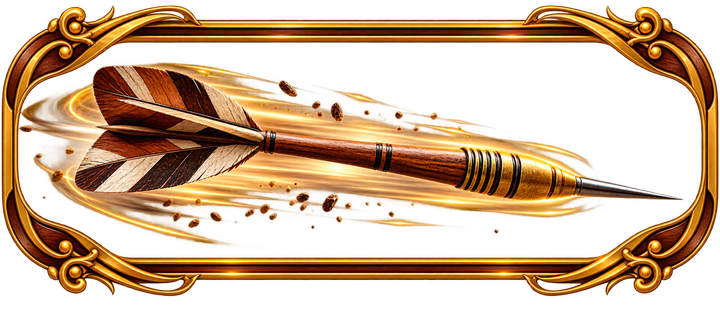
Early manufactured darts looked very different from many of the slim tungsten darts used by competitive players today. Wooden darts became a familiar part of the game’s history and are still remembered by enthusiasts and collectors.
These traditional darts typically used a wooden body combined with a metal point. Feathers could be attached to the rear to help stabilise the dart during flight.
The principle was similar to an arrow: the rear feathers helped keep the projectile stable as it travelled toward the target.
Compared with today’s equipment, these darts could appear relatively large and simple. However, they represented an important stage in the transformation of darts from an informal pastime into an organised game with recognisable equipment.
Feathers Before Modern Flights
One of the most noticeable differences between historical and modern darts is the flight.
Today, dart flights are generally made from synthetic materials and are available in an enormous selection of shapes, thicknesses, colours and designs. Earlier darts could use real feathers for stabilisation.
Feather flights could work effectively, but they also had disadvantages. Natural material could become damaged, bent or worn, and achieving complete consistency between different darts was difficult.
Manufacturing developments eventually made it possible to replace natural feathers with more uniform artificial flights. This helped make darts easier to manufacture consistently while also giving players more freedom to customise their equipment.
The modern flight might look simple, but its job remains extremely important. It creates drag behind the dart and helps influence how the dart behaves in the air.
The Development of the Modern Dart
As darts became established as a popular pub and competitive game during the twentieth century, the equipment gradually became more sophisticated.
The recognisable modern dart developed around several separate components: the point, barrel, shaft and flight.
This modular approach was revolutionary for players because individual components could be replaced or changed. A damaged flight no longer meant replacing the entire dart. A player could experiment with different shaft lengths or flight shapes while keeping the same barrel.
Eventually, this ability to customise darts became an important part of the sport.
The Brass Dart Era
Brass became one of the most important materials in the development of affordable modern darts.
It is relatively easy to machine and allows manufacturers to create darts in different shapes and weights without making them prohibitively expensive. Brass darts therefore became extremely common, particularly for recreational players and beginners.
There is, however, a disadvantage. Brass is less dense than tungsten, meaning that a brass barrel generally needs to be physically larger than a tungsten barrel of similar weight.
This matters because darts are frequently grouped tightly together on the board. A thick barrel can occupy valuable space in high-scoring areas.
Nevertheless, brass remains relevant today. Many starter sets use brass barrels because they offer an affordable introduction to the game.
Tungsten Changes Competitive Darts
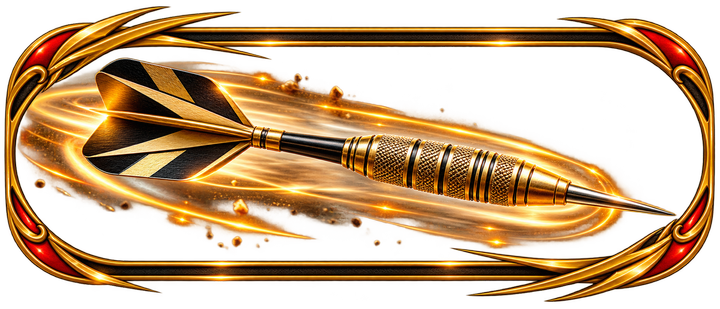
The introduction and widespread adoption of tungsten-based barrels was one of the biggest technological developments in dart equipment.
Tungsten is extremely dense. By using tungsten alloys, manufacturers can produce a relatively heavy dart with a much slimmer barrel than would normally be possible with brass.
For competitive players, this offers an obvious advantage: three slimmer darts can potentially be grouped more closely together.
This is particularly valuable when aiming for small scoring areas such as the treble 20. If the first dart lands perfectly, a slimmer barrel can leave more visible space for the following darts.
Modern tungsten darts are commonly advertised according to their tungsten percentage. Players can encounter barrels described as 80%, 90%, 95% tungsten and other compositions. Tungsten is generally combined with other metals because pure tungsten presents practical manufacturing challenges.
Higher tungsten content can allow extremely slim and compact designs, although the ideal dart still depends heavily on personal preference.
Barrel Shapes Become More Advanced
The earliest darts offered nowhere near the variety available today.
Modern barrels can be straight, tapered, torpedo-shaped, front-weighted, centre-weighted or rear-weighted. Manufacturers can machine extremely detailed grip patterns into the metal.
Ring grips, grooves, cuts, scallops and combinations of different textures allow players to select a barrel that suits the way they hold and release the dart.
This is important because there is no universal throwing style.
Some players hold the dart near the front. Others grip around the centre or rear. Some prefer aggressive grip patterns that provide strong feedback to the fingers, while others want a smoother barrel that leaves the hand easily.
The development of precision machining has transformed the dart barrel into a highly specialised piece of sporting equipment.
The Evolution of Dart Shafts
The shaft, sometimes called the stem, connects the barrel with the flight.
Like the barrel, shafts have changed significantly over the years. Modern versions can be produced from materials including nylon, plastic, aluminium and carbon-based composites.
Shaft length can influence the overall balance and behaviour of a dart. Short, medium and long options allow players to experiment with their setup.
Modern systems have taken this development even further. Some products integrate the shaft and flight into a single unit, while others use rotating or specially engineered systems designed to reduce damage or improve consistency.
What was once a simple supporting component has therefore become another important area of dart technology.
Flights Become Personal
Few parts of a dart offer as much visual variety as the flight.
Standard flights remain extremely popular, but players can choose from numerous shapes and sizes. Smaller flights can behave differently from larger ones because they interact with the air differently.
Professional players frequently have personalised flights carrying their names, logos, nicknames or sponsor designs. Recreational players can similarly choose almost any colour or style imaginable.
As a result, flights have become both functional equipment and a way of giving a set of darts personality.

Steel Tips and Soft Tips
Another major development in dart history came with the growth of electronic dartboards.
Traditional darts are normally played using steel-tip darts on a bristle-style dartboard. The sharp metal point enters the board and holds the dart in position.
Electronic boards generally require soft-tip darts. Instead of a sharp steel point, these darts use a replaceable plastic tip designed to enter holes in the electronic board.
Soft-tip darts became particularly popular in parts of Europe, Asia and the United States, helping create another major branch of competitive and recreational darts.
The existence of steel-tip and soft-tip formats demonstrates how the dart has continued to adapt alongside new technology.
Professional Players and Signature Darts
As professional darts grew into a major spectator sport, the equipment used by famous players became increasingly interesting to fans.
Manufacturers began producing signature darts based on the equipment used by professional players. Fans could purchase barrels inspired by their favourite stars and experiment with similar weights, dimensions and grip patterns.
This helped transform darts into a much larger equipment market.
A modern darts shop can contain hundreds or even thousands of possible combinations of barrels, shafts, flights and accessories.
The Science Behind a Modern Dart
Modern dart design involves considerably more engineering than its simple appearance suggests.
Weight distribution, barrel diameter, grip position, shaft length and flight size can all influence how a dart feels and behaves. Even relatively small changes can be noticeable to an experienced player.
However, expensive equipment does not automatically create a better player.
A beautifully engineered tungsten dart still has to be thrown accurately. Consistent technique, practice and confidence remain more important than simply purchasing the most expensive equipment available.
The best dart is ultimately the dart that feels comfortable and predictable in the player’s hand.

From Simple Arrows to Precision Equipment
The evolution of dart arrows reflects the evolution of darts itself.
What began with simple pointed throwing objects developed through wooden darts and feather flights into brass barrels, replaceable components and eventually precision-machined tungsten equipment.
Today’s player can select the weight, length, barrel diameter, grip pattern, shaft material, shaft length, flight shape and point style of a set of darts. That level of personalisation would have been unimaginable to the early players who helped establish the game.
Yet despite all these technological improvements, the basic challenge has hardly changed.
You stand at the throwing line.
You look at a small target.
You raise the dart.
And you try to place it exactly where you want it.
A Small Piece of Sporting History
A modern dart may only weigh a few dozen grams, but behind it lies generations of development. Every part of today’s dart represents an attempt to improve stability, accuracy, comfort or consistency.
From wood and feathers to precision-machined tungsten and advanced synthetic flights, dart equipment has travelled a remarkable path.
Technology will undoubtedly continue to change the equipment. New materials, manufacturing techniques, integrated flight systems and innovative point designs will continue to appear.
But the essential purpose of the dart will remain exactly the same: to fly from a player’s hand toward the board as accurately and consistently as possible.
That combination of simple purpose and endless possibilities for refinement is one of the reasons the humble dart has remained such a fascinating piece of sporting equipment throughout the history of the game.