Dart Scoring Systems – The Complete Guide

Dart scoring systems have transformed the way players enjoy, practise and compete in the wonderful world of darts. What once required a chalkboard, a piece of paper and a good understanding of mathematics can now be managed by electronic displays, mobile applications, computer software and sophisticated automatic scoring technology.
Whether you are playing a friendly game at home, practising for a local competition or enjoying online matches against opponents around the world, the right scoring system can make darts more convenient, enjoyable and informative.
In this comprehensive guide, Wizard of Darts explores the different types of Dart scoring systems, their advantages, limitations, technology, features and important considerations. The goal is to help you understand the available options without focusing on individual brands or specific products.
Here is the best Dart scoring systems available today:
Granboard 3s
Gran Eye G2 Camera System
Scolia home 2
Winmau autodarts x
Read more about Dart scoring systems in generel below this!
What Are Dart Scoring Systems?
Dart scoring systems are methods or devices used to calculate, display and record scores during a game of darts. They can be extremely simple, such as a handwritten scoreboard, or highly advanced, using cameras and software to detect the position of individual darts automatically.
Their primary purpose is to keep track of the game accurately. In popular formats such as 501, players need to subtract each visit from their remaining total until they reach the required finish. A scoring system helps manage these calculations and makes it easier for everyone to follow the match.
Modern digital systems often provide much more than basic calculations. They may display suggested checkouts, record player averages, track match histories, support training exercises and connect players through the internet.
An important distinction is the difference between digital scoring and automatic scoring. A digital scoreboard may calculate results automatically while still requiring players to enter their throws. A fully automatic system attempts to detect the darts themselves, removing the need for routine manual entry.
The Main Types of Dart Scoring Systems
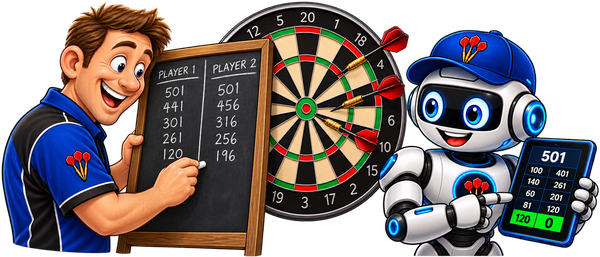
There are several categories of Dart scoring systems. Understanding their basic differences is the first step towards choosing a suitable solution.
| System Type | Scoring Method | Main Advantage |
|---|---|---|
| Chalkboard or Whiteboard | Handwritten calculations | Simple and inexpensive |
| Electronic Scoreboard | Manual input, digital calculation | Clear display |
| Mobile Application | Touchscreen entry | Portable and flexible |
| Computer Software | Keyboard, touchscreen or connected hardware | Statistics and large displays |
| Electronic Dartboard | Integrated board sensors | Built-in automatic scoring |
| Camera-Based System | Computer vision detection | Hands-free steel-tip scoring |
| Phone-Camera System | Camera image analysis | Less dedicated hardware |
Each category has a place in modern darts. The best choice depends on whether you value simplicity, traditional scorekeeping, automatic detection, online features or detailed performance information.
✏️ Traditional Manual Scoring Systems
Traditional manual scoring remains an important part of darts culture. For generations, players have recorded their scores using chalkboards, whiteboards, paper sheets and simple arithmetic.
A scorer watches each visit, adds the value of the darts and subtracts the total from the player’s remaining score. This approach requires no software, cameras, internet connection or complicated installation.
One of the greatest advantages is affordability. A basic scoreboard can last for years with very little maintenance. Manual scoring is also an excellent way to develop an understanding of numbers, finishes and checkout combinations.
However, mistakes are possible, particularly during fast-paced matches. Players may also find that stopping to calculate and record scores interrupts their throwing rhythm. Despite these limitations, traditional scoring remains reliable, practical and enjoyable for many darts enthusiasts.
🔢 Electronic Dart Scoreboards
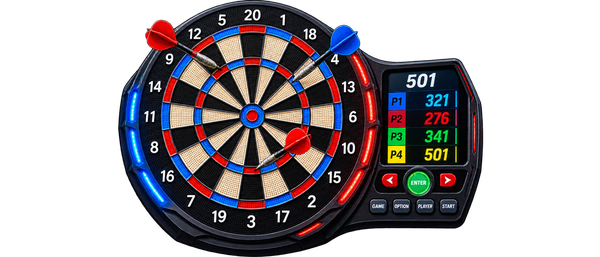
Electronic dart scoreboards provide an easy introduction to digital scoring. These devices generally feature a numerical display and a keypad or buttons for entering the score achieved during each visit.
The scoreboard performs the calculations and updates the remaining total. Depending on the device, additional features may include several player positions, game selection, leg counters and checkout suggestions.
Their main advantage is convenience. Players no longer need to perform every subtraction manually, and the current score can be displayed clearly beside the dartboard.
Electronic scoreboards are particularly suitable for permanent home dart setups and club environments where a dedicated scoring display is preferred over a smartphone.
The main disadvantage is that most still require manual input. They reduce the calculation work but do not necessarily detect individual darts. Screen visibility, button quality and power requirements should therefore be considered.
📱 Mobile Dart Scoring Applications
Smartphones and tablets have made Dart scoring systems accessible to an enormous range of players. A scoring application can turn an ordinary mobile device into a digital scoreboard with features that once required dedicated equipment.
Players usually enter their visit totals or individual dart values using a touchscreen. The application then calculates the remaining score, handles the selected game rules and records the result.
Many applications support different game formats, player profiles, practice routines, match histories and statistics. Some also include online multiplayer functionality and computer-controlled opponents.
Portability is a major advantage. A player can use the same application at home, in a club or while visiting friends. Basic scoring features are often available at little or no cost.
Disadvantages include the need to interact with a touchscreen, battery consumption and possible interruptions from notifications. Some applications also reserve advanced features for paid subscriptions.
For beginners and recreational players, mobile scoring often offers an excellent balance between functionality, convenience and affordability.
💻 Computer-Based Dart Scoring Systems
Computer-based Dart scoring systems offer a flexible solution for players who want a larger display, advanced software features or a dedicated darts station.
A desktop computer, laptop or compatible small computer can run scoring software while displaying results on a monitor or television. Scores may be entered using a keyboard, mouse, touchscreen or external scoring device.
Computer software can support detailed statistics, training routines, online matches and tournament management. Some programs also work with automatic camera hardware.
The larger display can create a professional atmosphere, especially when several people are watching a match. Player names, averages, remaining scores and checkout suggestions can be presented clearly.
However, computer-based scoring may require additional equipment, space and technical knowledge. Operating-system compatibility, software updates and power consumption are also worth considering.
📷 Automatic Camera-Based Dart Scoring Systems
Automatic camera-based Dart scoring systems represent one of the most exciting developments in modern steel-tip darts. These systems use cameras and image-processing software to identify where darts land on a traditional bristle dartboard.
Instead of entering scores manually, players simply throw their darts. Cameras observe the board, software analyses the images and the corresponding score is registered automatically.
Many systems use several cameras positioned around the dartboard. Multiple viewing angles help the software determine dart positions, especially when darts land close together or partially obscure one another.
The greatest advantage is uninterrupted gameplay. Players can concentrate on their technique and rhythm while the system handles routine scorekeeping.
Additional benefits may include automatic statistics, training exercises, online matches, computer opponents and detailed match histories.
The disadvantages are primarily cost, installation requirements and occasional detection errors. Cameras must remain correctly positioned, lighting should be consistent and the software may need calibration.
Even advanced systems can occasionally misread a dart near a segment boundary or when several darts overlap. A quick manual correction function is therefore essential.
For enthusiastic steel-tip players who practise regularly, automatic scoring can provide a particularly enjoyable combination of traditional equipment and modern technology.
📸 Smartphone Camera Scoring Systems
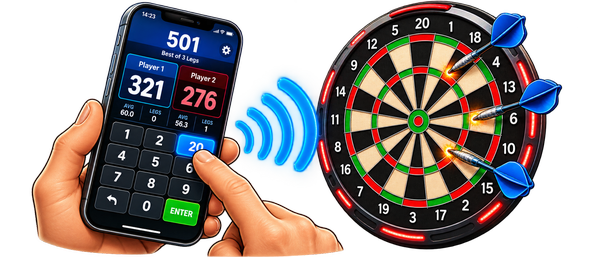
Another development involves using the camera built into a smartphone or tablet to detect darts automatically. Rather than installing a dedicated multi-camera arrangement, players position their device where it can observe the dartboard.
The application analyses the image and attempts to identify the landing position of each dart. Some solutions operate automatically, while others allow players to confirm or correct detected scores.
A significant advantage is the reduced amount of additional hardware. Players may only need a compatible device, suitable mounting equipment and appropriate lighting.
However, camera quality, processing performance, shadows, viewing angle and stability can influence reliability. Darts hidden behind other darts may also be difficult to identify.
Phone-camera scoring is especially interesting for players who want to experiment with automatic scoring before investing in a permanent system.
🎯 Electronic Dartboards with Built-In Scoring
Electronic dartboards are another established form of automatic scoring. They are most commonly associated with soft-tip darts, which use plastic points and specially designed dartboard segments.
When a dart enters a scoring segment, sensors within the board register the hit and update the score. Many electronic dartboards also include sound effects, multiple game formats and multiplayer features.
The greatest advantage is that scoring technology is integrated directly into the board. There is no need to install external cameras or manually calculate each visit.
Electronic dartboards are popular for recreational play, family entertainment and soft-tip competitions. However, their playing characteristics differ from traditional steel-tip dartboards.
Players should understand that sensor-based soft-tip scoring and camera-based steel-tip scoring are two different technologies, even though both can register results automatically.
Manual vs Digital vs Automatic Dart Scoring Systems
Different Dart scoring systems offer different levels of convenience, functionality and technical complexity. The following comparison highlights the main differences.
| Feature | Manual | Digital Entry | Automatic |
|---|---|---|---|
| Score Calculation | By player | By software | By system |
| Score Entry | Handwritten | Manual input | Detected |
| Initial Cost | Low | Low to moderate | Varies, often higher |
| Statistics | Manual records | Often available | Often detailed |
| Installation | Very easy | Usually easy | Depends on hardware |
| Internet Required | No | Not always | Depends on features |
Manual scoring offers simplicity, digital entry provides convenient calculations, and automatic detection delivers a more hands-free experience. Choosing between them is primarily a question of individual priorities.
📊 Statistics and Player Performance
One of the most useful advantages of modern Dart scoring systems is the ability to record statistics automatically. Instead of remembering previous performances, players can examine detailed information about their results.
Common statistics include three-dart averages, first-nine averages, checkout percentages, highest scores, 180s, legs won and match histories.
Some advanced systems can also record individual dart positions, missed doubles and scoring patterns. This information helps players identify strengths and weaknesses in their game.
For example, someone with a strong scoring average but a low checkout percentage may benefit from practising doubles. Another player might discover that their consistency decreases during longer matches.
Statistics are valuable when used constructively. They provide measurable information about progress, but they should never replace the enjoyment and excitement of playing darts.
🌍 Online Darts and Remote Competitions

Internet-connected Dart scoring systems allow players to compete against opponents in different locations. Each participant uses their own dartboard while the scoring platform synchronises the match results.
Depending on the platform, online features may include private matches, public matchmaking, leagues, tournaments and computer-controlled opponents.
Online darts can be particularly enjoyable for players who live far from clubs or struggle to find local opponents. It also creates opportunities to meet people who share the same enthusiasm for the sport.
Some platforms support video communication, allowing participants to see each other’s dartboards during matches.
When evaluating online scoring, it is important to consider connection stability, available opponents, platform compatibility and whether subscriptions are required for particular features.
🛠️ Installation and Equipment Requirements
Installation requirements vary significantly between Dart scoring systems. A chalkboard requires almost no preparation, while an automatic camera system may need careful mounting and calibration.
Before installing digital equipment, players should consider available wall space, access to electricity, cable management and the position of screens or mobile devices.
Camera-based systems often benefit from consistent lighting and a stable dartboard. Movement of the board or cameras can affect detection accuracy.
Players using portable dartboard stands should check whether the scoring equipment supports that type of installation. Compatibility should never be assumed.
A practical installation should also allow easy access to the dartboard for maintenance, rotation and replacement.
💡 Accuracy, Lighting and Calibration
Accuracy is especially important for automatic Dart scoring systems. Camera-based technology relies on identifying the position where each dart enters the board and matching that position to the correct scoring segment.
Lighting conditions, camera angles, image quality and calibration can influence the reliability of detection. Shadows, reflections and overlapping darts may occasionally create difficulties.
Correct calibration helps the software recognise the dartboard’s geometry and segment boundaries. Recalibration may be necessary after equipment has been moved.
Even sophisticated technology can make occasional mistakes. A dart landing extremely close to a wire may be challenging to identify correctly, particularly if another dart obstructs the view.
A reliable system should therefore provide a convenient way to correct errors. Consistent performance and easy correction are often more important than impressive accuracy claims alone.
💰 Cost and Long-Term Value
The cost of Dart scoring systems ranges from inexpensive manual equipment to advanced electronic installations. Understanding the complete cost is important before making a decision.
Traditional scoreboards are generally affordable and require minimal maintenance. Mobile applications may offer free basic scoring, while dedicated electronic displays involve an additional hardware purchase.
Automatic camera systems can require cameras, mounting equipment, lighting, processing hardware and compatible software.
Some digital platforms also charge for premium statistics, online services or additional features. Other systems include their main functionality without recurring fees.
Long-term value depends on how frequently the equipment is used. A dedicated player practising every day may appreciate the convenience of automatic scoring, while an occasional player might prefer a simple application.
The best investment is not necessarily the most expensive system. It is the solution that provides the features you need at a cost you are comfortable with.
🏠 Dart Scoring Systems for Home Players
Home players have different requirements depending on their experience, available space and playing habits. Someone enjoying occasional friendly matches may need little more than a scoreboard or mobile application.
Players who practise regularly may benefit from statistics, checkout suggestions and structured training features. Automatic scoring can also make solo practice more convenient.
Households with several players should consider multiple profiles, easy player selection and support for different game formats.
The ideal home system should be easy to operate, reliable and comfortable to use. Technology should encourage more time at the dartboard rather than create unnecessary complications.
🏆 Scoring Systems for Clubs and Tournaments
Darts clubs and tournament organisers often need scoring systems that are reliable, easy to read and suitable for repeated use throughout long playing sessions.
Large displays, simple controls and quick player changes can be especially useful when several matches take place simultaneously.
Some digital systems support tournament administration, match records and player statistics. Automatic scoring may reduce routine scorekeeping work, although official competition procedures must still be respected.
Durability, maintenance, technical support and recovery from connection problems are important considerations in busy environments.
For organised competitions, dependable operation should always take priority over features that are impressive but rarely needed.
🔐 Internet Connectivity and Privacy
Connected Dart scoring systems can store player profiles, match results, statistics and account information. These features provide convenience but also make privacy and account security important considerations.
Players should check which features require an internet connection and whether local scoring remains available during network interruptions.
Camera-based platforms may process images locally or through external services, depending on the technology. Understanding how information is stored and shared can help users make informed decisions.
Families should also review online communication options, public profiles and privacy settings when children use connected scoring platforms.
🔧 Maintenance and Troubleshooting
Every Dart scoring system benefits from basic maintenance. Manual scoreboards require little more than cleaning and replacement chalk or markers.
Electronic displays and digital devices may occasionally require software updates, fresh batteries or checks of their power connections.
Camera-based systems benefit from clean lenses, stable mounting and consistent lighting. If detection becomes unreliable, checking camera alignment and calibration is a sensible starting point.
Players should also ensure that cables and electronic components are protected from accidental damage and stray darts.
Keeping a simple manual scoreboard available as a backup can be useful when technical problems interrupt an important match.
🚀 The Future of Dart Scoring Systems
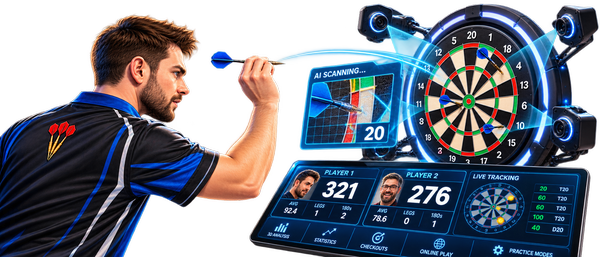
The future of Dart scoring systems is closely connected to developments in cameras, computer vision, software and digital communication.
Improved image processing may make automatic scoring more reliable in difficult lighting conditions and when darts land very close together.
Portable solutions could also make automatic scoring easier to use in temporary installations, while better software integration may simplify online matches and training.
Advanced performance analysis could eventually provide more detailed feedback about scoring patterns and practice routines.
However, traditional scoring is unlikely to disappear. Many players appreciate the simplicity of chalkboards and the satisfaction of calculating their own scores.
The most exciting development is the growing freedom to choose how technology supports the game without changing the essential enjoyment of throwing darts.
❓ Frequently Asked Questions About Dart Scoring Systems
What is the easiest dart scoring system for beginners?
A traditional scoreboard or simple mobile scoring application is usually a practical starting point. Both are affordable and help beginners understand how darts scoring works.
Can automatic dart scoring work with a normal dartboard?
Yes. Many camera-based systems are designed to work with traditional steel-tip bristle dartboards, although equipment compatibility and mounting requirements vary.
Do digital scoring systems calculate checkouts?
Many digital systems can recommend checkout combinations and calculate remaining scores. The available features depend on the software or device.
Are automatic dart scoring systems completely accurate?
No. Automatic detection can occasionally make mistakes, particularly when darts overlap or lighting conditions are difficult. Manual correction features remain important.
Do Dart scoring systems require internet access?
Not always. Some digital systems work offline, while online matches, cloud statistics and certain connected features require internet access.
Can a scoring system improve my darts performance?
A scoring system cannot improve your throwing technique by itself, but statistics and training features can help identify weaknesses and measure progress.
Are expensive scoring systems necessary?
No. Darts can be enjoyed with very simple equipment. Advanced scoring systems mainly provide additional convenience, automation and performance information.
Final Thoughts – Choosing the Right Dart Scoring System
Dart scoring systems have evolved from simple handwritten calculations into a wide range of digital and automatic solutions. Today, players can choose between traditional scoreboards, mobile applications, computer software, electronic dartboards and sophisticated camera-based technology.
Each approach offers valuable advantages. Manual scoring develops arithmetic skills and preserves tradition. Digital scoring makes calculations easier and provides convenient features. Automatic systems allow players to concentrate on throwing while technology handles score detection.
The ideal solution depends on your budget, experience, playing environment and personal preferences. Before choosing, consider reliability, installation, maintenance, statistics, online features and long-term costs.
At Wizard of Darts, we believe that technology should enhance the enjoyment of darts rather than distract from it. Whether you prefer a traditional chalkboard or a modern automatic scoring system, the excitement of hitting a perfect double remains exactly the same.
Keep practising, enjoy every match and never stop chasing that perfect 180!
🎯 The Wizard of Darts Team

📚 Sources & Further Reading
Want to learn more about dart scoring systems, official darts competitions and modern scoring technology? Explore these useful resources:
Professional Darts Corporation (PDC) – Information about professional darts, tournaments and the competitive game.
World Darts Federation (WDF) – International darts information, regulations and competitions.
Autodarts – Learn about camera-based automatic scoring technology for steel-tip darts.
DartConnect – Explore digital darts scoring, match statistics and tournament technology.
These external resources are provided for additional information. Wizard of Darts is not affiliated with these organisations or services unless otherwise stated.