How to Play Darts
How to Play Darts – The Complete Beginner’s Guide
Everything You Need to Know to Start Playing Darts Like a Pro!
Have you ever watched professional darts on television and wondered how the players manage to hit such tiny targets with incredible accuracy? Perhaps you have recently bought your first dartboard, or maybe you simply want to challenge your friends to a game at your local pub. Whatever your reason, learning how to play darts is easier than you might think.
Darts is one of the most enjoyable and accessible precision sports in the world. You do not need expensive equipment, exceptional physical strength or years of experience to get started. All you need is a dartboard, three darts, a safe playing area and a willingness to practise.
However, there is much more to darts than simply throwing pointed objects at a circular board. Understanding the scoring system, developing a consistent throwing technique and learning how to finish games are essential skills that every beginner should master.
In this complete beginner’s guide, we will explain how to play darts step by step, covering everything from setting up your first dartboard to mastering the popular 501 game, understanding doubles and trebles, improving your accuracy and developing winning strategies.
By the end of this guide, you will have the knowledge and confidence to enjoy your first proper game of darts!
1. What Is Darts and How Does It Work?
Darts is a precision game in which players throw small, pointed projectiles called darts at a circular target known as a dartboard. The objective depends on the game being played, but most competitive formats involve scoring points and reducing a starting total to exactly zero.
The game is traditionally played by two opponents, although doubles matches, team competitions and multiplayer variations are also popular. Each player normally throws three darts per turn, and the points scored are recorded before the next player takes their turn.
A standard dartboard contains 20 numbered sections arranged around a central bullseye. Different areas of the board award different numbers of points, making accuracy and strategic decision-making extremely important.
The most popular professional format is called 501. In this game, both players begin with 501 points and attempt to reduce their score to exactly zero. The final dart must land in a double-scoring section or the inner bullseye.
Although the basic rules are straightforward, darts combines concentration, hand-eye coordination, mental arithmetic and psychological control. These qualities make the game surprisingly challenging and rewarding.
One of the greatest advantages of darts is that people of different ages and experience levels can enjoy playing together. Beginners can have fun immediately, while experienced competitors can spend years perfecting their technique.
2. What Equipment Do You Need to Play Darts?
Before learning how to play darts, you need a few essential pieces of equipment. Fortunately, getting started does not require a complicated or expensive setup.
A Dartboard
A traditional steel-tip dartboard is usually manufactured from tightly packed sisal fibres. These fibres allow the pointed darts to enter the board while helping the surface recover after the darts are removed.
For beginners who want to learn the same game played in professional tournaments, a regulation-size bristle dartboard is an excellent choice. Look for a board with clearly visible scoring sections, a thin wire system and a rotating number ring.
Three Darts
Each player needs a set of three darts. A dart consists of four main components: the point, barrel, shaft and flight. The point enters the dartboard, the barrel provides the gripping surface, the shaft connects the barrel to the flight, and the flight helps stabilise the dart during flight.
Beginner steel-tip darts commonly weigh somewhere between 20 and 26 grams. A set weighing approximately 22 to 24 grams can be a comfortable starting point, although the ideal weight depends on personal preference.
A Throwing Line
The throwing line is called the oche, pronounced approximately “ockey.” It marks the minimum distance from which players must throw their darts. You can use a proper raised oche, a dart mat or a clearly marked line for casual home practice.
A Scoreboard
You will also need a way to record scores. Traditional chalkboards and whiteboards work perfectly, but electronic scoring applications can make life much easier for beginners who are still learning the mathematics of darts.
Useful Accessories
A dartboard surround protects the wall from missed throws, while a dart mat protects the floor and helps mark the correct throwing distance. Good lighting is also important because shadows can make the scoring sections difficult to see.
Always install the board securely, keep the throwing area clear of people and pets, and never throw while somebody is standing near the board.
3. How to Set Up a Dartboard Correctly
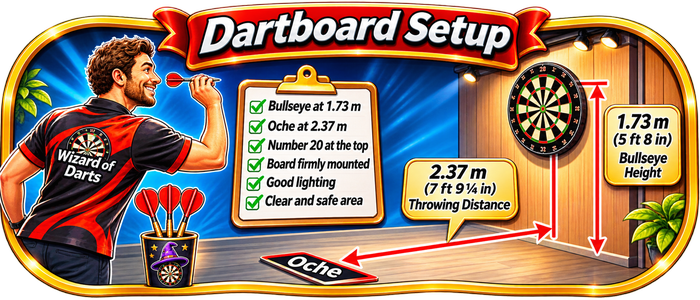
Setting up your dartboard at the correct height and distance is essential. Practising from an incorrect position can make it harder to develop a consistent throwing technique and may cause problems when you play elsewhere.
For standard steel-tip darts, the centre of the bullseye must be positioned 1.73 metres above the floor. The throwing line must be 2.37 metres from the front surface of the dartboard, measured horizontally along the floor.
These measurements are used in professional steel-tip darts competitions and should also be followed when creating a practice area at home.
| Measurement | Metric | Imperial |
|---|---|---|
| Bullseye height | 1.73 m | 5 ft 8 in |
| Throwing distance | 2.37 m | 7 ft 9¼ in |
| Diagonal measurement | Approximately 2.93 m | Approximately 9 ft 7½ in |
Step-by-Step Dartboard Installation
Step 1: Choose a suitable wall with enough space around the board and behind the throwing line. Avoid doorways, narrow corridors and areas where people regularly walk.
Step 2: Measure 1.73 metres vertically from the floor and mark the position of the bullseye.
Step 3: Attach the dartboard using its mounting system, making sure the number 20 is positioned at the top.
Step 4: Measure 2.37 metres horizontally along the floor from the front face of the board to the throwing line. Do not measure from the wall behind the dartboard.
Step 5: Mark the oche clearly and install suitable lighting. Check that the board is secure before throwing your first dart.
Some electronic soft-tip dartboards use a throwing distance of 2.44 metres, or 8 feet. Always check the rules and manufacturer’s instructions for the particular electronic board you are using.
4. Understanding the Dartboard and Its Scoring Areas
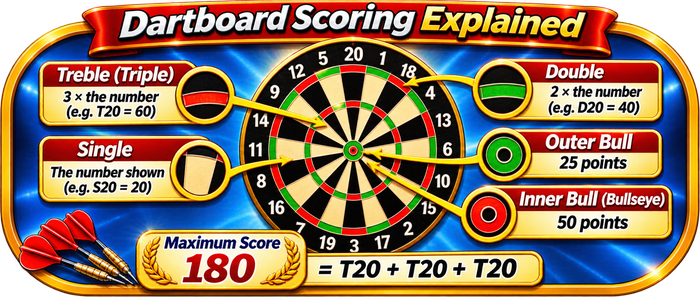
Learning how the dartboard works is one of the most important parts of understanding how to play darts. At first glance, the board can appear confusing because of its numbers, coloured rings and narrow scoring sections.
Fortunately, the scoring system becomes easy to understand once you know the purpose of each area.
Single Sections
The large black and cream sections are called singles. A dart landing in one of these areas scores the number displayed at the edge of that section. For example, hitting the large single 20 area scores 20 points.
Double Ring
The thin ring around the outer edge of the scoring area is called the double ring. Hitting this ring awards twice the number of the section. Double 20 therefore scores 40 points, while double 16 scores 32.
Treble Ring
The narrow ring located approximately halfway between the bullseye and the outer double ring is called the treble, or triple, ring. A dart landing here scores three times the section number.
Treble 20 scores 60 points, making it the highest-scoring individual section on a standard dartboard.
Outer Bull
The outer section surrounding the central bullseye scores 25 points. It is often called the outer bull or single bull.
Inner Bullseye
The small central bullseye scores 50 points. It also counts as double 25, which means it can be used to finish a game requiring a double.
| Scoring Area | Example | Points |
|---|---|---|
| Single | Single 20 | 20 |
| Double | Double 20 | 40 |
| Treble | Treble 20 | 60 |
| Outer bull | 25 | 25 |
| Bullseye | Bull | 50 |
| Outside scoring area | Miss | 0 |
How to play darts at a high level. The maximum score possible with three darts is 180, achieved by hitting treble 20 three times. This is commonly known as a maximum or a 180.
5. How to Hold a Dart Correctly
A comfortable and repeatable grip is essential for accurate throwing. However, there is no single grip that works perfectly for everybody. Professional players use different techniques depending on their hand size, dart design and personal preferences.
Most beginners find it comfortable to hold the dart between the thumb and two or three fingers. The barrel should rest naturally in the hand without excessive pressure.
Imagine holding a pencil. Your grip should be secure enough to control the dart but relaxed enough to release it smoothly.
Gripping too tightly can create unnecessary tension in the fingers, wrist and forearm. This may interfere with your throwing motion and cause inconsistent releases.
Begin by placing your thumb underneath the barrel and your index finger above it. Add your middle finger for extra stability if necessary. Experiment with small adjustments until the dart feels balanced.
Some players grip near the front of the barrel, while others prefer the middle or rear. Neither approach is automatically better.
The most important principle is consistency. Once you discover a grip that feels comfortable and produces predictable results, avoid changing it after every missed dart.
Beginner tip: Practise holding and releasing a dart without throwing it. This simple exercise can help you become familiar with the balance of your equipment. How to play darts is not that hard, it is however hard to become good at darts.
6. Finding the Perfect Darts Stance
Your stance is the foundation of your throwing technique. A stable body position makes it easier to repeat the same movement and maintain accuracy throughout a game.
Stand behind the oche with your dominant-side foot slightly forward. Right-handed players commonly place their right foot nearer the line, while left-handed players often prefer the opposite arrangement.
Your front foot should provide most of your stability, with your rear foot helping maintain balance. You can position your feet sideways, diagonally or in a more open stance depending on what feels natural.
Keep your knees relaxed and your upper body reasonably still. A slight forward lean may feel comfortable, but avoid leaning so far that you lose balance or place unnecessary strain on your back.
Your head should remain relatively steady while you aim and throw. Excessive body movement makes it harder to deliver the dart consistently.
It is also important to stand in approximately the same position for every visit. Even small changes in foot placement can affect your alignment with the target.
Try marking your preferred foot position during practice. This can help you develop a reliable routine before each throw.
Remember that a good stance should feel stable and comfortable rather than forced or unnatural.
7. How to play darts – How to Throw a Dart – Step by Step
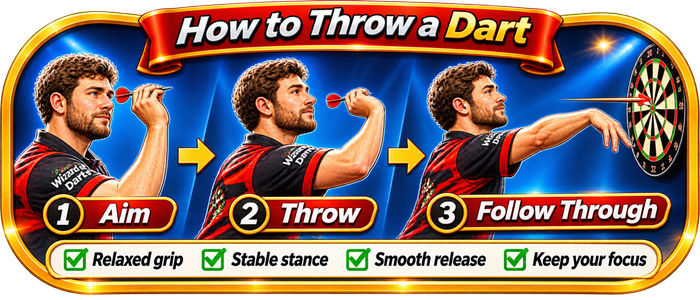
Learning how to throw a dart accurately takes patience and repetition. The basic movement is relatively simple, but developing consistency requires practice.
Step 1 – Focus on Your Target
Choose a specific area of the dartboard before beginning your throw. Instead of looking vaguely at the entire board, concentrate on the exact section you want to hit.
Step 2 – Raise Your Dart
Bring the dart into a comfortable aiming position near your dominant eye or slightly to the side of your face. Keep your elbow reasonably stable and avoid unnecessary shoulder movement.
Step 3 – Draw the Dart Back
Move your forearm backwards in a smooth, controlled motion. Your elbow acts as an important reference point while your forearm performs much of the throwing movement.
Step 4 – Accelerate Forward
Move your forearm towards the target and allow your wrist and fingers to release the dart naturally. Avoid forcing the throw with your entire body.
Step 5 – Follow Through
After releasing the dart, allow your throwing arm to continue naturally towards the target. A relaxed follow-through can help promote a smoother and more repeatable delivery.
Step 6 – Repeat the Same Motion
Consistency is more important than throwing with maximum power. Try to repeat your stance, aiming position, arm movement and release for every dart.
Do not become discouraged if your first throws land far away from the intended target. Every experienced darts player began by learning these same fundamentals.
Beginner tip: Focus on throwing smoothly rather than quickly. Accuracy usually improves when you develop a comfortable and repeatable rhythm.
8. How to Play 501 Darts – The Most Popular Game
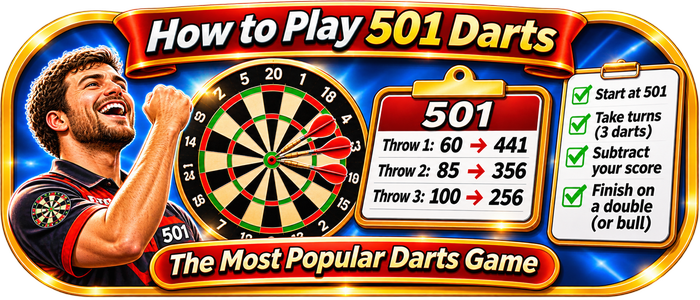
If you want to learn how to play darts like the professionals, 501 is the most important game to understand. It is the standard format used in many major professional tournaments, including the PDC World Darts Championship.
Both players begin with exactly 501 points. Each player takes turns throwing up to three darts, and the total score from each visit is subtracted from their remaining points.
The objective is to reduce your score to exactly zero before your opponent. However, there is one important requirement: your final dart must land in a double or the inner bullseye.
Example of a 501 Game
Imagine you begin with 501 points and score 60 with your first three darts. Your remaining score becomes 441.
On your next visit, you score 85 points. Your total decreases to 356. If you then score 100, you will have 256 remaining.
You continue subtracting your scores until you reach a number that can be finished with a double.
For example, if you have 40 points remaining, hitting double 20 wins the leg immediately.
If you have 32 remaining, double 16 is a popular finishing target. If you have 50 remaining, you can finish by hitting the inner bullseye.
The challenge is not simply to score as many points as possible. You must also plan your final throws carefully so that you leave yourself a manageable finishing opportunity.
This combination of scoring and strategy is one reason 501 remains so popular among beginners and professionals alike.
9. What Does Double Out Mean in Darts?
How to play darts with Double out – The double-out rule is one of the most important concepts in competitive darts. It means that the final dart of a leg must land in a double-scoring area and reduce the player’s remaining score to exactly zero.
For example, if you have 20 points remaining, you must hit double 10 to finish with one dart. Hitting single 20 would reduce your score to zero, but it would not be a legal finish in standard double-out 501.
If you have 16 remaining, double 8 wins the leg. If you have 8 remaining, double 4 wins the leg.
The inner bullseye is also a legal finishing target because it counts as double 25.
Many beginners concentrate almost entirely on hitting treble 20, but experienced players understand that doubles are often the deciding factor in matches.
A player who scores consistently but struggles to finish may lose against an opponent who scores fewer points but hits doubles more reliably.
For this reason, practising doubles should be an essential part of your training routine from the very beginning.
10. What Is a Bust in Darts?
A bust occurs when a player cannot legally complete their remaining score during a turn. Understanding this rule prevents confusion and unnecessary arguments during matches.
In standard double-out 501, you go bust if your score falls below zero, if you leave exactly one point remaining, or if you reach zero without hitting a valid double.
When a bust occurs, your entire visit is cancelled and your remaining score returns to the number you had before beginning that turn.
Example 1 – Scoring Too Many Points
You have 20 points remaining but accidentally hit treble 20, scoring 60. You have exceeded your remaining score, so your turn is bust and you return to 20.
Example 2 – Leaving One Point
You have 16 remaining and hit single 15. This leaves one point, which cannot be finished with a double. Your visit is bust and your score returns to 16.
Example 3 – Reaching Zero Without a Double
You have 20 remaining and hit single 20. Although the mathematical total reaches zero, the dart did not land in a double. Your turn is bust and you remain on 20.
Learning to avoid busts is an important part of becoming a more strategic darts player.
11. Beginner Darts Checkout Chart
A checkout is the combination of darts used to finish a leg. Knowing common checkout routes can make the game much easier, particularly when you begin approaching zero.
The following table shows simple one-dart finishes and useful two-dart examples. The letter D means double, while S means single.
| Remaining Score | Suggested Checkout | Explanation |
|---|---|---|
| 40 | D20 | Double 20 |
| 36 | D18 | Double 18 |
| 32 | D16 | Double 16 |
| 24 | D12 | Double 12 |
| 20 | D10 | Double 10 |
| 16 | D8 | Double 8 |
| 8 | D4 | Double 4 |
| 50 | Bull | Inner bullseye |
| 41 | S9 + D16 | 9 + 32 |
| 45 | S13 + D16 | 13 + 32 |
| 52 | S20 + D16 | 20 + 32 |
| 60 | S20 + D20 | 20 + 40 |
| 64 | S16 + D24 not possible | Use T16 + D8 instead |
| 70 | T18 + D8 | 54 + 16 |
Learning the most common doubles and checkout combinations helps you make better decisions under pressure. Double 16 is especially popular because missing into single 16 leaves double 8, followed by double 4 if necessary.
12. How to Play Darts – 301 Darts
301 is an excellent alternative to 501, especially for beginners who want shorter games. The scoring system is almost identical, but each player begins with 301 points instead of 501.
Players take turns throwing three darts and subtracting their scores from the remaining total. The objective is to reach exactly zero before the opponent.
In a common beginner-friendly version, players start scoring immediately and must finish on a double. Some leagues use double-in, double-out rules, requiring a double to start scoring as well as to finish. Always agree on the format before playing.
Because the starting score is lower, games usually finish more quickly than 501. This makes 301 useful for casual competitions, shorter practice sessions and players who are still learning basic scoring.
Beginners may also play a simplified straight-out version in which any scoring section can finish the game, although this differs from the standard double-out format.
Once you become comfortable with 301, moving to 501 is a natural progression.
13. How to Play Darts – Cricket Darts
Cricket is another extremely popular darts game, particularly in North America. Unlike 501, Cricket focuses on specific numbered sections rather than reducing a starting score.
The targets are numbers 15, 16, 17, 18, 19 and 20, together with the bull. Players must hit each target three times to close it.
A single counts as one mark, a double counts as two marks and a treble counts as three marks. For the bull, the outer bull counts as one mark and the inner bull counts as two marks.
Once you have closed a number, additional hits can score points if your opponent has not yet closed that number. If both players have closed it, further hits on that number do not score.
For example, imagine you have already closed 20 but your opponent has not. Hitting treble 20 awards 60 points under standard scoring Cricket rules.
To win, you must close all required targets and have at least as many points as your opponent.
Cricket is a fantastic game for improving accuracy because it encourages players to aim at different sections of the dartboard instead of concentrating exclusively on treble 20.
It also introduces strategic decisions about whether to score additional points or close targets that your opponent is using.
14. Understanding Legs, Sets and Matches
When watching professional darts, you will frequently hear commentators discussing legs, sets and matches. These terms describe how individual games are organised into larger competitions.
What Is a Leg?
A leg is one complete game of darts. In standard 501, the first player to reduce their score from 501 to exactly zero with a legal double wins the leg.
What Is a Set?
A set consists of several legs. For example, in a best-of-five-legs set, the first player to win three legs wins the set.
What Is a Match?
A match is the overall contest between players. Some tournaments use a legs-only format, while others require players to win a certain number of sets.
For example, a best-of-eleven-legs match is won by the first player to reach six legs. A best-of-five-sets match is won by the first player to win three sets.
Understanding these formats makes professional tournaments much easier to follow and helps you organise your own friendly competitions.
15. What Is a 180 in Darts?
A 180 is the maximum possible score with three darts on a standard dartboard. It is achieved by hitting treble 20 three times during a single visit.
Each treble 20 scores 60 points, so three successful darts produce a total of 180.
Professional tournaments often feature dramatic celebrations when players achieve a maximum, with enthusiastic crowds and commentators reacting to the achievement.
For beginners, however, chasing 180s should not be the main objective. Consistently hitting large single sections is often more useful during the early stages of learning.
A player who regularly scores 60 points with three single twenties may perform better than somebody who constantly attempts trebles but misses the scoring sections entirely.
As your accuracy improves, you can gradually concentrate on smaller targets and attempt higher scores.
Remember that a 180 is exciting, but winning a leg still requires a successful checkout.
16. What Is a Nine-Dart Finish?
A nine-dart finish is one of the greatest achievements in professional darts. It means completing a standard 501 leg using the minimum possible number of darts: nine.
One famous route begins with two consecutive 180 scores. After six darts, the player has scored 360 points and has 141 remaining.
The player can then finish with treble 20, treble 19 and double 12, scoring exactly 141 points with the final three darts.
This combination produces a perfect nine-dart leg.
There are several possible nine-dart checkout combinations, and professional players sometimes choose different routes depending on their preferences.
Although a nine-dart finish is extremely difficult, understanding how it works can help beginners appreciate the extraordinary skill demonstrated by the world’s best players.
For now, concentrate on developing consistent scoring and reliable doubles. Perfect legs can remain a long-term ambition!
17. Five Excellent Darts Practice Games for Beginners
Playing full matches is enjoyable, but structured practice can improve your accuracy much more effectively. The following exercises are ideal for beginners who want to develop their skills.
1. Around the Clock
Start by aiming at number 1, then progress through numbers 2 to 20 in order. Move to the next number after successfully hitting the required target. You can begin by counting any part of the numbered section and make the exercise harder by requiring singles, doubles or trebles.
2. Twenty Challenge
Throw ten visits of three darts while aiming exclusively at the 20 section. Record your total score and try to improve it during future sessions. This exercise helps develop grouping and consistent aiming.
3. Doubles Practice
Choose a double such as double 16 and throw nine darts at it. Record how many successful hits you achieve. Repeat with double 20, double 10, double 8 and double 4 to develop confidence with common finishes.
4. Bullseye Challenge
Throw 15 darts at the centre of the board. Award yourself one practice point for each outer bull and two for each inner bullseye. Track your results over several sessions to measure improvement.
5. Checkout Challenge
Start with 40 points and attempt to finish within three darts. If successful, try 32, 24, 20 and 16. This exercise helps develop confidence under finishing pressure.
These games are useful because they make practice more interesting while developing different skills. Try combining two or three exercises during each training session.
18. A Simple 30-Minute Darts Practice Routine
You do not need to practise for several hours every day to improve your darts. A focused 30-minute session can be extremely valuable, especially when performed regularly.
| Time | Exercise | Main Objective |
|---|---|---|
| 5 minutes | Warm-up | Develop a relaxed rhythm |
| 10 minutes | 20-section scoring | Improve accuracy and grouping |
| 10 minutes | Doubles practice | Improve finishing ability |
| 5 minutes | Checkout challenge | Combine scoring and strategy |
Begin each session with relaxed throws rather than immediately attempting difficult targets. Once your arm feels comfortable, move into focused scoring practice.
Spend time practising doubles because these are essential for winning competitive games. Finish your session with a checkout challenge to simulate match conditions.
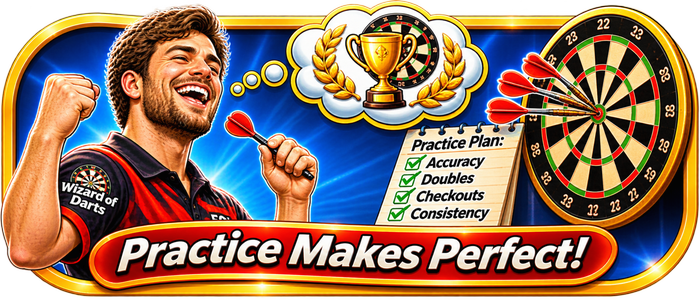
Keep a simple record of your scores and successful doubles. Comparing results over several weeks can provide motivation and reveal areas that need improvement.
Regular, enjoyable practice is generally more sustainable than occasional exhausting sessions.
19. Common Beginner Darts Mistakes to Avoid
Almost every beginner makes similar mistakes when learning how to play darts. Recognising these problems early can save frustration and help you develop better habits.
Gripping the Dart Too Tightly
Excessive grip pressure can make the release inconsistent. Try relaxing your fingers and allowing the dart to leave your hand smoothly.
Moving Your Entire Body
Large body movements can reduce accuracy. Concentrate on maintaining a stable stance while allowing your throwing arm to perform the main movement.
Changing Technique After Every Miss
Constantly changing your grip, stance or aiming position makes it difficult to develop consistency. Give a comfortable technique enough practice before making major adjustments.
Only Practising Treble 20
High scoring is important, but doubles, checkouts and accuracy across different sections are equally valuable. A balanced practice routine produces more complete players.
Throwing Too Quickly
Some beginners rush their throws because they are excited or nervous. Develop a comfortable rhythm and concentrate on each dart without unnecessary delays.
Expecting Immediate Results
Darts requires patience. Even experienced players miss their intended targets regularly. Focus on gradual improvement rather than perfection.
20. How to Improve Your Darts Accuracy
Improving accuracy is one of the most rewarding parts of learning darts. As your technique becomes more consistent, you will begin noticing tighter groupings and more predictable results.
One useful approach is to focus on a specific target rather than simply aiming at a general area. When practising treble 20, concentrate on the narrow treble section itself.
Another important factor is maintaining the same preparation routine before each throw. Place your feet consistently, establish your grip, focus on the target and release the dart with a controlled movement.
Avoid changing equipment too frequently. Although different darts can affect comfort and performance, constantly switching between sets makes it difficult to understand which adjustments genuinely help.
Pay attention to your dart grouping. If all three darts land close together but away from the intended target, your throwing motion may already be reasonably consistent. A small adjustment in alignment or aiming may help.
If your darts scatter across the board, focus on developing a repeatable release and stable stance before attempting difficult scoring targets.
Recording your practice results can also be helpful. Track your average scores, successful doubles and performance in specific exercises.
Most importantly, practise regularly and enjoy the learning process. Consistency develops through repetition, patience and experience.
21. Steel-Tip Darts vs Soft-Tip Darts
There are two major types of darts commonly played around the world: steel-tip darts and soft-tip darts. Although they share many similarities, there are important differences between them.
Steel-Tip Darts
Steel-tip darts have metal points and are normally used with traditional sisal bristle dartboards. This is the format associated with most major PDC professional tournaments.
Players generally record their scores manually or with a separate electronic scoring system. Steel-tip darts are particularly popular in the United Kingdom and many European countries.
Soft-Tip Darts
Soft-tip darts use flexible plastic points designed for electronic dartboards with small holes in the scoring surface.
Electronic boards often calculate scores automatically and offer numerous built-in games, including 501, Cricket and different practice challenges.
Soft-tip darts are especially popular in parts of Asia and North America, although they are enjoyed internationally.
Both formats can provide excellent entertainment and opportunities for competitive play. Beginners should choose the format that best suits their available space, equipment preferences and local playing opportunities.
22. Darts Etiquette – Important Rules Every Beginner Should Know
Good sportsmanship is an important part of darts, whether you are playing casually with friends or competing in an organised tournament.
Always wait until the previous player has finished throwing and moved away from the dartboard before approaching the oche. Never walk in front of somebody who is preparing to throw.
When retrieving your darts, remove them carefully and avoid damaging the board unnecessarily. Make sure everybody has returned to a safe position before the next player begins.
Respect your opponent’s concentration. Avoid unnecessary distractions, loud conversations or sudden movements while somebody is throwing.
Check scores carefully and resolve disagreements calmly. If you are playing without an official referee, agree on the rules before starting the match.
Congratulate your opponent after a good performance and accept both victories and defeats with good sportsmanship.
Most importantly, remember that darts should be enjoyable. Friendly competition and mutual respect help create a positive playing environment for everybody.
23. How Long Does It Take to Become Good at Darts?
One of the most common questions beginners ask is how long it takes to become a good darts player. Unfortunately, there is no universal answer because progress depends on practice frequency, natural coordination, technique and individual goals.
Some beginners notice improvements within their first few weeks. Others require several months before developing consistent scoring and reliable doubles.
If you practise regularly for 20 to 30 minutes, you may begin seeing measurable improvements in accuracy and confidence over time. How to play darts take time and effort for sure.
However, becoming a strong competitive player usually requires considerably more experience, including regular matches against opponents with different playing styles.
Rather than comparing yourself with professional players, set achievable personal targets. You might aim to improve your three-dart average, hit more doubles or complete your first 501 leg without assistance.
Celebrate these achievements as they happen. Progress in darts is rarely perfectly consistent, and occasional poor performances are completely normal.
The most important factor is developing a sustainable practice routine that keeps you motivated and interested in the game.
24. How to Play Your First Proper Darts Match
Now that you understand the equipment, scoring system and basic rules, you are ready to play your first proper darts match. How to play darts and setup it all, takes time and effort, but is worth it!
Begin by checking that the dartboard is mounted correctly and the throwing line is clearly marked. Each player should have three suitable darts.
Choose the game format. For beginners, 301 is an excellent starting point, while 501 provides the traditional professional experience.
Decide who throws first. A common method is for both players to throw one dart at the bullseye, with the player closest to the centre winning the opening throw.
The first player throws up to three darts and records their total score. The second player then takes their turn, and play continues alternately.
As the remaining scores become smaller, begin planning your finishing combinations. Remember that standard double-out games must end with a double or the inner bullseye.
The first player to reach exactly zero with a legal finish wins the leg.
For a longer match, try playing best of five legs. This means the first player to win three legs becomes the match winner.
Do not worry if your first match takes longer than expected. Enjoy the competition, practise your arithmetic and learn from every throw.
Frequently Asked Questions About How to Play Darts
How do you play darts for beginners?
Start with a properly installed dartboard and three darts. Learn the scoring sections, practise your throwing technique and begin with a simple game such as 301 or 501. Players take turns throwing three darts and subtracting their scores until somebody finishes legally.
How far away do you stand when playing darts?
In standard steel-tip darts, the throwing line is 2.37 metres, or 7 feet 9¼ inches, from the front surface of the dartboard.
How high should a dartboard be?
The centre of the bullseye should be 1.73 metres, or 5 feet 8 inches, above the floor.
What is the highest score with three darts?
The maximum score is 180, achieved by hitting treble 20 with all three darts.
Do you have to finish on a double?
In standard professional 501 and most traditional double-out games, yes. The final dart must land in a double or the inner bullseye. Some casual variations use different finishing rules.
Can you finish a darts game on the bullseye?
Yes. The inner bullseye scores 50 points and counts as double 25, making it a valid finishing target in double-out games.
What happens if a dart falls out of the board?
Under standard steel-tip competition rules, a dart that bounces out or falls out before retrieval does not score and is not thrown again.
What weight darts should beginners use?
Many beginners find darts weighing approximately 22 to 24 grams comfortable, although there is no single ideal weight. Experiment with different weights to discover what feels natural.
Is darts difficult to learn?
The basic rules are relatively easy to understand, but developing consistent accuracy requires patience and practice. Most beginners can start enjoying simple games almost immediately.
Can you play darts alone?
Absolutely. Solo practice games such as Around the Clock, doubles challenges and scoring exercises are excellent ways to improve your technique and track your progress.
Final Thoughts – Your Darts Journey Starts Here!
Learning how to play darts is the beginning of an exciting and rewarding journey. What initially appears to be a simple game of throwing darts at a board quickly reveals a fascinating combination of accuracy, strategy, concentration and competitive excitement.
By understanding the scoring system, installing your dartboard correctly and developing a comfortable throwing technique, you will have a strong foundation for improving your skills.
Start with simple games, practise your doubles, learn common checkout combinations and gradually challenge yourself with more difficult targets.
Remember that even the greatest professional players started as beginners. Nobody becomes an expert overnight, and every missed dart provides an opportunity to learn.
Whether your ambition is to enjoy friendly games at home, join a local darts league or eventually compete in organised tournaments, the most important thing is to keep practising and enjoying the sport.
Pick up your darts, step up to the oche and enjoy your first game. Your darts adventure begins now!
The Wizard of Darts Team
Official Rules and Further Reading
For additional information about how to play darts and rules, professional competitions and official playing formats, explore the following resources.