How to Become Better at Doubles
The Ultimate Darts Finishing Guide

Master Your Doubles, Improve Your Checkouts and Start Winning More Darts Matches!
Have you ever played a fantastic leg of darts, scored several impressive visits and then spent what felt like an eternity trying to hit your finishing double? If so, you are certainly not alone. Missing doubles is one of the most frustrating experiences in darts, affecting beginners, club players and even experienced competitors.
The ability to finish a leg efficiently is what separates players who score well from players who consistently win matches. You might regularly hit 100s and 140s, but if you cannot finish on a double, your opponent always has another opportunity.
Fortunately, learning how to become better at doubles does not require extraordinary natural talent. With structured training, better checkout knowledge and improved mental concentration, almost every player can develop stronger finishing skills.
In this comprehensive guide, we explain how to improve your doubles accuracy, which doubles you should practise, how to develop a reliable throwing routine and how to remain calm when the pressure increases.
We also include effective doubles training games, useful checkout combinations and a practical 14-day improvement challenge. This is How to become better at doubles, in simple steps!
Ready to stop wasting darts at doubles and start finishing more legs? Let’s get started!
1. Why Are Doubles So Important in Darts?
In standard 501 darts, each player starts with 501 points and attempts to reach exactly zero. However, the final dart must land in a double, including the inner bullseye, which counts as double 25.
The doubles are located in the narrow outer scoring ring of the dartboard. Hitting double 20 scores 40 points, while double 16 scores 32 points. The narrow inner scoring ring is the treble ring, which is used primarily for high scoring.
This distinction makes finishing especially challenging. You cannot simply aim at a large single segment to win a leg. Instead, you must hit a relatively small target while maintaining your concentration.
Imagine reaching 40 points remaining after just 15 darts. You have played an excellent scoring leg, but if you require another 12 darts to hit double 20, your final average will suffer considerably.
Strong doubles players reduce these missed opportunities. They also place greater pressure on opponents because they can finish legs quickly when given a chance.
Remember: High scoring creates opportunities, but accurate doubles win legs. Remember How to become better at doubles is all about focus!
2. Understand the Double Ring Before Practising
Before developing your finishing technique, make sure you understand exactly where the doubles are located.
A standard dartboard contains 20 numbered segments. Each segment has a narrow outer double ring and a narrow inner treble ring.
For example, double 20 is located at the very top of the dartboard in the outer red scoring ring. Treble 20 is the narrow red section further down inside the same numbered segment.
Double 16 is located towards the lower-left area of the board, while double 8 is found towards the lower-right area.
When practising, concentrate on the exact double segment rather than simply looking towards the general number.
Some players prefer focusing on the centre of the double bed. Others find it helpful to concentrate on a small point within the target. Experiment with both approaches and choose whichever feels most natural.
The objective is to develop a clear visual target before releasing every dart.
3. Find Your Favourite Finishing Doubles
Although every double is worth practising, most players naturally develop favourites. Some feel confident aiming at double 20, while others prefer double 16 or double 10.
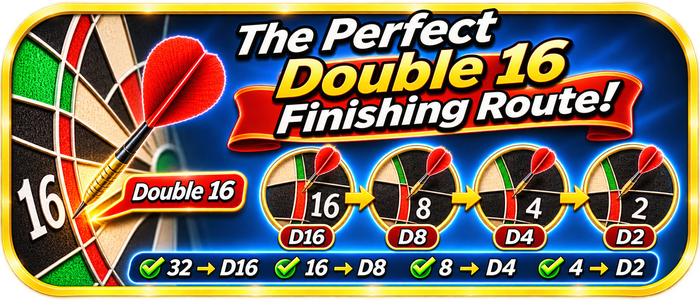
Double 16 is especially popular because it offers convenient alternatives if you accidentally hit the single 16.
For example, if you have 32 remaining and hit single 16, you leave 16 points and can attempt double 8. If you then hit single 8, you leave double 4.
This creates a useful finishing sequence: double 16, double 8, double 4 and double 2.
However, do not make the mistake of practising only your favourite double. Competitive darts regularly forces you to attempt unfamiliar finishes.
Training tip: Choose two or three preferred doubles, but include all 20 doubles in your weekly training routine.
Over time, your confidence should improve across the entire dartboard.
4. Improve Your Stance and Balance
A stable stance is essential when aiming at narrow doubles. Even small changes in body position can affect your accuracy. How to become better at doubles is all about the small details!
Position your leading foot comfortably behind the throwing line and maintain a balanced posture. Avoid excessive leaning or unnecessary movement during the throw.
Many players become tense when attempting an important checkout. This tension can cause them to lean further forward, lift their shoulder or alter their throwing motion.
Instead, try to maintain the same stance you use when scoring. Your body should remain relatively stable while your throwing arm performs the main movement.
When changing from double 20 to double 16, allow yourself to adjust your alignment naturally without dramatically changing your technique.
How to practise: Throw ten visits at double 20 while concentrating entirely on balance and foot placement. Record how many darts hit the intended double.
Repeat the exercise on another double and compare your results.
5. Use a Relaxed Grip and Smooth Release
One of the most common mistakes players make when attempting doubles is gripping the dart too tightly.
When you become nervous, your fingers may naturally apply more pressure to the barrel. Unfortunately, excessive tension can interfere with your release and make the dart travel away from its intended target.
Try to hold the dart securely but comfortably. Your fingers should remain relaxed enough to allow a smooth release.
Avoid changing your grip simply because you are aiming at a double instead of a treble. A consistent throwing technique makes it easier to reproduce accurate results.
Your follow-through is equally important. Allow your throwing arm to extend naturally towards the target rather than stopping abruptly.
Training tip: Spend five minutes throwing at double 16 while concentrating on a relaxed grip and controlled follow-through. Ignore your score during the first few visits and focus on the quality of your technique.
6. Develop a Consistent Pre-Throw Routine

Consistency is one of the most valuable qualities in darts. A simple pre-throw routine can help you maintain concentration and reduce unnecessary changes in technique.
Before attempting a double, position your feet, establish your grip and focus on the exact target. Take a comfortable breath and throw at your natural pace.
Avoid rushing because your opponent is waiting. Equally, do not spend so much time thinking about the dart that you become uncomfortable.
The ideal routine should feel natural and repeatable. It does not need to involve complicated movements or lengthy preparation.
Try using the same routine during practice sessions and competitive matches. This familiarity may help you remain calm when an important checkout opportunity appears.
Remember: Your finishing throw should feel as normal as your scoring throw.
7. Learn the Most Important Doubles and Checkouts
Knowing which double to aim for can improve your finishing efficiency. Instead of reaching a checkout and wondering what to do next, develop familiarity with common finishing numbers. How to become better at doubles you will know when you see it!
The following table shows several useful one-dart finishes and their corresponding doubles.
| Points Remaining | Target | Finish |
|---|---|---|
| 40 | Double 20 | D20 |
| 36 | Double 18 | D18 |
| 32 | Double 16 | D16 |
| 24 | Double 12 | D12 |
| 20 | Double 10 | D10 |
| 16 | Double 8 | D8 |
| 8 | Double 4 | D4 |
| 4 | Double 2 | D2 |
| 2 | Double 1 | D1 |
| 50 | Inner Bullseye | Bull |
Practise these finishes regularly until you can recognise the required double immediately.
8. Master the Double 16 Finishing Route

Double 16 is one of the most useful targets to practise because it provides a convenient sequence of alternative finishes.
Imagine you have 32 points remaining. Your first target is double 16. If you hit single 16 instead, you leave 16 points and can attempt double 8.
If you hit single 8, you leave 8 points for double 4. The sequence continues through double 2 and double 1.
This does not mean you should deliberately aim for single segments. The objective is always to hit the intended double, but understanding your next option helps you react confidently to a miss.
An effective training exercise is to start with 32 points and attempt to finish within three darts. Record your successful checkouts out of ten attempts.
Repeat the exercise several times per week and compare your results.
Learning this sequence also improves your understanding of checkout arithmetic, which can reduce hesitation during matches.
9. Play Bob’s 27 – One of the Best Doubles Training Games
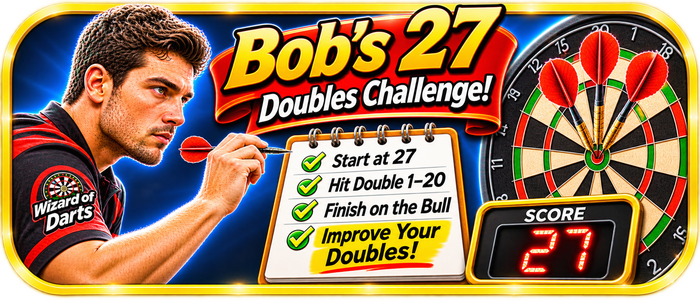
Bob’s 27 is a popular darts practice game designed specifically to improve doubles accuracy.
You begin with 27 points and work through doubles 1 to 20, finishing with the bullseye.
At each target, you throw three darts. For every successful hit, add the value of the double to your score. If all three darts miss the intended double, subtract the double’s value instead.
For example, when aiming at double 5, each successful dart adds 10 points. If you miss with all three darts, subtract 10 points.
If your score falls below zero, the game ends. Your objective is to survive as long as possible and gradually improve your final score.
This game is particularly valuable because it encourages you to practise every double rather than concentrating only on your favourites.
Training tip: Play Bob’s 27 twice per week and record your highest score. Over time, aim to progress further around the board and achieve more successful hits.
10. Try Around the Clock Doubles
Around the Clock Doubles is another simple but effective exercise for developing finishing accuracy.
Begin by aiming at double 1. Once you hit it, move to double 2, then double 3, continuing until you reach double 20.
For an additional challenge, finish the exercise by hitting the inner bullseye.
You can play without a time limit or count the total number of darts required to complete the challenge.
Beginners may prefer a simpler variation in which they receive three darts at each double before moving to the next target, regardless of whether they hit it. How to become better at doubles is this way for sure…
More experienced players can use the traditional progression format and record how many darts they need to complete all 20 doubles.
The advantage of this exercise is that it develops accuracy across the entire dartboard and prevents you from becoming dependent on a small number of favourite targets.
11. Practise Doubles Under Pressure
Hitting a double during relaxed practice is one thing. Hitting the same double when your opponent is waiting on a finish can feel completely different.
Pressure often causes players to tighten their grip, rush their throwing motion or become distracted by the importance of the moment.
To improve your performance, introduce realistic consequences into your training sessions.
For example, give yourself three darts to hit double 20. If you succeed, award yourself one point. If you miss, award a point to an imaginary opponent.
Play the exercise as a race to ten points. This creates a simple competitive situation without requiring another player.
You can also challenge a friend to a doubles competition, alternating between different targets.
The purpose is not to make practice stressful. Instead, you want to become familiar with maintaining your normal throwing technique when the result matters.
Remember: The more comfortable you become with pressure during training, the easier it may be to handle important checkouts in real matches.
12. Learn to Recover After Missing a Double
Missing a double is frustrating, particularly when you have already thrown several unsuccessful finishing darts.
However, frustration can quickly lead to additional mistakes. Some players throw harder after missing, while others change their stance or rush the next dart.
Instead, treat every dart as a separate opportunity. If you miss, briefly identify where the dart landed and decide whether a small adjustment is necessary.
Avoid making dramatic technical changes after a single miss. Your normal throwing motion is usually the best starting point.
If you hit a single segment instead of the intended double, calculate your remaining score before throwing again.
For example, with 40 remaining, hitting single 20 leaves 20 points. Your next target becomes double 10.
Maintaining composure and understanding your finishing options can prevent one missed dart from turning into an entire wasted visit.
13. Track Your Doubles Checkout Percentage
If you want to become better at doubles, tracking your results is extremely useful.
Your doubles checkout percentage measures how many successful finishing darts you hit compared with the total number of darts attempted at doubles during games.
Checkout Percentage = (Successful Checkout Darts ÷ Darts Attempted at Doubles) × 100
For example, if you successfully finish five legs using 25 darts attempted at doubles, your checkout percentage is 20%.
If you later finish five legs using only 15 darts at doubles, your checkout percentage increases to approximately 33.3%.
When measuring practice drills, record the percentage of darts that hit the intended double separately from your match checkout percentage. These are useful but different measurements.
Avoid judging your ability from one short session. Compare results across several weeks to identify meaningful trends.
You may discover that double 16 is consistently stronger than double 20 or that your finishing improves after a proper warm-up.
These observations can help you create a more effective training programme.
14-Day Doubles Improvement Challenge
Follow this two-week training plan to improve your doubles accuracy, checkout knowledge and confidence. Most sessions can be completed in approximately 20–30 minutes.
| Day | Training Exercise | Main Objective |
|---|---|---|
| 1 | 30 darts at D20 | Measure starting accuracy |
| 2 | 30 darts at D16 | Develop a reliable finish |
| 3 | Around the Clock Doubles | Improve all-round accuracy |
| 4 | D20, D10, D5 practice | Learn finishing alternatives |
| 5 | Bob’s 27 | Practise every double |
| 6 | Finish 32 in three darts | Improve checkout combinations |
| 7 | Five legs of 501 | Evaluate first-week progress |
| 8 | 30 darts at D8 | Improve lower-board accuracy |
| 9 | Checkout 40, 32 and 24 | Develop common finishes |
| 10 | Pressure doubles challenge | Improve mental confidence |
| 11 | Around the Clock Doubles | Measure accuracy improvements |
| 12 | Bob’s 27 | Beat your previous score |
| 13 | Five legs of 501 | Practise match finishing |
| 14 | 30 darts at D20 | Compare with Day 1 |
Record your successful hits and compare your performance at the beginning and end of the challenge. Improvement may be gradual, but consistent practice helps develop confidence and reliable technique.
Common Mistakes Players Make When Practising Doubles
Practising Only Favourite Doubles
Although favourite doubles are useful, relying exclusively on them can create weaknesses elsewhere on the board. Include unfamiliar doubles in your regular training.
Changing Technique Under Pressure
Avoid changing your grip, stance or throwing speed simply because you are attempting an important finish.
Ignoring Checkout Arithmetic
Understanding which numbers leave comfortable doubles can save valuable darts during matches.
Practising Without Recording Results
Tracking your doubles accuracy allows you to identify improvements and weaknesses rather than relying on guesswork.
Becoming Frustrated After Missing
Missed doubles are normal. Stay relaxed, maintain your routine and concentrate on the next opportunity.
Frequently Asked Questions About Doubles in Darts
How can I become better at doubles in darts?
Practise doubles regularly, maintain a consistent throwing technique and develop familiarity with common checkout combinations. Training games such as Bob’s 27 and Around the Clock Doubles are excellent starting points.
Which double should beginners practise first?
Double 20 and double 16 are useful starting targets. Double 16 is particularly popular because hitting single 16 leaves double 8.
How long should I practise doubles every day?
Approximately 10–20 minutes of focused doubles training can be a practical starting point. The quality and consistency of your practice are more important than simply throwing more darts.
What is a good checkout percentage?
Checkout percentages vary considerably depending on playing level and match conditions. Rather than concentrating on a universal target, aim to improve your own results over time.
Does the bullseye count as a double?
Yes. In standard double-out darts, the inner bullseye scores 50 points and counts as double 25, meaning it can finish a leg when 50 points remain.
Why do I hit doubles during practice but miss them in matches?
Competitive pressure can influence concentration, grip pressure and throwing rhythm. Practising under realistic match conditions can help you maintain your normal technique.
Final Thoughts – Become a More Confident Doubles Player!
Learning how to become better at doubles is one of the most valuable investments you can make in your darts game.
You do not need to hit spectacular maximum scores to win matches. Consistent scoring combined with reliable finishing can make you a difficult opponent at almost any recreational or club level.
Focus on developing a stable stance, relaxed grip and repeatable throwing routine. Practise a variety of doubles, learn your checkout combinations and use structured training games to keep your sessions interesting.
Most importantly, remain patient. Every player misses doubles, and improvement rarely happens overnight.
Use the 14-day challenge as a starting point, record your results and continue practising the exercises that help you improve.
Over time, stronger finishing skills can improve your three-dart average, increase your confidence and help you win more legs.
Remember: Scoring gets you to the finish line, but doubles take you across it!
The Wizard of Darts Team
Discover More Darts Guides
Want to improve your darts technique, scoring and finishing? Explore more guides and helpful resources from Wizard of Darts.