The Ultimate Darts Checkout Guide
From 2 to 170 Darts Checkout Guide
Master Your Finishing, Improve Your Doubles & Win More Matches
Discover the complete darts checkout guide, featuring recommended finishing combinations for every possible checkout from 2 to 170.
Welcome to The Ultimate Darts Checkout Guide at Wizard of Darts. Whether you are a complete beginner, an experienced league player or an ambitious darts enthusiast looking to improve your finishing percentage, understanding checkout combinations is one of the most important skills you can develop.
Scoring heavily is an essential part of darts, but scoring alone will not win matches. You can hit maximum 180s throughout a leg and still lose if you struggle to finish on a double. Knowing which numbers to aim for, how to calculate your remaining score and how to leave your favourite doubles can make an enormous difference to your overall performance.
This comprehensive darts checkout guide covers every possible finishing score from 2 to 170 in standard double-out 501 darts. We will also explore alternative checkout routes, common finishing mistakes, bogey numbers and effective practice routines designed to help you become a more confident and successful darts player.
What Is a Checkout in Darts?
A checkout is the finishing combination that allows a player to reduce their remaining score to exactly zero and win the leg. In standard double-out 501 darts, the final dart must land in a double segment or the inner bullseye, which counts as double 25.
For example, if you have 40 points remaining, you can win the leg by hitting double 20. If you have 100 points remaining, you can finish with treble 20 followed by double 20.
The highest possible checkout using three darts is 170, achieved by hitting treble 20, treble 20 and the bullseye. This spectacular finish is commonly known as the Big Fish and is one of the most celebrated achievements in professional darts.
🎯 The Golden Rule of Darts
Scoring gets you to a finish, but doubles win you the match!
Understanding Darts Checkout Abbreviations
Before exploring The Ultimate Darts Checkout Guide, it is important to understand the abbreviations commonly used in checkout charts. These abbreviations make finishing combinations easier to read, remember and calculate during matches.
| Abbreviation | Meaning | Example |
|---|---|---|
| S | Single | S20 = 20 points |
| D | Double | D20 = 40 points |
| T | Treble | T20 = 60 points |
| 25 | Outer Bull | 25 points |
| Bull | Inner Bullseye | 50 points |
All checkout combinations in this guide are valid mathematical finishes under standard double-out rules. However, many scores can be finished using several different combinations. The recommended routes are practical examples rather than the only correct way to finish.
The Ultimate Darts Checkout Guide – Complete Checkout Chart
The following tables provide recommended checkout combinations for every score from 2 to 170. Use these tables as a reference during practice until the most common finishing combinations become second nature.
Darts Checkout Chart – From 2 to 40
Checkouts between 2 and 40 are particularly important because they include all twenty standard doubles. Even numbers can be finished with a single dart, while odd numbers require at least one setup dart before attempting a double.
| Score | Checkout | Score | Checkout |
|---|---|---|---|
| 2 | D1 | 22 | D11 |
| 3 | S1 – D1 | 23 | S7 – D8 |
| 4 | D2 | 24 | D12 |
| 5 | S1 – D2 | 25 | S9 – D8 |
| 6 | D3 | 26 | D13 |
| 7 | S3 – D2 | 27 | S11 – D8 |
| 8 | D4 | 28 | D14 |
| 9 | S1 – D4 | 29 | S13 – D8 |
| 10 | D5 | 30 | D15 |
| 11 | S3 – D4 | 31 | S15 – D8 |
| 12 | D6 | 32 | D16 |
| 13 | S5 – D4 | 33 | S1 – D16 |
| 14 | D7 | 34 | D17 |
| 15 | S7 – D4 | 35 | S3 – D16 |
| 16 | D8 | 36 | D18 |
| 17 | S1 – D8 | 37 | S5 – D16 |
| 18 | D9 | 38 | D19 |
| 19 | S3 – D8 | 39 | S7 – D16 |
| 20 | D10 | 40 | D20 |
| 21 | S5 – D8 | – | – |
Double 16 is a favourite among many darts players because missing inside leaves double 8, followed by double 4, double 2 and double 1. This sequence provides several opportunities to finish without needing an additional setup dart.
Darts Checkout Chart – From 41 to 60
Finishes between 41 and 60 are excellent opportunities to win a leg. Most of these scores can be completed using a single number followed by a double, meaning you do not need to hit a treble to create a finishing opportunity.
| Score | Checkout | Score | Checkout |
|---|---|---|---|
| 41 | S9 – D16 | 51 | S19 – D16 |
| 42 | S10 – D16 | 52 | S20 – D16 |
| 43 | S11 – D16 | 53 | S13 – D20 |
| 44 | S12 – D16 | 54 | S14 – D20 |
| 45 | S13 – D16 | 55 | S15 – D20 |
| 46 | S14 – D16 | 56 | S16 – D20 |
| 47 | S15 – D16 | 57 | S17 – D20 |
| 48 | S16 – D16 | 58 | S18 – D20 |
| 49 | S17 – D16 | 59 | S19 – D20 |
| 50 | S18 – D16 | 60 | S20 – D20 |
Although 50 can be finished directly on the bullseye, many players prefer single 18 followed by double 16 when they have enough darts available. Choosing a larger single segment can create a more comfortable finishing opportunity.
Darts Checkout Chart – From 61 to 80
These checkouts introduce more treble combinations and tactical decisions. Hitting the recommended treble can leave two darts at a double when starting with three darts in hand. However, you should always consider what happens if your first dart lands in the single segment instead.
| Score | Checkout | Score | Checkout |
|---|---|---|---|
| 61 | T15 – D8 | 71 | T13 – D16 |
| 62 | T10 – D16 | 72 | T16 – D12 |
| 63 | T13 – D12 | 73 | T19 – D8 |
| 64 | T16 – D8 | 74 | T14 – D16 |
| 65 | T19 – D4 | 75 | T17 – D12 |
| 66 | T10 – D18 | 76 | T20 – D8 |
| 67 | T17 – D8 | 77 | T19 – D10 |
| 68 | T20 – D4 | 78 | T18 – D12 |
| 69 | T19 – D6 | 79 | T19 – D11 |
| 70 | T18 – D8 | 80 | T20 – D10 |
Darts Checkout Chart – From 81 to 100
Checkouts between 81 and 100 are an important part of competitive darts. Learning these combinations can help you punish opponents who miss doubles and win legs that might otherwise appear difficult to finish.
| Score | Checkout | Score | Checkout |
|---|---|---|---|
| 81 | T19 – D12 | 91 | T17 – D20 |
| 82 | Bull – D16 | 92 | T20 – D16 |
| 83 | T17 – D16 | 93 | T19 – D18 |
| 84 | T20 – D12 | 94 | T18 – D20 |
| 85 | T15 – D20 | 95 | T19 – D19 |
| 86 | T18 – D16 | 96 | T20 – D18 |
| 87 | T17 – D18 | 97 | T19 – D20 |
| 88 | T16 – D20 | 98 | T20 – D19 |
| 89 | T19 – D16 | 99 | T19 – S10 – D16 |
| 90 | T18 – D18 | 100 | T20 – D20 |
💡 Checkout Tip
99 is the only score below 101 that cannot be checked out with two darts. Remember this when calculating your remaining score during a match.
Darts Checkout Chart – From 101 to 120
Finishes above 100 are commonly called ton-plus checkouts. Most require three darts, although 101, 104, 107 and 110 can also be finished with a treble followed by the bullseye. Becoming comfortable with these combinations can make you a dangerous opponent, particularly when the pressure is on.
| Score | Checkout | Score | Checkout |
|---|---|---|---|
| 101 | T17 – Bull | 111 | T20 – S19 – D16 |
| 102 | T20 – S10 – D16 | 112 | T20 – S20 – D16 |
| 103 | T19 – S6 – D20 | 113 | T20 – S13 – D20 |
| 104 | T18 – Bull | 114 | T20 – S14 – D20 |
| 105 | T20 – S13 – D16 | 115 | T20 – S15 – D20 |
| 106 | T20 – S14 – D16 | 116 | T20 – S16 – D20 |
| 107 | T19 – Bull | 117 | T20 – S17 – D20 |
| 108 | T20 – S16 – D16 | 118 | T20 – S18 – D20 |
| 109 | T20 – S17 – D16 | 119 | T19 – T10 – D16 |
| 110 | T20 – Bull | 120 | T20 – S20 – D20 |
The 120 checkout is often called Shanghai because it involves hitting the single, treble and double of the same number. This is a particularly satisfying finish because all three darts can be aimed at the 20 segment.
Darts Checkout Chart – From 121 to 140
These larger finishes frequently require two trebles or a combination involving the bullseye. Understanding several possible routes is valuable because your first dart may determine whether you should continue attacking the finish or concentrate on leaving a comfortable double.
| Score | Checkout | Score | Checkout |
|---|---|---|---|
| 121 | T20 – T11 – D14 | 131 | T20 – T13 – D16 |
| 122 | T18 – T18 – D7 | 132 | T20 – T16 – D12 |
| 123 | T19 – T16 – D9 | 133 | T20 – T19 – D8 |
| 124 | T20 – T16 – D8 | 134 | T20 – T14 – D16 |
| 125 | 25 – T20 – D20 | 135 | T20 – T17 – D12 |
| 126 | T19 – T19 – D6 | 136 | T20 – T20 – D8 |
| 127 | T20 – T17 – D8 | 137 | T20 – T19 – D10 |
| 128 | T18 – T14 – D16 | 138 | T20 – T18 – D12 |
| 129 | T19 – T16 – D12 | 139 | T20 – T13 – D20 |
| 130 | T20 – T20 – D5 | 140 | T20 – T20 – D10 |
Darts Checkout Chart – From 141 to 160
Checkouts in this range demonstrate exceptional accuracy and finishing ability. They generally require two accurate treble darts followed by a double or bullseye. Successfully completing one of these finishes during a competitive match can completely change the momentum of the game.
| Score | Checkout | Score | Checkout |
|---|---|---|---|
| 141 | T20 – T19 – D12 | 151 | T20 – T17 – D20 |
| 142 | T20 – T14 – D20 | 152 | T20 – T20 – D16 |
| 143 | T20 – T17 – D16 | 153 | T20 – T19 – D18 |
| 144 | T20 – T20 – D12 | 154 | T20 – T18 – D20 |
| 145 | T20 – T15 – D20 | 155 | T20 – T19 – D19 |
| 146 | T20 – T18 – D16 | 156 | T20 – T20 – D18 |
| 147 | T20 – T17 – D18 | 157 | T20 – T19 – D20 |
| 148 | T20 – T16 – D20 | 158 | T20 – T20 – D19 |
| 149 | T20 – T19 – D16 | 159 | Bogey Number |
| 150 | T20 – T18 – D18 | 160 | T20 – T20 – D20 |
Darts Checkout Chart – From 161 to 170
The final section of The Ultimate Darts Checkout Guide contains the biggest possible finishes in standard 501 darts. Only four scores between 161 and 170 can be checked out using three darts, and all four require the bullseye as the final dart.
| Score | Recommended Checkout |
|---|---|
| 161 | T20 – T17 – Bull |
| 162 | Bogey Number |
| 163 | Bogey Number |
| 164 | T20 – T18 – Bull |
| 165 | Bogey Number |
| 166 | Bogey Number |
| 167 | T20 – T19 – Bull |
| 168 | Bogey Number |
| 169 | Bogey Number |
| 170 | T20 – T20 – Bull |
🐟 The Big Fish – The Ultimate 170 Checkout
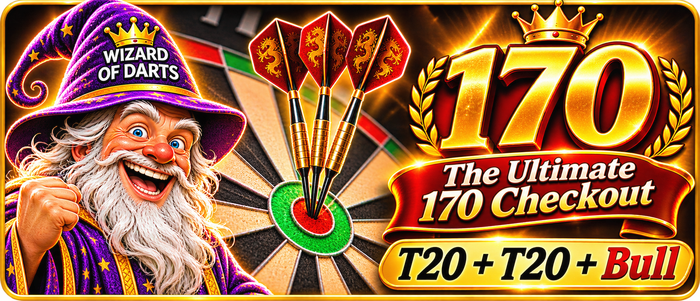
T20 + T20 + Bull = 170
60 + 60 + 50 = 170
The biggest possible three-dart checkout in standard double-out darts!
What Are Bogey Numbers in Darts?
Bogey numbers are remaining scores within the normal checkout range that cannot be finished using three darts. Understanding these numbers is an essential part of intelligent scoring and checkout preparation.
There are seven three-dart bogey numbers between 2 and 170. Experienced players try to avoid leaving these scores when approaching the finishing stage of a leg because doing so guarantees that they cannot win with their next three darts.
| Bogey Number | Possible Setup Dart | Remaining Score |
|---|---|---|
| 159 | S19 | 140 |
| 162 | S20 | 142 |
| 163 | S19 | 144 |
| 165 | S19 | 146 |
| 166 | S20 | 146 |
| 168 | S20 | 148 |
| 169 | S19 | 150 |
The setup darts shown above are examples of how to move from a bogey number to a possible three-dart finish for your next visit. When you have additional darts available, you should normally try to reduce your remaining score further.
For example, if you have 189 remaining and only one dart left, hitting treble 20 leaves 129, which is a possible checkout. However, hitting single 20 leaves 169, which is a bogey number. Aiming at the 19 segment instead leaves 170 if you hit the single or 132 if you hit the treble. Both are possible three-dart finishes.
The Best Doubles to Leave in Darts
Although every double can win a leg, some doubles provide more convenient recovery opportunities than others. Many experienced players deliberately aim to leave doubles that can be repeatedly divided by two if a dart lands inside the double ring.
| Double | Score | Recovery Sequence |
|---|---|---|
| Double 16 | 32 | D16 – D8 – D4 – D2 – D1 |
| Double 20 | 40 | D20 – D10 – D5 |
| Double 8 | 16 | D8 – D4 – D2 – D1 |
| Double 12 | 24 | D12 – D6 – D3 |
| Double 18 | 36 | D18 – D9 |
| Double 10 | 20 | D10 – D5 |
Double 16 offers an excellent recovery sequence, while double 20 is another popular choice because of its familiar position at the top of the dartboard. Nevertheless, your preferred double should ultimately depend on your personal accuracy and confidence.
10 Popular Darts Checkouts and Alternative Routes
One of the most valuable lessons in The Ultimate Darts Checkout Guide is that there is rarely only one correct finishing combination. Learning alternative routes allows you to adapt when a dart misses its intended target or when you prefer to finish on a particular double.
| Score | Route 1 | Route 2 |
|---|---|---|
| 50 | Bull | S18 – D16 |
| 64 | T16 – D8 | T8 – D20 |
| 70 | T18 – D8 | T10 – D20 |
| 80 | T20 – D10 | T16 – D16 |
| 82 | Bull – D16 | T14 – D20 |
| 90 | T18 – D18 | T20 – D15 |
| 100 | T20 – D20 | T16 – S20 – D16 |
| 110 | T20 – Bull | T20 – S10 – D20 |
| 121 | T20 – T11 – D14 | T17 – T10 – D20 |
| 130 | T20 – T20 – D5 | T20 – S20 – Bull |
Professional players frequently adjust their finishing combinations depending on how many darts remain in their hand, their preferred doubles and the remaining score of their opponent. Developing this flexibility is more valuable than simply memorising one route for every number.
How to Calculate Darts Checkouts Quickly
Learning checkout mathematics can initially appear complicated, particularly when you are concentrating on your throwing technique. However, regular practice makes the calculations considerably easier.
Start by memorising the value of every treble and double on the dartboard. Next, practise subtracting your favourite double from different remaining scores. If you prefer double 16, subtract 32 from your remaining total to determine how many points you need to score before attempting the finish.
For example, with 92 remaining, subtracting 32 leaves 60. You therefore know that treble 20 followed by double 16 will complete the checkout. With 76 remaining, subtracting 16 leaves 60, giving you another familiar route through treble 20 and double 8.
Always calculate your remaining score after every dart. Do not continue following a memorised combination when your first dart has landed in the wrong segment. Successful finishing requires both mathematical knowledge and the ability to adapt quickly.
Five Common Darts Checkout Mistakes

1. Ignoring Bogey Numbers
Many beginners concentrate exclusively on scoring as many points as possible without considering their remaining total. Learning to recognise bogey numbers can prevent wasted finishing opportunities and improve your tactical awareness.
2. Always Aiming at Treble 20
Treble 20 is the highest-scoring segment, but it is not always the correct target. Treble 19, treble 18 and other segments can provide more convenient checkout combinations depending on your remaining score.
3. Forgetting About Missed Trebles
Before throwing your first dart, consider where a single would leave you. A good checkout route should ideally provide a useful alternative when you miss the intended treble.
4. Neglecting Unfamiliar Doubles
Practising only double 16 and double 20 can leave you vulnerable when a missed dart forces you onto another double. Develop confidence around the entire dartboard rather than relying exclusively on your favourite finishing segments.
5. Rushing Under Pressure
Many players change their throwing rhythm when attempting a match-winning double. Try to maintain the same comfortable routine you use during practice. Focus on the target rather than the consequences of missing it.
Five Practice Games to Improve Your Darts Checkouts
Reading The Ultimate Darts Checkout Guide is an excellent starting point, but regular practice is essential if you want to turn checkout knowledge into successful finishing performances.
1. Around the Clock Doubles
Start at double 1 and work your way around the dartboard until you reach double 20. Finish the exercise by hitting the bullseye. Record how many darts you need to complete the challenge and try to improve your personal record.
2. The 32 Checkout Challenge
Start with 32 remaining and give yourself three darts to complete the checkout. Repeat the challenge twenty times and record your successful finishes. This exercise develops confidence on double 16 and its recovery doubles.
3. The 61 Checkout Game
Start with 61 points remaining and attempt to finish using three darts. Increase the starting score by one whenever you succeed and decrease it by one whenever you fail. Continue for twenty visits and record your highest completed checkout.
4. The Random Checkout Challenge
Choose random remaining scores between 41 and 100. Give yourself three darts to complete each checkout. This exercise helps develop mathematical awareness, adaptability and confidence with unfamiliar finishing combinations.
5. The Big Fish Challenge
Start with 170 remaining and attempt the famous Big Fish checkout. If you miss the required combination, continue playing the remaining score until you finish. Record the total number of darts required and try to improve your best performance.
The Ultimate 30-Minute Checkout Practice Routine
A structured practice session can be more effective than spending an entire evening throwing randomly at treble 20. The following routine combines doubles practice, finishing mathematics and simulated match pressure.
| Duration | Exercise | Purpose |
|---|---|---|
| 5 minutes | Warm-up and scoring | Develop throwing rhythm |
| 5 minutes | Double 16 and Double 20 | Improve favourite doubles |
| 5 minutes | Around the Clock Doubles | Improve board coverage |
| 5 minutes | Checkouts from 41 to 60 | Improve single-double finishes |
| 5 minutes | Checkouts from 61 to 100 | Improve combination finishing |
| 5 minutes | Random ton-plus checkouts | Develop advanced finishing |
| 30 minutes | Complete Checkout Training Session | |
Try to complete this routine several times each week. Keep a record of your checkout success rate so you can identify which areas require additional practice. Improvement becomes easier to recognise when you have previous results available for comparison.
Frequently Asked Questions About Darts Checkouts
What Is the Highest Possible Checkout in Darts?
The highest possible three-dart checkout in standard double-out darts is 170. It is completed by hitting treble 20, treble 20 and the inner bullseye.
What Is the Lowest Possible Checkout?
The lowest possible checkout is 2, which must be finished by hitting double 1. A remaining score of 1 cannot be finished under standard double-out rules.
How Many Bogey Numbers Are There in Darts?
There are seven bogey numbers between 2 and 170 that cannot be checked out with three darts: 159, 162, 163, 165, 166, 168 and 169.
How Many Possible Checkout Scores Are There?
There are 162 possible checkout scores between 2 and 170. The range contains 169 different scores, of which seven are impossible to finish using three darts.
Can You Finish a Leg on the Bullseye?
Yes. The inner bullseye is worth 50 points and counts as double 25, making it a valid finishing target. The outer bull, worth 25 points, cannot be used as the final dart in standard double-out darts.
What Happens If You Bust a Checkout?
A bust occurs when you score more than your remaining total, leave yourself with exactly one point or reach zero without hitting a double. Your score returns to the total you had at the beginning of that visit, and your turn ends immediately.
What Is the Highest Two-Dart Checkout?
The highest possible two-dart checkout is 110, achieved by hitting treble 20 followed by the bullseye.
What Is the Best Double in Darts?
Double 16 is a popular choice because of its convenient recovery sequence. However, double 20 and double 18 are also preferred by many players. The best double for you is ultimately the one you can hit most consistently.
Should Beginners Practise High Checkouts?
Beginners should initially concentrate on doubles and checkouts below 61. Once these combinations become more comfortable, gradually introduce higher finishes and more challenging treble-double combinations.
Final Thoughts – Master The Ultimate Darts Checkout Guide
Becoming a successful darts player requires more than impressive scoring averages and occasional maximum 180s. The ability to finish legs efficiently, calculate checkout combinations and remain confident under pressure is what separates consistent winners from players who regularly miss opportunities.
The Ultimate Darts Checkout Guide provides a complete reference for every possible three-dart checkout from 2 to 170. By learning these combinations, understanding bogey numbers and practising your doubles regularly, you can develop a more intelligent and effective approach to finishing.
Remember that you do not need to memorise every checkout combination immediately. Start with the smaller finishes, become comfortable with your favourite doubles and gradually expand your knowledge as your confidence improves.
Every successful checkout is another step towards becoming a better darts player. Whether you are celebrating your first double 16, completing your first ton-plus finish or finally landing the spectacular 170 checkout, enjoy the journey and continue challenging yourself.
🎯 Become a Checkout Wizard!
Learn your numbers, practise your doubles and make every finishing opportunity count.
Great Scoring Creates Opportunities – Great Finishing Wins Matches!
Discover More at Wizard of Darts
Explore Wizard of Darts for more helpful darts guides, training exercises, equipment reviews, legendary player profiles, fascinating darts facts, incredible world records and entertaining darts videos.
🎯 See awesome darts videos here!
Keep Practising, Keep Improving & Keep Throwing!