How to Hit Your First 180
The Ultimate Darts Guide

Master Your Aim, Perfect Your Throw and Celebrate Your First Maximum!
There is one moment almost every darts player dreams about: throwing three perfect darts into the treble 20 and hearing somebody shout “ONE HUNDRED AND EIGHTY!” Whether you play casually at home, compete in a local league or simply enjoy watching professional darts, hitting your first 180 is an unforgettable achievement.
However, achieving a maximum score is not simply a matter of luck. It requires consistent technique, accurate grouping, concentration and plenty of practice. Even experienced players sometimes struggle to produce three perfect darts in a single visit.
If you are wondering how to hit your first 180, this comprehensive guide will explain everything you need to know. We will explore throwing techniques, aiming strategies, equipment choices, practice routines and the psychological challenges involved in achieving your first maximum.
Most importantly, we will show you how to develop the skills that make hitting a 180 increasingly possible without allowing the pressure of chasing one to ruin your enjoyment of darts. Read on and learn how to hit your first 180.
1. What Exactly Is a 180 in Darts?
A 180 is the highest possible score with three darts on a standard dartboard. To achieve it, all three darts must land inside the treble 20 section during the same visit.
The treble ring multiplies the value of the numbered section by three. Because the number 20 is the highest value on the board, hitting treble 20 scores 60 points.
Three darts scoring 60 points each produce the famous maximum of 180.
Treble 20 + Treble 20 + Treble 20 = 180 points.
Although the calculation is simple, the physical challenge is considerable. The treble ring is narrow, and players must deliver three accurate darts into the same small target.
In professional tournaments, a 180 often produces enormous excitement among spectators. Television commentators celebrate maximum scores, while fans hold up signs and cheer as the third dart lands.
For amateur players, the first 180 can feel almost as exciting as winning a tournament. It represents a personal milestone and proves that your technique is capable of producing three exceptionally accurate throws.
2. Why Is Hitting a 180 So Difficult?
The difficulty of scoring 180 comes from the size of the target and the consistency required. A standard treble ring is only approximately eight millimetres wide, meaning that small variations in your release can cause a dart to land in the single 20 or a neighbouring section.
Hitting treble 20 once is a satisfying achievement for a beginner. Hitting it twice during the same visit is even more impressive. Hitting it three times requires excellent precision and the ability to repeat almost exactly the same throwing motion.
Another challenge is dart grouping. Once the first dart enters the treble, it occupies part of the available space. The second and third darts must find room around the existing darts without being deflected away from the scoring area.
Psychology also plays an important role. After hitting two treble twenties, many beginners become excited or nervous. They begin thinking about the potential 180 rather than concentrating on their normal throwing technique.
This sudden change in concentration can cause the final dart to miss. Learning to remain calm and repeat your normal routine is therefore an essential part of the process.
3. Choose the Right Darts for Your Throwing Style
Equipment alone will not produce a 180, but using darts that feel comfortable can help you develop a more consistent throwing technique.
Most traditional steel-tip darts consist of a point, barrel, shaft and flight. Each component influences the overall balance and flight characteristics of the dart.
Beginners often find darts weighing approximately 22 to 24 grams comfortable, although lighter and heavier options may suit different throwing styles. There is no universal perfect weight.
The barrel is particularly important because it determines where your fingers grip the dart. Some barrels have aggressive grooves that provide substantial grip, while others have smoother surfaces.
Flights also influence how darts travel through the air. Standard-shaped flights generally provide more aerodynamic stability than smaller flight designs, although the ideal combination depends on your release and throwing speed.
If your darts regularly enter the board at an awkward angle or collide with one another, experimenting with shaft length or flight shape may help. Make only one adjustment at a time so you can evaluate the results.
Most importantly, avoid changing your equipment after every unsuccessful practice session. Developing confidence with a familiar set of darts is usually more valuable than constantly searching for new equipment.
You are one step close to learn how to hit your first 180!
4. Perfect Your Stance Before Chasing Maximum Scores
A stable stance provides the foundation for accurate darts throwing. If your feet and body move significantly between throws, it becomes much harder to deliver three darts into the same small target.
Stand comfortably behind the oche with your dominant-side foot closer to the throwing line. Right-handed players commonly place their right foot forward, while left-handed players often prefer their left foot.
Your front foot should provide a stable base, with your rear foot helping maintain balance. Keep your knees relaxed and avoid unnecessary movement during the throw.
Some players prefer standing almost sideways, while others use a more diagonal position. Experiment until you discover a stance that allows you to aim naturally without straining your back or shoulders.
Once you find a comfortable position, try to repeat it consistently. Even small changes in foot placement can alter your alignment with the dartboard. Learning how to hit your first 180 can be small adjustments, thats all….
Remember that your objective is not to imitate a particular professional player perfectly. Your stance should suit your own body and throwing style.
5. Develop a Relaxed and Consistent Grip
A good grip allows you to control the dart without creating unnecessary tension. Many beginners hold their darts too tightly, especially when attempting difficult targets such as treble 20.
Try holding the barrel between your thumb and two or three fingers. The dart should feel secure but not squeezed. Imagine holding a pencil comfortably rather than gripping a heavy object.
Your fingers should release the dart smoothly during the forward throwing motion. Excessive pressure can interfere with this release and cause the dart to travel in an unexpected direction.
Pay attention to where your fingers sit on the barrel. Some players prefer a front grip, others a central grip and some a rear grip. The most important factor is being able to reproduce the same position repeatedly.
When practising for your first 180, concentrate on making all three darts feel identical in your hand. A consistent grip makes it easier to repeat the same movement and improve grouping.
6. How to Aim at Treble 20
Accurate aiming begins with choosing a specific target. Instead of looking generally towards the upper part of the dartboard, focus on a small area within the treble 20 segment.
The treble 20 is located in the narrow inner scoring ring directly beneath the number 20 at the top of the board. Its neighbouring numbered sections are 5 and 1.
Before throwing, establish a comfortable visual focus on the target. Bring your dart into your usual aiming position and allow your arm to move naturally towards the selected area.
Some players prefer aiming at the centre of the treble 20, while others adjust slightly depending on how their darts enter the board and where previous darts are positioned.
Avoid constantly shifting your eyes between the dart in your hand and the dartboard. Experiment with a simple routine that allows you to concentrate confidently on the target.
If your darts consistently land above or below treble 20, observe your release and follow-through rather than immediately making dramatic changes to your entire technique.
Remember that good aiming is only one part of accurate throwing. Your stance, grip, arm movement and release must work together. How to hit your first 180 can take some time, it is not done in a day or two!
7. Master the Follow-Through
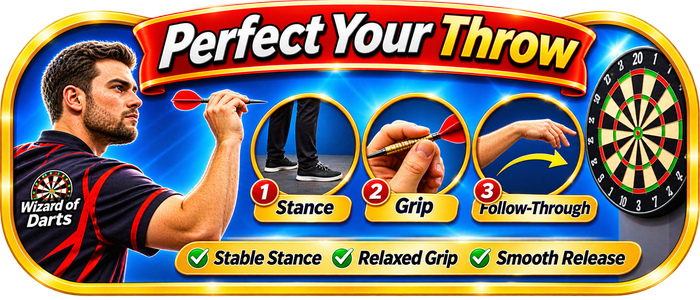
The follow-through is the continuation of your throwing motion after the dart leaves your fingers. A smooth follow-through can help promote a repeatable release and prevent unnecessary changes in your throwing direction.
Begin with your dart raised comfortably and your eyes focused on the target. Draw your forearm backwards, then accelerate it forward in a controlled movement.
As the dart leaves your hand, allow your arm to continue naturally towards the target. Your fingers should open smoothly rather than forcing the dart out of your grip.
Avoid suddenly stopping your arm or pulling it sideways immediately after release. These movements may indicate tension or an inconsistent throwing action.
A useful practice exercise is to throw three darts slowly while concentrating entirely on maintaining the same follow-through. Ignore the score temporarily and focus on repeating your movement.
Once your release becomes more consistent, return your attention to the treble 20 target and observe whether your grouping improves.
8. Why Dart Grouping Is More Important Than High Scores
If you want to learn how to hit your first 180, developing tight dart grouping should be one of your main priorities.
Grouping refers to how closely your darts land together. A player who regularly places three darts within a small area has developed an important foundation for hitting maximum scores.
For example, imagine throwing three darts that all land close together in single 20. Although the total score is only 60, the grouping suggests that your technique is reasonably consistent.
Compare this with a player who scores 100 points but has darts scattered across different parts of the board. The higher score may look more impressive, but the grouping is less consistent.
Try practising with the objective of placing all three darts close together, regardless of whether they land in the treble. As your grouping improves, you can gradually refine your aim. Learning how to hit your first 180 is not all about the treble twenty field.
A useful exercise is to throw your first dart at treble 20 and then attempt to place the next two darts close to it. This encourages consistent alignment and repeatable delivery.
Tight grouping does not guarantee a 180, but it significantly improves your ability to place multiple darts in a small scoring area.
9. The Psychological Challenge of the Third Dart
One of the most exciting moments in darts occurs when your first two darts land in treble 20. Suddenly, your first maximum is just one accurate throw away.
Unfortunately, this is also the moment when many players become nervous. Their heart rate increases, their grip tightens and their normal throwing rhythm changes.
The best approach is to treat the third dart exactly like the first two. Maintain your normal stance, focus on the target and repeat the same controlled throwing movement.
Avoid thinking about celebrations, spectators or the possibility of missing. These thoughts can distract you from the physical action required.
If you feel nervous, allow yourself a brief moment to regain concentration. However, do not introduce an entirely new routine simply because the final dart feels important.
Professional players often appear calm during high-pressure moments because they have developed familiar routines through extensive practice.
You can build the same habit by practising situations in which your final dart determines whether you achieve a particular target or complete a checkout.
The key is learning to focus on the process rather than the result. Even if you learn how to hit your first 180, it can takes weeks between you hitting them.
10. Five Excellent Practice Exercises for Your First 180
Structured practice can help you develop the skills required to hit three treble twenties during one visit. These five exercises are particularly useful for players chasing their first maximum.
Exercise 1 – The Treble 20 Challenge
Throw ten visits of three darts while aiming exclusively at treble 20. Record how many darts land in the treble during the 30 throws. Repeat the exercise regularly and try to improve your total.
Exercise 2 – Grouping Practice
Choose a target within the 20 section and concentrate on placing all three darts as close together as possible. Do not worry about the total score. Instead, observe the distance between your darts.
Exercise 3 – The 100-Point Challenge
Try to score at least 100 points with three darts while aiming at the 20 section. A common combination is treble 20 followed by two single twenties. This helps build confidence with higher-scoring visits.
Exercise 4 – Two-Treble Pressure Training
Whenever your first two darts land in treble 20, deliberately concentrate on maintaining your normal rhythm for the third dart. Record how often you reach this situation and how you respond to the pressure.
Exercise 5 – Maximum Attempts
Set aside five minutes at the end of practice to attempt 180s. Keep throwing at treble 20, but do not become frustrated if you fail. The purpose is to gain experience and confidence with repeated maximum attempts.
Combining these exercises creates a balanced training routine that develops accuracy, grouping, scoring ability and mental control.
11. A 30-Minute Practice Routine for Hitting 180s
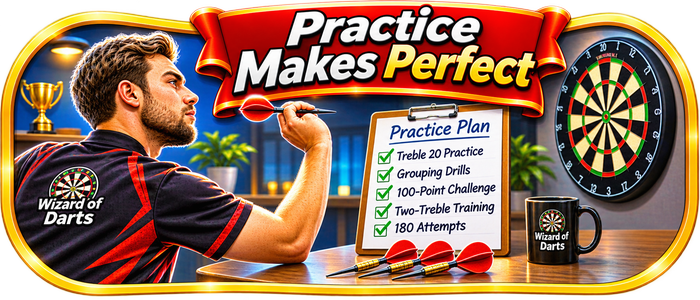
You do not need to practise for hours every day to improve your chances of hitting a maximum. A focused 30-minute routine can help develop consistency without creating unnecessary fatigue.
| Time | Exercise | Objective |
|---|---|---|
| 5 minutes | Warm-up throws | Relax your arm and establish rhythm |
| 10 minutes | Treble 20 practice | Improve scoring accuracy |
| 5 minutes | Grouping exercise | Improve consistency |
| 5 minutes | 100-point challenge | Build confidence with high scores |
| 5 minutes | 180 attempts | Practise maximum-score situations |
Try completing this routine several times per week. Keep a record of your treble 20 hits, highest visits and any maximum scores achieved.
Over time, your results may reveal improvements that are not immediately obvious during individual practice sessions.
How to hit your first 180 and when you do, you will get the feeling of being a champion.
12. Common Mistakes That Prevent Your First 180
Many beginners unknowingly make mistakes that reduce their chances of achieving a maximum. Fortunately, most of these problems can be improved through awareness and practice. Learning how to hit your first 180 can make one frustrated, but be cool and keep on!
Throwing Too Hard
Darts requires controlled accuracy rather than maximum physical power. Throwing excessively hard can create tension and make your release less consistent.
Changing Your Grip
Small changes in finger placement can affect the dart’s flight. Try to maintain the same comfortable grip for every throw.
Moving Your Head or Body
Unnecessary movement can alter your alignment with the target. Maintain a stable stance and concentrate on repeating your throwing action.
Rushing the Third Dart
Excitement after two trebles can cause players to throw the final dart too quickly. Maintain your usual rhythm and focus on the target.
Practising Only Maximum Attempts
Constantly chasing 180s can become frustrating. Include grouping exercises, doubles practice and complete games in your training routine to develop a balanced skill set.
13. How Long Does It Take to Hit Your First 180?
There is no fixed timetable for hitting your first 180. Some players achieve a maximum relatively early in their darts journey, while others practise for months or years before experiencing the moment.
Your progress depends on several factors, including practice frequency, natural coordination, equipment comfort and the consistency of your throwing technique.
It is important to remember that even highly skilled players do not hit a 180 during every match. Maximum scores are difficult precisely because they require three accurate darts in succession.
Instead of measuring success exclusively by the number of 180s you achieve, track improvements in your scoring average, treble accuracy and grouping.
If you previously struggled to hit treble 20 once during a practice session but now hit it several times, that represents meaningful progress.
Similarly, regularly scoring 100 or 140 points demonstrates that your ability to group darts in the 20 section is improving.
The first 180 will often arrive when you are concentrating on throwing naturally rather than desperately trying to force the achievement.
14. What Should You Do After Hitting Your First 180?

When your third dart finally lands in treble 20, enjoy the moment! Hitting your first 180 is a genuine achievement and deserves to be celebrated.
Take a photograph if you wish, share the experience with your friends or simply appreciate how much progress you have made.
However, remember that one maximum does not automatically make somebody a complete darts player. Consistent scoring, reliable doubles and strong checkout skills remain essential for winning matches.
After celebrating, continue practising the fundamentals that helped you achieve the milestone. Focus on making high-scoring visits more frequent rather than expecting another 180 immediately.
Your next objectives might include hitting multiple maximums during a week, improving your three-dart average or completing a 501 leg in fewer darts.Learning how to hit your first 180 is just one part of the game 501.
Every achievement creates an opportunity to set new goals and enjoy the challenge of becoming a better player.
Frequently Asked Questions About Hitting a 180
What is the easiest way to hit a 180 in darts?
There is no guaranteed easy method. The best approach is to develop a stable stance, consistent grip, smooth release and accurate grouping while regularly practising treble 20.
Do you need expensive darts to hit a 180?
No. Comfortable, well-balanced darts are more important than expensive equipment. Many players achieve excellent results with relatively affordable darts.
Can beginners hit a 180?
Yes. Beginners can occasionally hit maximum scores, although consistent technique and regular practice generally improve the chances.
Why do I miss my third dart after hitting two trebles?
Excitement, nervousness and changes in your throwing rhythm may contribute. Concentrate on repeating your normal routine rather than thinking about the potential result.
Is a 180 better than a nine-dart finish?
A 180 is the highest possible score in one three-dart visit, while a nine-dart finish is a perfect 501 leg completed in the minimum possible number of darts. A nine-dart finish is a much rarer and more demanding overall achievement.
How often should I practise treble 20?
Regular short practice sessions can be very effective. Try including focused treble 20 exercises several times per week while also practising doubles and other important targets.
Final Thoughts – Your First 180 Is Waiting!
Learning how to hit your first 180 is an exciting challenge that can make practising darts even more enjoyable. Although the target is small and the achievement is difficult, every practice session provides an opportunity to improve.
By developing a comfortable stance, relaxed grip, consistent throwing technique and reliable grouping, you can gradually increase your chances of achieving a maximum score.
Remember that patience is essential. Do not become discouraged by missed darts or unsuccessful attempts. Even professional players experience frustrating moments and periods of inconsistent scoring.
Focus on the process, celebrate small improvements and continue enjoying the game. The more consistently you throw, the more opportunities you will create for those magical three darts.
One day, your first dart will hit treble 20. Then your second. And when the third follows, you will understand why the first 180 is a moment darts players never forget!
The Wizard of Darts Team

More Darts Guides and Resources
Discover more helpful information about darts, professional tournaments and improving your game.