Common Mistakes Beginners Make in Darts
The 15 Most Common Mistakes Beginners Make in Darts

A Complete Beginner’s Guide to Improving Your Accuracy, Technique and Confidence!
Darts might look like a simple game. You stand behind a line, aim at a dartboard and throw three darts. However, anyone who has tried to improve their accuracy knows that becoming a consistent darts player requires much more than simply throwing darts at a target.
Every beginner makes mistakes. Some players struggle with their stance, others hold their darts incorrectly, and many develop bad habits without even realising it. Unfortunately, these small mistakes can prevent players from improving, even when they practise regularly.
The good news is that most beginner mistakes are relatively easy to identify and correct. By understanding what you are doing wrong, you can develop better habits, improve your scoring and enjoy the game much more.
In this comprehensive guide, we explore the 15 most common mistakes beginners make in darts and explain exactly how to avoid them. Whether you are playing your first game of 501 or dreaming about hitting your first 180, these practical tips will help you become a more confident and consistent player.
Let’s discover the Common Mistakes Beginners Make in Darts, that might be holding your darts game back!
1. Using the Wrong Darts
One of the most common mistakes beginners make in darts is choosing equipment without considering their throwing style. Many new players simply purchase the cheapest darts available or select a set because their favourite professional player uses something similar.
However, darts come in different weights, shapes, barrel designs and grip styles. These differences can influence how comfortable the darts feel and how consistently you release them.
Steel-tip darts commonly weigh between approximately 20 and 26 grams, although lighter and heavier models are available. Beginners often find a medium-weight set around 22 to 24 grams a reasonable starting point.
The barrel shape is equally important. Some players prefer straight barrels, while others feel more comfortable with tapered or front-weighted designs. Grip texture also varies considerably between manufacturers.
How to fix it: Try several dart weights and barrel styles before investing in expensive equipment. Visit a darts shop where you can test different sets if possible. Choose darts that feel comfortable and allow you to repeat your throwing motion naturally.
Remember that expensive darts do not automatically make you a better player. Consistency and practice are far more important than the price of your equipment.
2. Standing Incorrectly at the Oche
One of the Common Mistakes Beginners Make in Darts is Your stance, it is the foundation of your throwing technique. Unfortunately, many beginners pay very little attention to how they position their feet and body before throwing.
Some players stand with their feet too close together, while others lean excessively towards the dartboard. Both habits can affect balance and make accurate throwing more difficult.
A stable stance allows you to concentrate on your throwing arm without unnecessary body movement. Most right-handed players prefer placing their right foot forward, while left-handed players commonly lead with their left foot.
However, there is no single perfect stance for everybody. Some players stand almost sideways, while others prefer a more diagonal position.
How to fix it: Position your feet comfortably behind the oche, distribute your weight naturally and maintain a stable upper body. Experiment with small adjustments until you discover a stance that feels balanced.
Once you find a comfortable position, try to reproduce it every time you approach the dartboard. Consistent foot placement can make a noticeable difference to your accuracy.
3. Holding the Dart Too Tightly
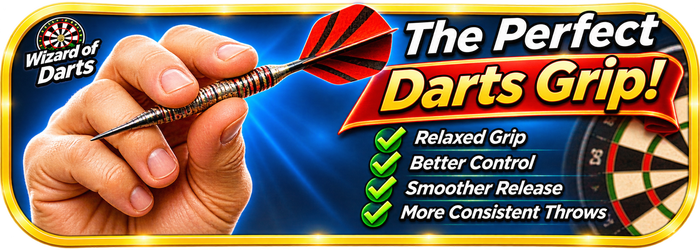
A tight grip is another common problem among beginners. When players become nervous or concentrate intensely on hitting a difficult target, they often squeeze the dart harder than necessary.
Unfortunately, excessive grip pressure can create tension in the fingers, wrist and forearm. This tension may interfere with the release and cause the dart to travel in an unexpected direction.
A relaxed grip allows the dart to leave your hand more naturally. The dart should feel secure, but you should not need to squeeze the barrel aggressively to maintain control.
Different players use different numbers of fingers. Some prefer a three-finger grip, while others use two or four fingers. What matters most is comfort and consistency.
How to fix it: Hold the dart with enough pressure to control it without creating unnecessary tension. Practise releasing it smoothly and pay attention to whether your fingers remain relaxed.
Avoid constantly changing your grip during a match. Once you find a comfortable position, work on repeating it consistently.
4. Throwing the Dart Too Hard
Many beginners believe that throwing harder will make their darts travel straighter and hit the board more accurately. In reality, darts is primarily a game of precision rather than physical strength.
Excessive throwing force can cause unnecessary movement in your shoulder, elbow and wrist. It may also make your release more difficult to control.
Professional darts players generally use a controlled throwing action that allows them to repeat their movements consistently. The objective is to deliver the dart accurately, not to throw it as fast as possible.
The dart only needs sufficient speed to travel comfortably towards the board and remain securely embedded in the surface.
How to fix it: Concentrate on a smooth, controlled throwing motion. Allow your forearm to move naturally and avoid using excessive shoulder movement.
Practise throwing at a comfortable pace while maintaining your balance. Over time, you should develop a repeatable motion that feels natural rather than forced. Dont make the Common Mistakes Beginners Make in Darts.
5. Forgetting the Follow-Through
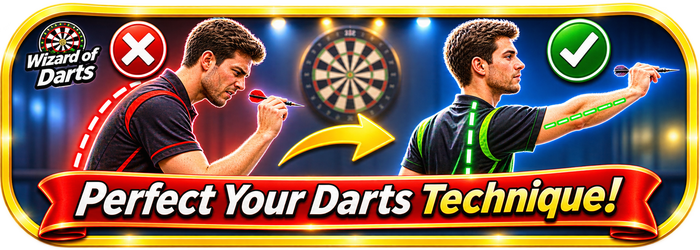
The follow-through is one of the most important parts of a consistent darts throw. Unfortunately, beginners often stop their throwing arm immediately after releasing the dart.
This sudden stopping movement may be associated with tension or an inconsistent release. It can also make it more difficult to reproduce the same throwing action.
A natural follow-through allows your hand and arm to continue moving towards the target after the dart leaves your fingers.
Many experienced players finish their throwing motion with their arm extended and their fingers pointing towards the dartboard.
How to fix it: Practise extending your throwing arm smoothly towards the target. Avoid pulling your hand sideways or stopping abruptly.
Try throwing ten darts while concentrating entirely on your follow-through rather than your score. This exercise can help develop a more consistent throwing action.
6. Moving Your Body During the Throw
A stable body position is essential for accurate darts throwing. However, many beginners move their shoulders, head or upper body while releasing the dart.
These movements can change the alignment between your throwing arm and the target. Even a small movement may affect where the dart lands.
Some players lean forward during the throwing motion, while others twist their shoulders or lift their rear foot unnecessarily.
Although every player has a slightly different technique, unnecessary movement generally makes consistency more difficult.
How to fix it: Maintain a balanced stance and keep your body relatively stable while your throwing arm performs the main movement.
Recording yourself from the side can be particularly helpful. Watch the footage and look for unnecessary head movement, shoulder rotation or changes in balance.
Small improvements in stability may produce noticeable improvements in your dart grouping.
7. Aiming at the Wrong Part of the Dartboard
Beginners often make the mistake of aiming generally towards a large section instead of selecting a specific target.
For example, a player attempting to hit treble 20 might simply look towards the upper part of the dartboard rather than concentrating on the narrow treble ring.
The smaller and more clearly defined your intended target, the easier it becomes to evaluate your accuracy.
However, beginners should also avoid becoming obsessed with difficult targets before developing basic consistency.
The treble 20 is located in the inner narrow scoring ring of the 20 segment. The outer narrow ring is double 20, not treble 20.
How to fix it: Select a precise target before each throw. Begin by aiming at the large single 20 section, then gradually introduce more difficult targets such as treble 20 and doubles.
Maintain visual concentration on your chosen target and avoid constantly shifting your attention during the throwing motion.
8. Practising Without a Plan
One of the biggest common mistakes beginners make in darts is spending hours throwing randomly without following a structured practice routine.
Although casual throwing can be enjoyable, it does not always provide the focused repetition needed to improve specific skills.
Many beginners spend almost all their practice time aiming at treble 20 because they want to achieve a 180. Unfortunately, this means they often neglect doubles, checkouts and other important areas of the board.
A balanced practice routine should include scoring, grouping, doubles and match situations.
How to fix it: Divide your practice into short sessions with clear objectives. For example, spend ten minutes practising scoring, ten minutes working on doubles and ten minutes playing a game of 501.
Keep track of your results so you can identify improvements and weaknesses over time.
Focused practice is generally more productive than repeatedly throwing darts without a clear purpose.
9. Ignoring Doubles Practice

Scoring heavily is exciting, but finishing a leg is equally important. Many beginners concentrate almost entirely on treble 20 and forget that standard 501 requires a double to win.
A player might regularly score 100 points or more during a visit but still struggle to finish a leg because they cannot hit their doubles consistently.
This can become particularly frustrating during competitive matches, where missed doubles provide opportunities for your opponent.
Common finishing targets include double 20, double 16, double 10 and double 8. Learning several doubles gives you more options when approaching a checkout.
How to fix it: Dedicate part of every practice session to doubles. Try hitting each double from 1 to 20 or play Bob’s 27, a popular training game designed to improve finishing accuracy.
Remember that the inner bullseye also counts as a double worth 50 points in standard double-out darts.
Improving your doubles can make a substantial difference to your ability to win matches.
10. Changing Equipment Too Frequently
When beginners experience a disappointing practice session, they sometimes blame their darts rather than examining their technique.
This can lead to constantly changing dart weights, flights, shafts and barrels in the hope of finding equipment that instantly improves their accuracy.
Although equipment adjustments can sometimes be beneficial, frequent changes make it difficult to develop a consistent throwing action.
Different dart configurations may produce different flight characteristics, requiring time to become familiar with each setup.
How to fix it: Choose a comfortable set of darts and use it consistently for a reasonable period. If you decide to experiment, change only one component at a time.
For example, test a different flight shape while keeping the same barrel and shaft. This makes it easier to determine whether the adjustment actually improves your results.
Remember that your technique will usually have a greater influence on your accuracy than minor equipment changes. Common Mistakes Beginners Make in Darts is quite a lot as you can see, dont fall into the trap of making them yourself!
11. Rushing Every Throw
Darts requires rhythm, but many beginners confuse rhythm with speed. They rush their throws, particularly when playing against an opponent or trying to achieve a high score.
Throwing too quickly can cause changes in grip, stance and release. It may also prevent players from concentrating properly on their intended target.
However, throwing extremely slowly is not necessarily better. Some players become uncomfortable when they spend too much time thinking about each dart.
The objective is to establish a natural rhythm that allows you to remain relaxed and focused.
How to fix it: Develop a simple pre-throw routine. Position your feet, establish your grip, focus on the target and throw at a comfortable pace.
Try to maintain this routine during both practice sessions and competitive matches.
Consistency matters more than throwing quickly or slowly.
12. Becoming Frustrated After Missing
Every darts player misses targets, including the world’s best professionals. Unfortunately, beginners sometimes become frustrated when their darts fail to land exactly where intended.
Frustration can create tension, reduce concentration and encourage players to make unnecessary changes to their technique.
A missed treble 20 might cause a player to throw the next dart harder, change their grip or rush the remainder of the visit.
These reactions often make the situation worse rather than better.
How to fix it: Accept that missed darts are a normal part of learning. Concentrate on repeating your technique rather than reacting emotionally to every result.
Set realistic goals and celebrate gradual improvements. For example, increasing your scoring average or hitting more doubles during practice represents meaningful progress.
A calm and patient approach can help you maintain confidence during difficult matches.
13. Not Understanding Darts Scoring and Checkout Rules
Many beginners learn how to throw darts before fully understanding how the scoring system works.
In standard 501, players begin with 501 points and subtract their scores after each visit. The objective is to reach exactly zero, with the final dart landing in a double.
If a player scores more than the remaining total, leaves exactly one point or reaches zero without a valid double, the visit is a bust. The score returns to what it was before that visit.
Understanding these rules is essential for planning successful checkouts.
For example, if you have 40 points remaining, hitting double 20 finishes the leg. If you have 32 points remaining, double 16 is a popular finishing target.
How to fix it: Learn the basic scoring rules and practise common checkouts. Start with simple finishes such as 16, 20, 32 and 40 before moving on to more complicated combinations.
Improving your mental arithmetic can also help you make faster decisions during competitive games.
14. Practising with an Incorrect Dartboard Setup
An incorrectly installed dartboard can create problems that beginners may not immediately recognise.
If the board is mounted too high or too low, or the throwing line is positioned incorrectly, players may develop habits that do not translate well to standard playing conditions.
For traditional steel-tip darts, the centre of the bullseye should be 1.73 metres above the floor. The standard throwing distance is 2.37 metres, measured horizontally from the face of the dartboard to the throwing line.
Lighting is another important consideration. Poor lighting can create shadows that make small targets more difficult to see.
How to fix it: Measure your dartboard installation carefully and ensure the 20 segment is positioned at the top. Use adequate lighting and keep the throwing area free from distractions.
A properly installed dartboard provides a consistent environment for developing your skills.
15. Expecting to Improve Too Quickly
Perhaps the biggest mistake beginners make in darts is expecting immediate results. After watching professional players hit maximum scores and impressive checkouts, beginners sometimes assume that similar achievements should be possible after only a few practice sessions.
However, professional players have usually spent years developing their technique, accuracy and mental discipline.
Darts improvement is rarely perfectly consistent. Some days you may throw exceptionally well, while other sessions feel disappointing despite using the same equipment and technique.
These fluctuations are normal and should not discourage you.
How to fix it: Establish realistic goals and measure progress over several weeks rather than individual sessions.
Focus on improving your grouping, scoring average, checkout percentage and confidence.
Most importantly, remember why you started playing darts. Enjoyment should remain an important part of the experience.
Quick Overview – 15 Beginner Darts Mistakes and Solutions
Use this simple reference table to identify areas of your game that could benefit from improvement.
| No. | Common Mistake | Best Solution |
|---|---|---|
| 1 | Wrong darts | Choose comfortable equipment |
| 2 | Poor stance | Improve balance and stability |
| 3 | Tight grip | Relax your fingers |
| 4 | Throwing too hard | Use controlled movements |
| 5 | Poor follow-through | Extend your arm naturally |
| 6 | Body movement | Maintain a stable stance |
| 7 | Poor aiming | Focus on a precise target |
| 8 | Random practice | Follow a training routine |
| 9 | Ignoring doubles | Practise checkouts regularly |
| 10 | Changing equipment | Keep a consistent setup |
| 11 | Rushing throws | Develop a natural rhythm |
| 12 | Frustration | Stay calm and patient |
| 13 | Poor scoring knowledge | Learn the 501 rules |
| 14 | Incorrect board setup | Check official measurements |
| 15 | Unrealistic expectations | Set achievable goals |
A Simple 30-Minute Practice Routine for Beginners
Avoiding mistakes becomes easier when you follow a consistent training routine. The following 30-minute practice plan is designed to develop several important skills without making your sessions unnecessarily complicated.
| Duration | Exercise | Purpose |
|---|---|---|
| 5 minutes | Warm-up throws | Relax and establish rhythm |
| 10 minutes | Scoring practice | Improve accuracy and grouping |
| 5 minutes | Doubles training | Improve finishing ability |
| 5 minutes | Checkout practice | Learn finishing combinations |
| 5 minutes | Match simulation | Develop confidence under pressure |
Repeat this routine several times per week and record your progress. As your technique improves, gradually increase the difficulty of your exercises.
Frequently Asked Questions About Beginner Darts Mistakes

What is the biggest mistake beginners make in darts?
One of the biggest mistakes is practising without a clear plan. Beginners often spend too much time aiming at high-scoring targets while neglecting doubles, checkouts and basic throwing technique.
How can beginners improve their darts accuracy?
Focus on a stable stance, comfortable grip, smooth throwing motion and consistent follow-through. Regular practice with specific targets can help develop better accuracy.
Should beginners use heavy or light darts?
There is no universal perfect dart weight. Many beginners find medium-weight darts comfortable, but the best choice depends on individual preferences and throwing style.
How often should beginners practise darts?
Several focused sessions each week can be effective. Short, structured practice sessions are often more manageable than occasional lengthy sessions.
Why do my darts keep landing in different places?
Inconsistent grouping may result from changes in grip, stance, release timing or body movement. Try concentrating on repeating the same comfortable throwing action.
Is it normal to struggle with doubles?
Yes. Doubles are narrow targets, and many players find finishing more difficult than ordinary scoring. Regular doubles practice can gradually improve your confidence.
Final Thoughts – Avoid These Mistakes and Become a Better Darts Player!
Understanding the most common mistakes beginners make in darts is an important step towards becoming a more consistent and confident player.
Whether you struggle with your grip, stance, aiming technique or practice routine, small improvements can make a significant difference over time.
Remember that every experienced darts player was once a beginner. Nobody develops perfect accuracy overnight, and even professional players occasionally miss seemingly simple targets.
The most important thing is to develop good habits early, practise regularly and remain patient when progress feels slow.
Instead of trying to correct all 15 mistakes immediately, identify the two or three areas that affect your game the most. Concentrate on improving those weaknesses before moving on to additional challenges.
With the right approach, your grouping can become tighter, your scoring more consistent and your confidence stronger.
Keep practising, enjoy the game and remember: every great darts player started with their very first throw!
The Wizard of Darts Team
Discover More Darts Guides
Want to improve your technique and learn more about the exciting world of darts? Explore our guides and helpful resources.