The Weirdest Dartboards Ever Invented
The Weirdest Dartboards Ever Invented – 12 Strange and Wonderful Designs
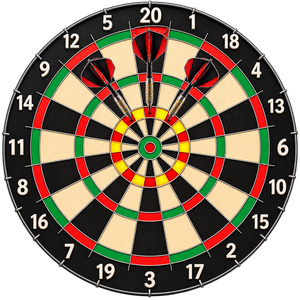
When most people imagine a dartboard, they picture the familiar circular board with twenty numbered segments, red and green doubles, a treble ring and a bullseye in the middle. However, the history of darts is far stranger than most players realise.
Throughout the development of the sport, inventors, pub owners and manufacturers have experimented with unusual scoring systems, different shapes, extra scoring rings and completely unexpected playing surfaces. Some designs became regional traditions, others disappeared almost immediately, and a few have returned decades after their original release.
In this fascinating journey through The Weirdest Dartboards Ever Invented, we explore twelve remarkable dartboard designs that challenge everything you thought you knew about the game. From boards capable of producing 240 points with three darts to miniature targets and baseball-inspired games, these creations prove that darts has always attracted creative minds.
Best of all, the historical designs featured here are real, documented examples rather than imaginary inventions.
1. Harrows Quadro 240 – The Dartboard That Changed Everything
Imagine throwing three darts and scoring 240 instead of the traditional maximum of 180. That is exactly what the legendary Harrows Quadro 240 dartboard made possible.
Originally introduced during the 1990s, this unusual dartboard added a fourth scoring ring between the traditional treble ring and the bullseye. Landing a dart in this special section multiplied the segment value by four.
Three darts in quadruple 20 therefore produced an astonishing 240 points. The additional ring also created entirely new checkout combinations, making conventional finishing charts far less useful.
The Quadro appeared in professional competition during the 1990s but never replaced the standard dartboard. Many players preferred familiar scoring routes, while commentators and referees faced more complicated calculations.
After disappearing from production, the Quadro became a cult favourite among collectors. Harrows eventually revived the design with modern sisal construction and improved wiring.
The Weirdest Dartboards Ever Invented for sure.
Weirdness factor: 10/10 – A genuine 240-point maximum!
2. Manchester Log-End – The Tiny Dartboard
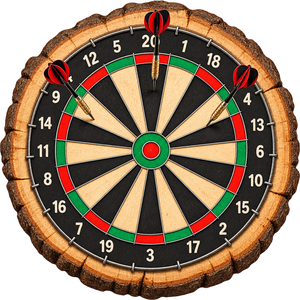
The Manchester Log-End dartboard looks like somebody took an ordinary dartboard, removed several features and dramatically reduced its size.
This historic regional design was traditionally made from the end grain of a wooden log. Its playing area is considerably smaller than a standard competition dartboard, demanding impressive accuracy from anyone brave enough to use it.
The board has no treble ring and no outer bullseye. Its numbering arrangement also differs from the familiar international sequence.
The Manchester board developed its own playing traditions and remains an important example of regional darts culture in England. For players accustomed to large modern sisal boards, its compact dimensions can be a serious challenge.
Weirdness factor: 9/10 – Small board, enormous difficulty.
3. London Fives – The Dartboard With Only Four Numbers
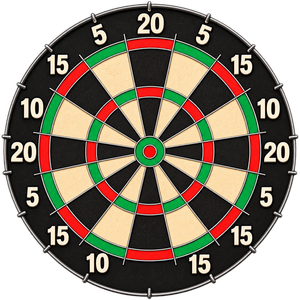
The London Fives dartboard is one of the most fascinating alternatives to the modern twenty-number board. It is indeed a clear favourite for the The Weirdest Dartboards Ever Invented.
Instead of displaying twenty different values, its twelve scoring segments repeat just four numbers: 20, 5, 15 and 10. The sequence appears three times around the playing surface.
This unusual arrangement creates a very different approach to scoring and strategy. Players cannot simply aim for familiar treble 19 combinations or rely on ordinary 501 checkout routes.
Traditional games associated with London Fives include 305, 505 and 705. The board is closely connected with the history of darts in London and surrounding areas.
Although the design appears strange today, it demonstrates how local traditions developed independently before international standardisation.
Weirdness factor: 9/10 – Twenty segments? Who needs them?
4. Manlon – The Miniature Practice Monster
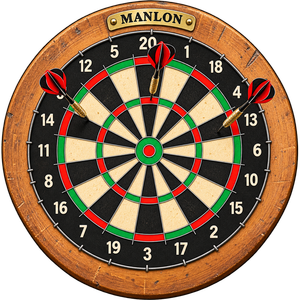
The Manlon dartboard combined the appearance of a standard London board with the compact dimensions of the Manchester Log-End.
Introduced by Perrigo Darts in 1953, this unusual hybrid offered players a much smaller version of the familiar twenty-segment layout.
The idea was simple: practise on a tiny dartboard and a normal-sized target should feel easier afterwards.
Some versions were made with a Manchester board on one side and the miniature London layout on the other, offering two different challenges in one piece of equipment.
Despite its clever concept, the Manlon never achieved widespread popularity. Production eventually ended, leaving surviving examples as fascinating pieces of darts history.
Weirdness factor: 9/10 – A standard dartboard after a shrinking experiment.
5. Yorkshire Dartboard – No Trebles Allowed
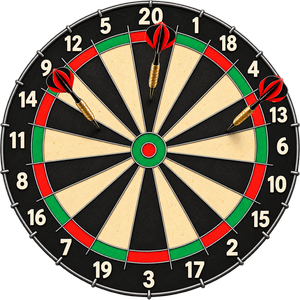
The traditional Yorkshire dartboard looks surprisingly familiar at first glance. It has twenty numbered segments arranged in the standard sequence, but something important is missing.
There is no treble ring. Just like a dartboard in the The Weirdest Dartboards Ever Invented category is intended.
Instead, the traditional regional design relies on single scoring areas, doubles and the bullseye. This changes the entire rhythm of the game because the famous treble 20 cannot deliver sixty points.
Players must develop different strategies and cannot depend on modern professional scoring patterns.
The historic Yorkshire board is a reminder that the dartboard familiar to television viewers was not always the only accepted design. Different regions maintained their own equipment and traditions for many years.
Weirdness factor: 7/10 – A dartboard that refuses to give you a 180.
6. Black Irish Dartboard – A Forgotten Regional Curiosity
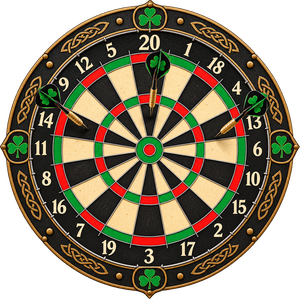
Long before modern dartboard designs became internationally standardised, regional variations appeared across Britain and Ireland.
Among the lesser-known historical examples was the Black Irish dartboard, a design mentioned in specialist histories of regional darts equipment.
Like several early wooden boards, it belonged to an era when local craftsmen produced targets according to regional preferences rather than one universal specification.
Today, the Black Irish board is far less familiar than the Manchester or Yorkshire designs. That rarity makes it particularly interesting to historians and collectors.
Its story also highlights an important fact: not every unusual dartboard survived long enough to become a commercially successful product.
Weirdness factor: 8/10 – A mysterious survivor from regional darts history.
7. American Style Dartboard – A Completely Different Tradition
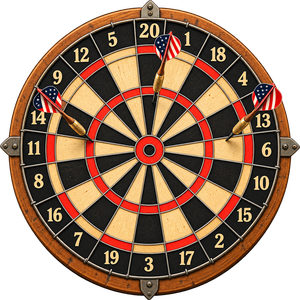
Traditional American darts developed along a different path from the British steel-tip game.
Instead of using a modern sisal board with the internationally recognised scoring arrangement, American-style darts commonly use distinctive wooden boards with their own segment layouts.
Manufacturers such as Widdy helped establish this tradition in the United States. The equipment was often paired with large wooden-bodied darts rather than the compact tungsten darts used by many modern players.
One particularly interesting feature of some American boards is a rotating central section, developed to help distribute wear.
The result is a darts experience that can look almost like a different sport to someone familiar only with televised professional competition.
Those Americans sure deserve a place in the The Weirdest Dartboards Ever Invented hall of fame.
Weirdness factor: 8/10 – A completely different branch of darts evolution.
8. Dartball – When Darts Meets Baseball
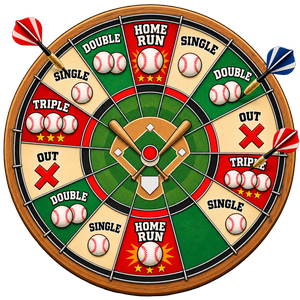
What happens when somebody combines darts with baseball? The answer is Dartball, one of the strangest and most entertaining target games ever developed.
Rather than following conventional dartboard scoring, Dartball uses a target designed around baseball-style gameplay.
Different areas represent outcomes associated with the sport, turning each throw into part of a simulated baseball contest.
The game has a documented history in the United States dating back to the 1920s, with organised leagues appearing in subsequent years.
Dartball became particularly associated with community competitions and recreational leagues. Its combination of precision throwing and baseball strategy makes it one of the most distinctive alternatives to traditional darts.
Weirdness factor: 10/10 – A baseball game played with darts!
9. Box Darts – The Board Invented to Avoid Restrictions
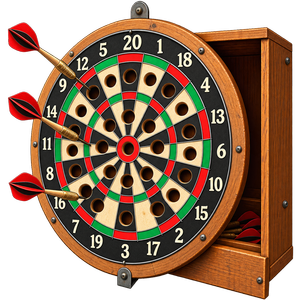
One of the most unusual inventions in darts history was Box Darts, a variation associated with restrictions on ordinary darts during the Second World War.
A publican in Huddersfield reportedly developed a target featuring holes through which rubber-nosed darts could pass. The darts were then collected inside a box behind the playing surface.
The intention was to create an alternative to conventional pointed darts while preserving some of the enjoyment of target throwing.
Unfortunately, the idea never became particularly popular, and the unusual design faded into obscurity.
Nevertheless, Box Darts deserves recognition for demonstrating how inventive people became when ordinary equipment was restricted.
The Weirdest Dartboards Ever Invented for sure, but not such bad an idea after all.
Weirdness factor: 9/10 – Darts disappearing through holes into a box.
10. Champion’s Choice – The Dartboard That Punishes Mistakes
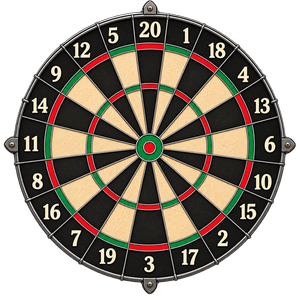
Some unusual dartboards are designed purely to make players better, and the Champion’s Choice concept is a perfect example.
Rather than introducing bizarre numbers or additional scoring areas, this training design makes the doubles and trebles narrower than those on an ordinary board.
That means every scoring opportunity becomes more difficult. A throw that would normally land safely inside treble 20 might instead register as a single.
The theory is that practising on smaller targets encourages precision and makes a regulation board feel more forgiving.
Whether it improves an individual player’s performance depends on their training habits, but the concept remains a clever alternative to ordinary practice.
Weirdness factor: 7/10 – A dartboard designed to make you suffer before you improve.
11. Grimsby Dartboard – The Board With 28 Numbers
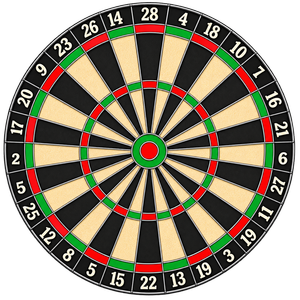
One of the most remarkable historical curiosities is the Grimsby dartboard, which appears in an illustration dating from before 1900.
Instead of the twenty numbered segments recognised today, the historical example featured twenty-eight numbers arranged in an unusual pattern.
Its layout demonstrates that dartboard designers were experimenting with scoring arrangements long before the familiar modern sequence became dominant.
The Grimsby board is particularly fascinating because it challenges the assumption that twenty numbered sections were always an essential feature of darts.
Although its original popularity and detailed rules are not as well documented as those of modern boards, its appearance makes it one of the most intriguing early examples.
This is one of our favourites in the category: The Weirdest Dartboards Ever Invented.
Weirdness factor: 10/10 – Twenty-eight numbers instead of twenty.
12. Electronic Soft-Tip Dartboards – The Board That Scores Itself
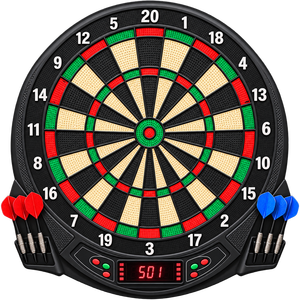
Today, electronic dartboards are familiar equipment in homes, bars and amusement venues. However, compared with traditional wooden and sisal targets, their design represents a radical technological departure.
Instead of penetrating densely packed fibres, soft-tip darts enter small holes in a segmented plastic playing surface. Sensors register the impact and automatically calculate the score.
Many electronic models also include digital displays, sound effects, numerous game modes and multiplayer features.
Some modern systems connect to smartphones and online services, allowing players to compete against opponents in other countries.
Electronic dartboards are no longer rare, but their transformation of a centuries-old throwing game into an interactive digital experience certainly earns them a place among the most unconventional dartboard developments.
Weirdness factor: 6/10 – Once futuristic, now a familiar part of darts.
Comparison: The Weirdest Dartboards Ever Invented
| Dartboard | Unusual Feature | Weirdness |
|---|---|---|
| Harrows Quadro 240 | Quadruple scoring ring | 10/10 |
| Manchester Log-End | Tiny wooden playing area | 9/10 |
| London Fives | Only four different numbers | 9/10 |
| Manlon | Miniature standard layout | 9/10 |
| Yorkshire | No treble ring | 7/10 |
| Black Irish | Rare historical regional design | 8/10 |
| American Style | Wooden board and distinct scoring | 8/10 |
| Dartball | Baseball-inspired gameplay | 10/10 |
| Box Darts | Darts pass through target holes | 9/10 |
| Champion’s Choice | Narrower doubles and trebles | 7/10 |
| Grimsby | Twenty-eight numbered sections | 10/10 |
| Electronic Soft-Tip | Electronic sensors and scoring | 6/10 |
Weirdness ratings are editorial opinions from Wizard of Darts, not official rankings of The Weirdest Dartboards Ever Invented.
Why Did So Many Strange Dartboards Disappear?
Most unusual dartboards faced the same challenge: players were already comfortable with familiar rules and equipment.
Changing the size of the target, removing the treble ring or adding quadruple scoring created new strategic possibilities, but it also made the game more complicated.
As organised competitions expanded, standardised equipment became increasingly important. Players needed predictable conditions, spectators wanted familiar scoring, and tournament organisers benefited from consistent rules.
However, the disappearance of a design does not necessarily mean it was a bad invention. Many unusual boards remain enjoyable recreational alternatives, valuable historical artefacts or excellent training tools.
Frequently Asked Questions
What is the weirdest dartboard ever invented?
The Harrows Quadro 240 is a strong contender because its additional quadruple ring allows a maximum score of 240 with three darts. Dartball and the twenty-eight-number Grimsby board are equally unusual for different reasons.
Can you really score 240 with three darts?
Yes. On a Quadro 240 dartboard, three darts in quadruple 20 produce 240 points.
Are unusual dartboards still available?
Some are. The Quadro 240 has been reintroduced, while other historic designs are mainly found through specialist makers, collectors or traditional regional clubs.
Why did older dartboards have different numbers?
Before modern standardisation, regional craftsmen and players experimented with different layouts and rules. Several local designs developed independently.
Final Thoughts – The Wonderful World of Weird Dartboards
The history of darts is filled with creativity, experimentation and wonderfully strange ideas. From miniature Manchester boards to baseball-inspired targets and the extraordinary Quadro 240, inventors have repeatedly challenged the traditional dartboard.
Although the standard twenty-segment board remains the undisputed favourite for professional competition, these alternative designs reveal a much richer history than most players realise.
Our personal favourite is the Harrows Quadro 240 because it takes the familiar game and changes the mathematics completely. However, the historic Grimsby board and the remarkable Dartball concept deserve special recognition for originality.
If you ever get the opportunity to try one of these unusual boards, take it. You might discover that darts can be even stranger, harder and more entertaining than you imagined.
Keep throwing, keep exploring and enjoy the weird side of darts!
The Wizard of Darts Team

Sources and Further Reading