Eric Bristow – The Story of “The Crafty Cockney”
Long before modern darts filled enormous arenas and created international superstars, one player helped transform the game through talent, confidence, personality and an extraordinary desire to win: Eric Bristow.
Nicknamed “The Crafty Cockney”, Bristow became the dominant figure in darts during much of the 1980s. With five World Championship titles, five World Masters victories and countless memorable matches, he established himself as one of the first true superstars of televised darts.
Bristow was much more than a successful player.
He was confident, controversial, entertaining and sometimes deliberately provocative. Crowds might support him or desperately want his opponent to beat him, but very few people ignored him.
His influence also extended far beyond his own trophy collection. Most famously, Bristow recognised the potential of a young Phil Taylor and helped him pursue a professional darts career.
The result was one of the most remarkable connections in sporting history: one darts legend helping create another.
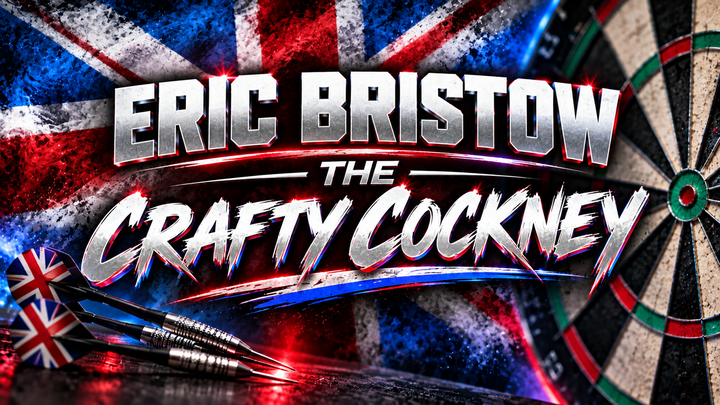
Growing Up in London
Eric John Bristow was born on 25 April 1957 in Hackney, London.
He grew up in an era when darts was closely connected with pubs, working men’s clubs and local leagues.
Long before huge prize funds and packed arenas became normal, talented players developed their skills by competing against experienced opponents in small venues.
Bristow discovered darts while still young and quickly became fascinated by the game.
His competitive personality suited darts perfectly.
He didn’t simply want to participate.
He wanted to win.
🎯 FUN FACT #1
Eric Bristow began playing darts as a teenager and developed much of his early game in the pubs and clubs of London.
Those early experiences helped develop more than his throwing ability.
Playing in pubs also taught Bristow how to perform in noisy environments where spectators could stand close to the action.
That ability would later become extremely useful when television turned darts into a major spectator sport.
The Crafty Cockney
Every great darts player needs a memorable nickname, and few have been better than Bristow’s.
THE CRAFTY COCKNEY
The nickname became inseparable from him.
It reflected his London background, but it was also associated with the name of a pub in Santa Monica, California.
🍺 FUN FACT #2
Bristow’s famous “Crafty Cockney” nickname was connected with a pub of the same name in California that he encountered during his travels.
The name fitted his personality beautifully.
Bristow was clever around the dartboard and understood the psychological side of competition.
He knew that professional darts was not simply about throwing accurately.
It was also about confidence.
If an opponent believed Bristow was going to win, half the battle might already be over.
A Throw Nobody Could Forget
Bristow had one of the most recognisable throwing styles in darts history.
Instead of standing completely still at the oche, he adopted an unusual stance and often held his little finger away from the dart.
To modern viewers, the technique can look unconventional.
But it worked.
Extremely well.
☝️ FUN FACT #3
Bristow’s throwing action became famous partly because of the distinctive way his little finger pointed away from the dart as he aimed.
His technique was instantly recognisable on television.
Combined with his confidence and facial expressions, it made Bristow one of the most distinctive personalities in the game.
Becoming World Champion
By the end of the 1970s, Bristow had established himself among the strongest players in darts.
But the trophy that truly defined careers was the World Championship.
Bristow reached the final of the 1980 BDO World Professional Darts Championship.
His opponent was fellow Londoner Bobby George.
The final featured two players who understood entertainment as well as competition.
Bristow won 5–3.
Eric Bristow was World Champion.
It was his first world crown.
It certainly wouldn’t be his last.
Five World Championships
The 1980 victory began a remarkable period of domination.
Bristow successfully defended his title in 1981.
He returned to the winner’s circle in 1984.
Then he won again in 1985.
And again in 1986.
👑 FUN FACT #4
Eric Bristow won five BDO World Championships: 1980, 1981, 1984, 1985 and 1986.
During this period, Bristow became the player everybody wanted to beat.
His success wasn’t limited to the World Championship either.
He accumulated major titles across the darts calendar and spent long periods regarded as the best player in the world.
The World Masters King
Another tournament played a major role in Bristow’s career.
The World Masters was one of the most prestigious competitions in darts.
Bristow won it for the first time in 1977.
Then he won again.
And again.
By the end of his career, he had captured the tournament five times.
🏆 FUN FACT #5
Bristow won the prestigious World Masters five times – in 1977, 1979, 1981, 1983 and 1984.
His World Masters success demonstrated how consistently brilliant he was during his peak years.
Whether the competition was the World Championship, World Masters or another major event, Bristow expected to win.
The Rivalry With Jocky Wilson
Great champions often become even more interesting when they have great rivals.
For Bristow, one of the most memorable was Scotland’s Jocky Wilson.
The two players were very different characters.
Bristow was the confident Londoner who enjoyed reminding everyone how good he was.
Wilson was a fiery Scottish competitor capable of beating anybody when his game was working.
Their matches became a classic England-versus-Scotland darts rivalry.
The rivalry reached its greatest stage in the 1989 World Championship final.
Wilson won 6–4.
For Bristow, it was another reminder that even the dominant champion could be beaten.
For darts fans, however, matches between the two became part of the sport’s golden television era.
The Famous 1983 Final
One of Bristow’s most famous World Championship matches ended in defeat.
At the 1983 tournament, he reached the final against Keith Deller.
Bristow was the established superstar.
Deller was the qualifier and enormous outsider.
Almost everyone expected Bristow to win.
The match eventually reached a dramatic deciding set.
Bristow had an opportunity to finish 121.
Instead of attempting the bullseye route, he chose a different tactical option and left himself 32.
Deller responded with one of the most famous checkouts in darts history.
He finished 138 to become World Champion.
😲 FUN FACT #6
Keith Deller’s famous 138 checkout to defeat Bristow in the 1983 World Championship final became one of the most iconic finishes in darts history.
The finish became so famous that darts fans still discuss it decades later.
For Bristow, the defeat hurt.
But true to his competitive nature, he returned and won the next three World Championships.
Confidence and Psychology
Bristow understood something important about professional sport.
Talent alone is not always enough.
Confidence matters.
Bristow often projected enormous self-belief before matches.
He wasn’t afraid to say that he expected to win.
Sometimes his comments irritated opponents.
Sometimes they irritated spectators.
But that was part of the attraction.
Fans wanted characters.
Bristow gave them one.
When he walked onto the stage, the audience knew there was a strong possibility that something memorable would happen.
The World’s Number One
During his peak, Bristow was the benchmark for other professional players.
He spent several periods ranked as the world’s number-one player.
His domination of major tournaments meant that opponents frequently entered events knowing that the road to the trophy might eventually pass through The Crafty Cockney.
🌍 FUN FACT #7
Bristow spent long periods at the top of the world rankings during the 1980s and was the dominant international star of his era.
This dominance helped make him one of the faces of televised darts.
Even people who didn’t regularly follow the sport often recognised Eric Bristow.
The Problem That Changed His Career
Then something happened that dramatically changed Bristow’s career.
He developed a problem commonly known in darts as dartitis.
Dartitis is a psychological condition that can make it extremely difficult for a player to release the dart naturally.
A movement that had previously happened automatically can suddenly become almost impossible.
For an elite professional, the consequences can be devastating.
Bristow began experiencing the problem during the later 1980s.
🧠 FUN FACT #8
At the height of his career, Bristow developed dartitis – a condition that interfered with his ability to release the dart smoothly.
His results inevitably suffered.
Yet Bristow continued competing and working on his game.
The experience demonstrated how difficult darts can be mentally.
The target may be only a few metres away, but the psychological pressure can be enormous.
Discovering Phil Taylor
Perhaps the most remarkable chapter of Bristow’s legacy involves another player.
A young man from Stoke-on-Trent named Phil Taylor.
Taylor was an extremely talented local player but did not yet have the financial freedom to dedicate himself fully to professional darts.
Bristow recognised something special in him.
He decided to help.
Bristow provided Taylor with financial support so he could concentrate more seriously on darts and travel to tournaments.
💷 FUN FACT #9
Eric Bristow famously helped finance Phil Taylor’s early darts career – helping give the future 16-time World Champion the opportunity to become a professional.
It became one of the most extraordinary mentoring stories in sport.
But there was another twist coming.
Teacher vs Student
Phil Taylor developed rapidly.
By 1990, he had reached the BDO World Championship final.
Waiting on the opposite side of the stage was the man who had helped him.
Eric Bristow.
The mentor was playing the student.
Bristow was the five-time World Champion and favourite.
Taylor was appearing in his first world final.
Then Taylor produced a stunning performance.
He defeated Bristow 6–1.
🤝 FUN FACT #10
Phil Taylor won his first World Championship by defeating his mentor Eric Bristow 6–1 in the 1990 final.
Few sporting stories could have been scripted better.
Bristow had helped Taylor pursue his dream.
Taylor then defeated him to become World Champion.
And Taylor would eventually become the most successful world champion in the history of professional darts.
The Formation of the WDC
Professional darts experienced major difficulties during the late 1980s and early 1990s.
Television coverage had declined significantly, and many of the leading players were unhappy with the direction of the sport.
A group of top professionals decided that change was necessary.
Bristow was among the players involved in the breakaway organisation initially known as the World Darts Council.
The organisation eventually became the Professional Darts Corporation – PDC.
The split was controversial and created years of conflict within professional darts.
But the PDC eventually grew into the organisation responsible for many of today’s largest professional tournaments.
Bristow therefore played a role not only in darts history on the board, but also in the development of the modern professional game.
From Player to Television Personality
As Bristow’s competitive playing career declined, his connection with darts continued.
His personality made him a natural television personality.
He worked as a pundit and commentator, offering opinions on players and tournaments.
Bristow’s style remained unmistakably direct.
He rarely seemed interested in giving safe, predictable answers.
That meant viewers might strongly agree with him or completely disagree.
Either way, people listened.
I’m a Celebrity
Bristow’s fame eventually took him far beyond darts.
In 2012, he appeared on the British television programme I’m a Celebrity…Get Me Out of Here!.
His appearance introduced The Crafty Cockney to a younger audience who might not have watched his dominant darts years during the 1980s.
It also demonstrated just how recognisable Bristow had become.
Very few darts players from his generation achieved celebrity status outside the sport.
Bristow was one of them.
Why Was Eric Bristow So Good?
Bristow’s success wasn’t based entirely on spectacular scoring.
His greatest weapon may have been his competitive mentality.
He expected to win.
That confidence affected both himself and his opponents.
Bristow also possessed excellent finishing ability and a strong tactical understanding of the board.
He knew which combinations he preferred.
He understood when to apply pressure.
And he knew how to make an opponent feel that every missed double might be punished.
Modern darts players often produce higher statistical averages because equipment, practice methods and the professional environment have evolved.
But comparing eras purely through averages misses the point.
Bristow dominated the strongest players available during his peak.
That is what champions do.
One of Darts’ First Superstars
Televised darts experienced enormous popularity in Britain during the late 1970s and early 1980s.
Players suddenly became household names.
Bristow was perfectly suited to this new environment.
He had the ability.
He had the nickname.
He had the confidence.
He had the personality.
And he was willing to play the role of the man everyone wanted to beat.
That made his matches entertaining even before the first dart was thrown.
The Eric Bristow Career
Bristow’s career can be summarised through an extraordinary collection of achievements and memorable moments.
- He developed his game in the pubs and clubs of London.
- He became known worldwide as “The Crafty Cockney.”
- He won his first World Masters title in 1977.
- He became BDO World Champion for the first time in 1980.
- He successfully defended the world title in 1981.
- He won three consecutive World Championships from 1984 to 1986.
- He became a five-time World Champion.
- He won the World Masters five times.
- He developed one of darts’ most famous rivalries with Jocky Wilson.
- He experienced dartitis during his career.
- He recognised the enormous potential of Phil Taylor.
- He financially helped Taylor pursue professional darts.
- He lost the 1990 World Championship final to his former protégé.
- He became involved in the breakaway movement that eventually developed into the PDC.
- He later became a familiar television personality and darts pundit.
Eric Bristow’s Legacy
Eric Bristow died on 5 April 2018 at the age of 60.
The news came while the Premier League Darts event was taking place in Liverpool.
Players and spectators paid tribute to one of the most important figures in the history of the game.
His influence can still be seen throughout modern darts.
Part of that legacy comes from his five World Championships.
Part comes from his World Masters victories.
Part comes from his enormous personality and his role in making televised darts entertaining.
And part comes from Phil Taylor.
By recognising Taylor’s potential and helping him pursue professional darts, Bristow indirectly influenced decades of the sport that followed.
Taylor eventually won 16 World Championships and became the dominant player of the next era.
In that sense, the story of modern professional darts contains an extraordinary chain.
Eric Bristow dominated the 1980s.
He helped Phil Taylor begin his professional journey.
Taylor dominated the following era.
And the sport continued growing into the global spectacle we know today.
The Original Crafty Cockney
Darts has produced many extraordinary champions.
Phil Taylor brought unprecedented domination.
Raymond van Barneveld helped create a darts revolution in the Netherlands.
Michael van Gerwen brought explosive scoring and intensity.
Gary Anderson became famous for one of the smoothest throws in the game.
Luke Humphries demonstrated the value of patience and steady development.
Luke Littler introduced professional darts to another generation of fans.
But before many of those stories came Eric Bristow.
He helped show that a darts player could become more than a tournament winner.
A player could become a personality.
A celebrity.
A character fans either loved or wanted desperately to see defeated.
That combination helped make Bristow one of the defining figures of darts’ first great television era.
Five World Championships tell us how successful he was.
But his influence on the sport tells an even bigger story.
Five-time World Champion, mentor, entertainer and one of darts’ original superstars.
Eric “The Crafty Cockney” Bristow didn’t simply win darts tournaments – he helped shape the personality of professional darts itself.