30 Amazing Darts Facts You Probably Didn’t Know
30 Amazing Darts Facts You Probably Didn’t Know

Darts might look like a simple game involving three small arrows and a circular target, but behind those familiar pieces of equipment lies a fascinating world of history, mathematics, extraordinary records, unusual traditions and surprising scientific details.
From legendary world champions and almost impossible finishes to strange historical dartboards and the hidden mathematics behind professional scoring, there is much more to this wonderful sport than meets the eye.
Whether you are a beginner learning your first checkout combinations, a regular pub player or a dedicated fan of professional tournaments, these 30 Amazing Darts Facts You Probably Didn’t Know will give you plenty of interesting stories to share with your friends.
Some facts might improve your understanding of the game, while others will simply leave you wondering how such extraordinary things became part of darts history.
Get your darts ready, and let the surprises begin!
Here is the 30 Amazing Darts Facts You Probably Didn’t Know:
1. The Highest Possible Score With Three Darts Is 180

Every professional darts fan recognises the famous shout of “One Hundred and Eighty!” But have you ever wondered why 180 is the maximum score on a standard dartboard?
The highest numbered segment is 20, and its treble section multiplies that value by three. One dart in treble 20 therefore scores 60 points. Hit the same narrow section with all three darts and the result is 60 + 60 + 60 = 180.
Although 180 is the maximum, professional players do not always aim for treble 20. Depending on the score remaining, they might deliberately target treble 19, treble 18 or another section to create a more favourable finish.
Fun fact: A player can throw three perfectly accurate darts and still score less than 180 if the chosen targets are different.
2. A Perfect Game of 501 Requires Just Nine Darts
One of the greatest achievements in professional darts is the legendary nine-dart finish. It means completing a leg of 501 using the smallest number of darts mathematically possible.
A popular route involves scoring 180 with the first three darts, another 180 with the next three and finishing the remaining 141 points with treble 20, treble 19 and double 12.
The calculation is simple: 180 + 180 + 141 = 501. The execution, however, is incredibly difficult because every dart must contribute to a precise sequence.
Eight darts cannot possibly complete 501 because eight maximum-scoring darts would total only 480 points. Nine is therefore the absolute minimum under standard double-out rules.
A nine-darter is often called the perfect leg.
3. There Are Thousands of Mathematical Nine-Dart Routes
Most spectators associate a nine-darter with two consecutive 180s followed by a 141 checkout. However, that famous sequence is only one of many possibilities.
A mathematical enumeration of individual dart sequences identifies 3,944 valid ways of completing 501 in nine darts, when different throwing orders are counted separately.
One particularly unusual route consists of three identical visits worth 167 points each. Every visit contains treble 20, treble 19 and the inner bullseye, giving 60 + 57 + 50 = 167.
Three visits of 167 total exactly 501, with the final bullseye serving as the finishing double.
Professional players generally favour familiar combinations because they are easier to calculate and practise, but the mathematics proves there is far more variety than most people imagine.
4. The Highest Possible Checkout Is 170
A checkout is the final scoring combination that reduces a player’s remaining total to exactly zero. Under standard double-out rules, the highest checkout possible with three darts is 170.
The combination is treble 20, treble 20 and the inner bullseye. The two trebles contribute 120 points, while the bullseye adds the final 50.
This finish is affectionately known as the “Big Fish” because it is such an impressive catch during a match.
A player sitting on 170 can finish the leg in one visit, but someone sitting on 169 cannot. That surprising detail comes from the mathematics of the scoring segments and the requirement to finish on a double.
Remember: T20 + T20 + Bull = 170.
5. Some Scores Cannot Be Finished With Three Darts
A player might reasonably assume that any remaining score below 170 can be completed with three accurate darts. Surprisingly, that is not true.
The numbers 169, 168, 166, 165, 163, 162 and 159 are known as bogey numbers because they cannot be checked out with three darts on a standard board.
These totals arise because no valid combination of two scoring darts and a final double can produce the required result.
For example, a player leaving 169 must plan another visit rather than attempting an impossible finish.
Experienced professionals therefore think ahead while scoring. Sometimes choosing a slightly lower score is strategically better because it leaves a finish that is mathematically possible.
6. The Bullseye Is Actually Two Different Scoring Areas
Many beginners believe that hitting anywhere in the centre of a dartboard produces the same score. In reality, the bull consists of two distinct sections.
The outer bull is worth 25 points, while the smaller inner bullseye scores 50. Both are positioned at the centre of the playing surface.
The inner bull is especially important because it also counts as double 25, allowing players to finish a leg when exactly 50 points remain.
However, the outer bull is not a finishing double in standard double-out games.
That distinction becomes crucial during high-pressure checkouts, particularly when players attempt the famous 170 finish.
7. The Dartboard Number Sequence Is Surprisingly Clever
The numbers around a standard dartboard appear to be arranged almost randomly. They are not placed in numerical order, and high values frequently sit beside much lower ones.
For example, the 20 segment is positioned between 1 and 5, while the 19 segment sits between 3 and 7.
This arrangement punishes inaccurate throws. A player aiming for treble 20 might accidentally hit a neighbouring segment and receive far fewer points than expected.
The exact historical origin of the familiar sequence is debated, and the frequently repeated story that Brian Gamlin invented it has not been conclusively established.
Whatever its true origin, the arrangement adds a fascinating combination of skill, risk and strategy to the game.
8. Dartboards Were Once Made From Wood
Modern professional dartboards are generally made from compressed sisal fibres, but the sport has used many different materials throughout its history.
Traditional regional dartboards were often constructed from wood, including sections cut across the grain of a log.
Wooden boards required maintenance and could suffer from cracking, splitting and wear after repeated use.
Sisal became popular because densely packed fibres provide a durable playing surface. When a dart is removed, the fibres can close around the puncture rather than leaving a permanent open hole.
The development of modern bristle dartboards helped make equipment more consistent and reduced the amount of maintenance required by players and venues.
9. A Historical Dartboard Had a Maximum Score of 240
The Harrows Quadro 240 is one of the most remarkable dartboards ever produced because it introduced an additional quadruple scoring ring.
On an ordinary dartboard, the highest value available from one dart is treble 20, worth 60 points. On the Quadro, players could hit quadruple 20 for 80 points.
Three darts in that section produced an extraordinary maximum of 240 points.
The design appeared during the 1990s and was even used in televised darts. Although it never replaced the standard board, it became a favourite curiosity among enthusiasts.
The Quadro demonstrates how a relatively small design change can completely transform scoring strategy.
We continue with more of the 30 Amazing Darts Facts You Probably Didn’t Know:
10. Some Traditional Dartboards Have No Treble Ring
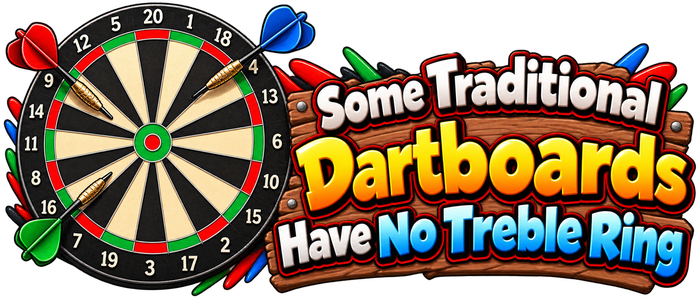
The Yorkshire dartboard is a fascinating example of how regional traditions developed before modern darts became standardised.
Its familiar twenty-number arrangement makes it look similar to an ordinary dartboard, but the traditional design has no treble scoring ring.
That means players cannot achieve a conventional 180 and must use completely different scoring strategies.
The Manchester Log-End board also lacks a treble ring and features a smaller playing area with an unusual numbering arrangement.
These boards remind us that the modern competition dartboard represents just one branch of a much larger family of traditional designs.
11. London Fives Uses Only Four Different Numbers
Imagine stepping up to a dartboard and discovering that most of the numbers have disappeared. That is exactly what happens when you encounter the traditional London Fives board.
Instead of the usual twenty values, the board repeats just four numbers: 20, 5, 15 and 10.
These values appear around twelve scoring segments, creating a very different playing experience.
Traditional games played on London Fives boards include 305, 505 and 705.
The design is a wonderful reminder that regional darts games can have their own scoring systems, equipment and traditions while still belonging to the same sporting family.
12. The First Televised Nine-Darter Was Thrown in 1984
John Lowe made darts history in October 1984 when he produced the first televised nine-dart finish.
The remarkable achievement took place during the MFI World Matchplay, where Lowe completed a perfect leg in front of television cameras.
His finishing combination was treble 17, treble 18 and double 18 after two visits of 180.
At the time, televised nine-darters were almost unimaginable. Lowe’s achievement instantly became one of the sport’s defining moments.
Today, perfect legs are celebrated with dramatic commentary, enormous crowd reactions and countless replays, but Lowe was the pioneer who showed television audiences what darting perfection looked like.
13. Phil Taylor Won Sixteen World Championships
Few athletes have dominated their sport as completely as Phil Taylor dominated professional darts.
Nicknamed “The Power”, Taylor won sixteen men’s world championship titles across the BDO and PDC organisations.
His extraordinary career combined technical precision, relentless practice, competitive confidence and an ability to perform under enormous pressure.
Taylor’s success helped transform darts into a major television sport, attracting sponsors, larger audiences and international attention.
His sixteen world titles remain one of the most remarkable achievements in darts history and a benchmark against which future champions are frequently compared.
14. Luke Littler Became World Champion at Just Seventeen
Luke Littler achieved something extraordinary on 3 January 2025 when he won the PDC World Darts Championship at the age of seventeen.
The English teenager defeated Michael van Gerwen in the final and became the youngest winner of the PDC men’s world championship.
Even more remarkably, Littler had reached the world championship final the previous year while still only sixteen.
His achievements demonstrated that exceptional talent can challenge experienced professionals at an astonishingly young age.
Littler’s rapid rise also introduced darts to a new generation of spectators and inspired younger players to take the sport seriously.
15. Professional Dartboards Have a Very Specific Height
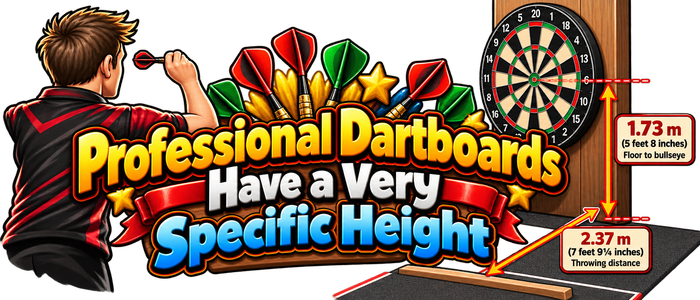
The centre of a regulation steel-tip dartboard must be positioned 1.73 metres above the floor, measured vertically to the bullseye.
This is approximately five feet and eight inches, making the board height remarkably consistent across properly regulated venues.
Correct positioning matters because even a small difference in height can affect a player’s familiar throwing motion and aiming reference.
Professional players rely heavily on repetition and muscle memory, so a properly installed board helps ensure fair conditions.
For anyone creating a home darts setup, measuring the bullseye height accurately should be one of the first installation steps.
16. The Official Throwing Distance Is 2.37 Metres
In standard steel-tip darts, the horizontal distance from the face of the dartboard to the throwing line is 2.37 metres, or approximately seven feet and nine-and-one-quarter inches.
The throwing line is commonly called the oche, a traditional darts term used in clubs and professional tournaments.
An important detail is that the measurement begins at the front face of the board rather than at the wall behind it.
Measuring from the wall can therefore create an incorrect throwing distance.
Different darts disciplines may use different distances, so players should always check the rules for the particular game or competition.
17. The Word Oche Has an Uncertain Origin
Every serious darts player eventually learns the word “oche”, but surprisingly, its precise linguistic origin is not firmly established.
The term refers to the line or raised marker behind which players stand when throwing their darts.
Various explanations have circulated over the years, including stories connecting the word to old pub practices or particular manufacturers.
However, not every popular explanation is supported by reliable historical evidence.
Whatever its origin, oche has become one of the most recognisable words in darts vocabulary, used by players, referees and commentators throughout the world.
18. Tungsten Darts Can Be Much Slimmer Than Brass Darts
Modern professional darts frequently contain a high percentage of tungsten, a metal prized for its density.
Because tungsten is considerably denser than brass, manufacturers can create a relatively slim barrel while maintaining the desired weight.
This matters when players aim repeatedly at narrow scoring areas. Slimmer barrels can provide more room for grouping three darts closely together.
Brass darts are usually less expensive and remain perfectly suitable for beginners, casual players and recreational use.
Tungsten does not automatically make someone a better player, but it allows manufacturers to produce barrel shapes and weight distributions that would be difficult to achieve using brass alone.
19. Dart Flights Are Essential for Stable Flight
The colourful material attached to the rear of a dart is known as the flight, and it performs an important aerodynamic function.
As the dart travels through the air, the flight helps stabilise its orientation and influences how it approaches the target.
Larger flights generally provide greater aerodynamic influence, while smaller flights can produce a different flight path and entry angle.
The effect also depends on shaft length, barrel design, throwing speed and the player’s individual technique.
This is why professionals sometimes experiment with different flight shapes and shaft combinations to find equipment that complements their natural throw.
Ready for more 30 Amazing Darts Facts You Probably Didn’t Know, then here you go:
20. A Dart Can Score Nothing Even After Hitting the Board
Imagine throwing a dart directly at the target, watching it strike the board and then seeing it fall to the floor.
Under ordinary steel-tip competition rules, a dart that does not remain in the board until scoring is completed generally does not count.
These frustrating incidents are commonly known as bounce-outs or fall-outs.
Bounce-outs can occur when the point strikes a wire, another dart or a hard surface that prevents proper penetration.
Modern thin-wire dartboards are designed partly to reduce deflections and improve the available scoring area, but no board can eliminate every unfortunate bounce-out.
21. Professional Players Can Deliberately Aim Away From Treble 20
Beginners often assume that the correct strategy is always to aim for the highest available score.
Professional players know that successful darts involves planning several throws ahead.
For example, a player might target treble 19 instead of treble 20 to leave a preferred finishing double or avoid an awkward remaining total.
The choice may also depend on whether the treble 20 is partially blocked by darts already in the board.
This strategic element makes darts much more than a simple test of accuracy. Excellent players combine precision with rapid mental arithmetic and a deep understanding of checkout combinations.
22. A Bust Can Cancel an Entire Visit
In standard double-out 501, players must reach exactly zero and finish on a double.
If a player scores more than the amount remaining, leaves exactly one point or reaches zero without hitting a valid finishing double, the visit is a bust.
When this happens, the player’s score returns to what it was at the beginning of that visit.
For example, a player starting a visit on 32 who accidentally scores 40 has busted. The remaining score stays at 32 rather than becoming negative.
This rule makes finishing accuracy especially important because one careless dart can waste an entire scoring opportunity.
23. The Three-Dart Average Is Not Always a Simple Visit Average
Television commentators frequently discuss a player’s three-dart average, one of the most widely used performance statistics in darts.
The calculation takes the total points scored and divides that figure by the number of darts thrown, then multiplies the result by three.
This method is more accurate than simply averaging completed three-dart visits because some legs finish after only one or two darts in the final visit.
A player who scores 501 points in fifteen darts produces a three-dart average of 100.20 for that leg.
Averages are useful indicators of scoring performance, but they do not tell the complete story. Finishing doubles, timing and match pressure also influence results.
24. A Nine-Darter Produces a 167 Three-Dart Average
The mathematics of a perfect leg produces another remarkable statistic.
When a player completes 501 in nine darts, the average score per dart is 501 divided by nine, or approximately 55.67 points.
Multiplying that number by three gives a three-dart average of exactly 167 for the leg.
This does not mean that every visit must score 167. The familiar nine-dart sequence produces visits of 180, 180 and 141.
It simply means that the overall scoring rate across the completed leg is equivalent to 167 points for every three darts thrown.
25. Cricket Is One of the Most Popular Alternatives to 501

Not every darts game involves counting down from 501. Cricket is another extremely popular format, particularly in North America and recreational darts communities.
The game focuses on the numbers 15 through 20 and the bullseye.
Players generally need three marks to close each number, while additional marks can produce points when the opponent has not yet closed the same target.
A treble counts as three marks, meaning one accurate dart can immediately close a number.
Cricket introduces a different balance between scoring and defence, making it a fascinating alternative for players who want something beyond conventional countdown games.
26. Some Professional Darts Games Require a Double to Start
Most players are familiar with double-out rules, where a leg must end on a double. However, certain competitions make the game even harder by requiring a double at the beginning.
This format is known as double-in, double-out and is famously associated with the World Grand Prix.
A player’s scoring does not begin until a valid opening double has been hit.
That creates additional pressure because even a player capable of regularly scoring 180 cannot immediately begin collecting points without first opening the leg.
The format also changes nine-dart strategies and produces unusual finishing combinations that are rarely seen in ordinary 501.
27. Brendan Dolan Achieved a Double-In Nine-Darter
Brendan Dolan created an extraordinary moment at the 2011 World Grand Prix by completing a nine-dart finish under double-in, double-out rules.
Because he had to begin the leg with a double, he could not simply start with three treble 20s.
Instead, his first visit was double 20, treble 20 and treble 20, producing 160 points.
He followed that with a maximum 180 and completed the remaining 161 using treble 20, treble 17 and the bullseye.
The result was one of the most memorable perfect legs in darts history and a demonstration of how alternative rules can make an already difficult achievement even more impressive.
28. Electronic Dartboards Can Calculate Every Score Automatically
Traditional darts relies on players or referees to record scores, but electronic dartboards can calculate them automatically.
Soft-tip boards generally use segmented plastic targets with sensors that detect where each dart lands.
More advanced steel-tip scoring systems use cameras and software to estimate dart positions on a conventional board.
Some systems connect to online platforms, allowing players in different countries to compete against one another without leaving home.
Automatic scoring does not eliminate every possible error, but it can make practice more convenient and provide useful statistics about scoring averages, checkout percentages and playing performance.
29. Dartboards Should Be Rotated to Reduce Wear
One of the simplest ways to extend the useful life of a traditional bristle dartboard is to rotate it regularly.
Players naturally throw more darts at certain sections, especially treble 20. Over time, these areas experience much heavier wear than less popular parts of the board.
Rotating the board distributes repeated impacts across different areas of the sisal surface.
On a standard board, the removable number ring can be repositioned so the 20 remains at the top after the playing surface has been turned.
Regular rotation, suitable indoor conditions and sensible maintenance can help a quality dartboard remain playable for longer.
30. Darts Combines Mathematics, Physics and Psychology
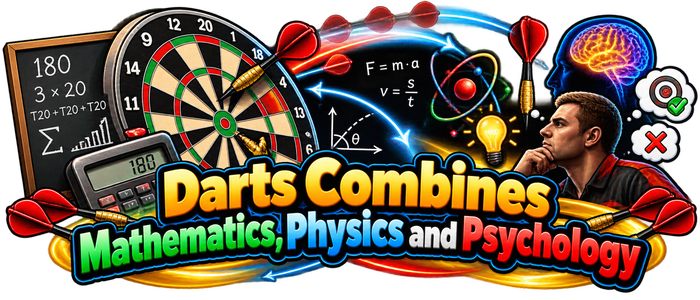
Perhaps the most surprising fact of all is that darts combines several different disciplines within a deceptively simple game.
Mathematics determines checkout possibilities, scoring strategies and the value of different target areas.
Physics influences dart flight, balance, release angle, speed and the effect of equipment design.
Psychology becomes important when a player faces a match-winning double in front of thousands of spectators or attempts the final dart of a perfect leg.
Successful players must combine these elements with concentration, repetition, confidence and precise hand-eye coordination.
That combination is what makes darts so fascinating: the rules are easy to understand, but mastering the sport can take a lifetime.
Amazing Darts Numbers at a Glance
Here are some of the most memorable figures from our collection of amazing darts facts.A part of our article: 30 Amazing Darts Facts You Probably Didn’t Know, read on and be amazed…
| Darts Fact | Number | Explanation |
|---|---|---|
| Maximum standard visit | 180 | Three treble 20s |
| Maximum checkout | 170 | T20 + T20 + Bull |
| Perfect 501 leg | 9 darts | Minimum possible |
| Nine-dart leg average | 167.00 | Three-dart average |
| Quadro maximum | 240 | Three quadruple 20s |
| Bullseye height | 1.73 m | From floor to centre |
| Throwing distance | 2.37 m | Standard steel-tip oche |
| Phil Taylor world titles | 16 | BDO and PDC combined |
| Luke Littler’s first PDC world title age | 17 | January 2025 |
| First televised nine-darter | 1984 | John Lowe |
Five Quick Darts Questions and Answers
What is the hardest achievement in darts?
A nine-dart finish is widely regarded as one of the sport’s greatest individual achievements because it requires a perfect combination of scoring and finishing accuracy.
Why do professional players aim at treble 20?
Treble 20 offers the highest available score from a single dart on a standard board: 60 points.
Why is 170 called the Big Fish?
The nickname refers to the exceptionally large checkout, which requires two treble 20s and the bullseye.
Are expensive darts always better?
Not necessarily. Barrel shape, balance, weight, grip and compatibility with the player’s technique are often more important than price alone.
Can beginners improve by practising on smaller targets?
Smaller-target practice can provide an additional accuracy challenge, although good technique, structured practice and consistent equipment remain important.
Final Thoughts – Darts Is More Amazing Than You Think!
From the extraordinary mathematics of a nine-dart finish to the unusual history of regional dartboards, darts is filled with surprises that even experienced players may never have encountered.
We have discovered why 180 is the highest standard score, how 170 became the ultimate checkout, why certain numbers cannot be finished in three darts and how technological innovation continues to change the game.
We have also explored legendary achievements from John Lowe, Phil Taylor, Luke Littler and Brendan Dolan, alongside the scientific details that make every dart throw unique.
The greatest thing about darts is that anyone can begin playing, but there is always something new to learn. Every practice session offers another opportunity to improve, experiment and appreciate the sport’s fascinating complexity.
We hope these 30 Amazing Darts Facts You Probably Didn’t Know have entertained you, taught you something new and given you a few surprising stories for your next darts night.
Keep practising, keep exploring and may your next three darts land exactly where you want them!
The Wizard of Darts Team
Sources and Further Reading
Dr Patrick Chaplin – Regional Dartboards and Darts History
Professional Dart Players Association – Darts History
Guinness World Records – Youngest PDC World Champion
Sky Sports – Nine-Dart Finishes Explained