The Biggest Comebacks in Darts History
The Biggest Comebacks in Darts History

Unforgettable Matches, Impossible Recoveries and Legendary Victories
There is nothing quite like a remarkable comeback in professional darts. One player appears completely defeated, the opponent is closing in on victory, and the crowd is already preparing to celebrate. Then, almost unbelievably, everything changes. A perfectly timed 180, a spectacular checkout or a missed match dart can transform an apparently hopeless situation into one of the most exciting moments in sporting history.
Throughout the history of professional darts, some of the greatest champions have demonstrated extraordinary determination when facing elimination. These players refused to surrender, even when they were several sets behind and seemingly had little chance of surviving.
In this article, The Biggest Comebacks in Darts History, we explore unforgettable matches involving Phil Taylor, Raymond van Barneveld, Rob Cross, Adrian Lewis, Luke Humphries and several other legendary players. We examine what happened, why the matches became famous and what recreational players can learn from these incredible recoveries.
Some of these comebacks changed the course of world championships. Others ended remarkable winning streaks or demonstrated that even the most experienced professionals can struggle when the pressure becomes overwhelming.
Prepare to discover why a darts match is never truly over until the winning double has been hit! The Biggest Comebacks in Darts History continues below…
What Makes a Darts Comeback So Extraordinary?
Darts is a sport in which momentum can change remarkably quickly. Unlike many other competitions, a player does not need to physically overpower an opponent or recover lost territory. Every new leg begins with another opportunity to score 501 points and finish on a double.
However, the psychological challenge of recovering from a large deficit is enormous. A player trailing by several sets knows that another mistake could end the match. Meanwhile, the opponent might be only one or two successful finishes away from victory.
The most impressive comebacks usually involve several ingredients: exceptional scoring, accurate finishing, mental resilience, missed opportunities by the leading player and a dramatic change in momentum.
There is also an important difference between recovering from a deficit in legs and recovering from a deficit in sets. Winning four consecutive sets usually requires a much longer period of sustained excellence than overturning a three-leg disadvantage.
For that reason, world championship matches frequently produce some of the most memorable recoveries in darts history.
1. Rob Cross vs Chris Dobey – The Incredible 2024 World Championship Comeback
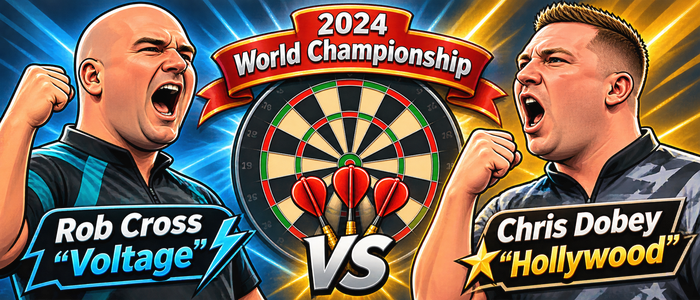
2024 PDC World Championship Quarter-Final | From 0-4 to 5-4
Few matches demonstrate the unpredictable nature of darts better than Rob Cross against Chris Dobey in the quarter-finals of the 2024 PDC World Darts Championship.
Dobey started brilliantly and established a commanding four-set lead. He appeared completely in control, and the possibility of Cross recovering seemed extremely remote. After all, Dobey needed only one more set to secure his place in the semi-finals.
Cross, the 2018 world champion, faced an extraordinary challenge. He needed to win five consecutive sets against an opponent who had been performing at an exceptionally high level.
Instead of accepting defeat, Cross gradually improved his finishing and began applying pressure. He won the fifth set, then the sixth, and suddenly the atmosphere inside Alexandra Palace started to change.
Dobey became increasingly aware that his enormous advantage was disappearing. Cross continued fighting, levelled the match at 4-4 and forced a deciding set.
The final set was dramatic. Cross produced a magnificent 130 checkout during the closing stages, and Dobey fought back to keep the contest alive. Eventually, Cross completed a 70 checkout to seal an extraordinary 5-4 victory.
The achievement was remarkable because Cross had recovered from a four-set deficit without being able to afford another lost set.
This is without a doubt on of The Biggest Comebacks in Darts History.
Why it matters: This is one of the clearest examples of a player recovering from the brink of elimination through sustained concentration and exceptional finishing.
2. Raymond van Barneveld vs Phil Taylor – The Legendary 2007 Final
2007 PDC World Championship Final | From 0-3 to 7-6
The 2007 World Championship final between Raymond van Barneveld and Phil Taylor is widely regarded as one of the greatest matches ever played.
Taylor was already a dominant figure in professional darts, and when he raced into a 3-0 lead in sets, another world title appeared increasingly likely.
However, Van Barneveld was no ordinary challenger. The Dutchman had already won four BDO world championships and possessed the experience necessary to compete with the very best.
Rather than becoming overwhelmed, Van Barneveld began rebuilding his performance. His scoring improved, his confidence returned and he gradually reduced Taylor’s advantage.
The match eventually reached 6-6 in sets, producing a thrilling final-set battle. Neither player was willing to surrender, and the championship was ultimately decided in a sudden-death leg.
Taylor began that final leg with a 180, but Van Barneveld responded with a maximum of his own. The Dutchman then created an opportunity to finish on double 20.
When Taylor failed to complete his remaining checkout, Van Barneveld stepped forward and hit the winning double.
The 7-6 victory secured his fifth world championship and his first PDC world title.
What makes this comeback particularly memorable is the identity of the opponent. Recovering from three sets behind against Phil Taylor in a world championship final required extraordinary composure.
Why it matters: This was not merely a recovery from a difficult position. It was a dramatic victory over one of the greatest players the sport has ever produced.
3. Adrian Lewis vs James Wade – The Extraordinary 2012 Semi-Final
2012 PDC World Championship Semi-Final | From 1-5 to 6-5
Adrian Lewis entered the 2012 World Championship as the defending champion, but his semi-final against James Wade nearly brought his title defence to a dramatic end.
Wade established a commanding 5-1 lead in sets and appeared certain to reach the final. Lewis needed to win five consecutive sets to survive.
The match was unusual because difficult playing conditions became part of the story. Air movement inside the venue affected the players, and the contest was interrupted while the problem was addressed.
Nevertheless, the biggest challenge for Lewis was psychological. Wade was only one set away from victory, and every missed opportunity could have ended Lewis’s championship hopes.
Lewis gradually found his rhythm and began reducing the deficit. His powerful scoring placed Wade under increasing pressure, while accurate finishing helped the defending champion stay alive.
As the sets accumulated, the seemingly impossible became increasingly realistic. Lewis eventually levelled the match and forced a dramatic conclusion.
He completed the comeback with a magnificent 161 checkout, securing a 6-5 victory and a place in the final.
Lewis subsequently defeated Andy Hamilton 7-3 to retain the world championship.
Why it matters: Recovering from 1-5 in a world championship semi-final, then going on to retain the title, makes this one of the sport’s defining comeback performances.
4. Luke Humphries vs Gerwyn Price – The Remarkable 2026 World Grand Prix Final
2026 World Grand Prix Final | From 0-3 to 6-4
One of the most memorable recent additions to the list of great darts comebacks occurred on 4 October 2026, when Luke Humphries faced Gerwyn Price in the World Grand Prix final.
Price began the match in excellent form and quickly established a three-set advantage. In a final requiring six sets for victory, Humphries was facing a serious challenge.
The World Grand Prix is especially demanding because players must hit a double to begin scoring as well as finish on a double. This double-in, double-out format introduces an additional element of pressure.
Humphries refused to allow the early deficit to determine the result. A crucial 105 checkout in the deciding leg of the fourth set helped him begin his recovery.
As the match progressed, Humphries found greater consistency and began winning the important moments. Price remained dangerous, but his early control gradually disappeared.
Humphries won six of the next seven sets to complete a spectacular 6-4 victory, securing his second World Grand Prix title.
The result also demonstrated how rapidly momentum can change in a major final, even when one competitor appears firmly in control.
Why it matters: Humphries overturned a three-set deficit in a major televised final under one of professional darts’ most demanding formats.
5. Phil Taylor vs Kevin Painter – The 2004 World Championship Final
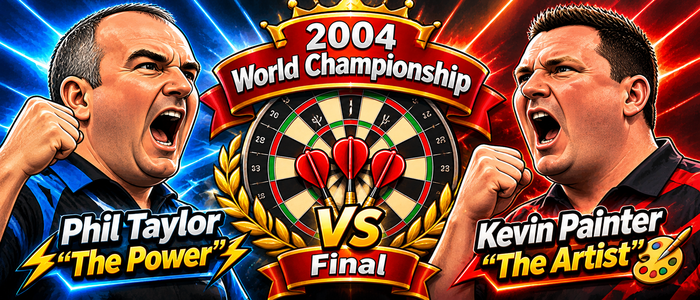
2004 PDC World Championship Final | From 1-4 to 7-6
Phil Taylor built his legendary reputation through consistency, accuracy and an extraordinary ability to perform under pressure. However, the 2004 World Championship final against Kevin Painter demonstrated that even the greatest champions sometimes have to fight their way back from seemingly impossible positions.
Painter produced an outstanding opening performance and moved into a 4-1 lead in sets. Taylor, who had lost the previous year’s world championship final to John Part, was in danger of suffering another painful defeat.
Rather than panicking, Taylor gradually improved his scoring and began taking control of the crucial legs.
The contest became increasingly tense as Taylor reduced the deficit and Painter attempted to protect his advantage.
Eventually, the two players reached a deciding thirteenth set. Taylor held his nerve and completed a dramatic 7-6 victory.
The triumph added another world championship to his extraordinary collection and reinforced his reputation as a competitor capable of finding another level when it mattered most.
Why it matters: Taylor recovered from three sets behind in a world championship final, proving that even dominant champions sometimes need remarkable comebacks to secure their greatest victories.
6. Wayne Mardle vs Phil Taylor – The Stunning 2008 Quarter-Final
2008 PDC World Championship Quarter-Final | From 0-3 to 5-4
Wayne Mardle produced one of the most emotional victories of his career when he defeated Phil Taylor in the quarter-finals of the 2008 World Championship.
Taylor had reached every previous PDC World Championship final, an astonishing record that made him the overwhelming favourite in many of his matches.
When Taylor moved into a 3-0 lead, another semi-final appearance seemed almost inevitable.
Mardle, however, began playing with greater freedom and confidence. He reduced the deficit, built momentum and gradually turned the contest into a genuine battle.
The atmosphere became increasingly dramatic as Mardle closed in on an extraordinary upset.
Eventually, he secured a 5-4 victory by winning the deciding set and ending Taylor’s remarkable sequence of world championship final appearances.
Mardle’s emotional reaction demonstrated just how much the achievement meant to him.
Although he subsequently lost to Kirk Shepherd in the semi-finals, his victory over Taylor remains one of the most memorable moments of the 2008 tournament.
Why it matters: Mardle not only recovered from three sets behind but also ended one of the most extraordinary records in professional darts.
7. Raymond van Barneveld vs Colin Lloyd – The 2007 Escape
2007 PDC World Championship | From 0-3 to 4-3
Before Raymond van Barneveld could produce his legendary comeback against Phil Taylor in the 2007 final, he first had to survive another remarkable recovery earlier in the tournament.
Facing Colin Lloyd in the second round, Van Barneveld found himself trailing by three sets to none.
Lloyd was an experienced and dangerous opponent who appeared ready to eliminate the Dutchman from his first PDC World Championship campaign.
Van Barneveld gradually fought his way back, winning three consecutive sets to level the match.
The deciding set was incredibly tense. Lloyd missed four match darts, giving Van Barneveld the opportunity to complete his escape.
The Dutchman eventually won 4-3, turning a seemingly certain defeat into a memorable victory.
That recovery became even more significant when Van Barneveld went on to win the entire tournament.
Without his victory over Lloyd, the famous 2007 world championship final against Taylor would never have happened.
Why it matters: This comeback saved a championship campaign that ultimately ended with one of the greatest world title victories in darts history.
8. Raymond van Barneveld vs Michael Smith – The 2016 Quarter-Final
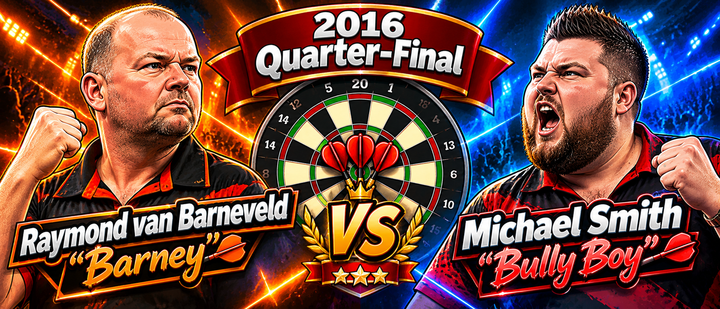
2016 PDC World Championship Quarter-Final | From 0-3 to 5-4
Raymond van Barneveld demonstrated his extraordinary comeback ability once again during the 2016 World Championship quarter-final against Michael Smith.
Smith began brilliantly, taking the opening three sets and putting the experienced Dutchman under enormous pressure.
Van Barneveld gradually improved his performance and began producing the kind of clinical finishing that had defined his greatest victories.
He won four consecutive sets to move ahead 4-3, but Smith refused to disappear and levelled the match at 4-4.
The deciding set produced another dramatic change in momentum. Smith established a two-leg advantage and appeared to have regained control.
Van Barneveld responded by winning four consecutive legs to secure the match.
The victory was particularly impressive because the Dutchman had to complete two separate recoveries: first from three sets behind, then from a dangerous position in the final set.
Why it matters: Van Barneveld showed that a comeback is not always a single uninterrupted surge. Sometimes a player must recover repeatedly before finally securing victory.
9. Jocky Wilson – A Career Comeback for the Ages
World Champion in 1982 and Again in 1989
Not every great darts comeback takes place during a single match. Some of the most remarkable recoveries unfold across several years.
Scottish darts legend Jocky Wilson won his first world championship in 1982, defeating John Lowe in the final.
Wilson became one of the sport’s most recognisable personalities, celebrated for his distinctive character, competitive determination and exceptional darting ability.
However, he experienced periods of inconsistent results and faced strong competition from a new generation of talented players.
Seven years after his first world title, Wilson returned to the summit of the sport by winning the 1989 BDO World Championship.
His second title demonstrated the importance of persistence and the ability to rebuild a successful career after difficult periods.
For many darts enthusiasts, Wilson’s achievements represent a different kind of comeback: one measured in years rather than legs or sets.
Why it matters: Wilson proved that a champion can return to the very top even after spending years away from world championship glory.
The Biggest Comebacks in Darts History – Comparison Table
The following table compares some of the most dramatic recoveries in major professional darts matches.
| Year | Winner | Opponent | Deficit | Final Score |
|---|---|---|---|---|
| 2024 | Rob Cross | Chris Dobey | 0-4 | 5-4 |
| 2007 | Raymond van Barneveld | Phil Taylor | 0-3 | 7-6 |
| 2012 | Adrian Lewis | James Wade | 1-5 | 6-5 |
| 2026 | Luke Humphries | Gerwyn Price | 0-3 | 6-4 |
| 2004 | Phil Taylor | Kevin Painter | 1-4 | 7-6 |
| 2008 | Wayne Mardle | Phil Taylor | 0-3 | 5-4 |
| 2007 | Raymond van Barneveld | Colin Lloyd | 0-3 | 4-3 |
| 2016 | Raymond van Barneveld | Michael Smith | 0-3 | 5-4 |
All deficits and final scores are shown in sets, from the winner’s perspective.
Which Was the Greatest Darts Comeback Ever?
Choosing the greatest comeback is difficult because every match has its own circumstances.
If the most important factor is the size of the deficit, Rob Cross recovering from 0-4 against Chris Dobey deserves special recognition. Cross had to win five consecutive sets to avoid elimination, an extraordinary achievement against a world-class opponent.
If the occasion and opponent are more important, Raymond van Barneveld’s 2007 victory over Phil Taylor is difficult to surpass. It took place in a world championship final, against a legendary champion, and ended in a dramatic deciding leg.
Adrian Lewis’s comeback against James Wade also deserves serious consideration because he recovered from 1-5 in a semi-final and ultimately retained the world title.
Meanwhile, Luke Humphries’ 2026 World Grand Prix victory demonstrates that spectacular recoveries continue to occur at the highest level of modern darts.
Our choice: Rob Cross against Chris Dobey for the sheer scale of the deficit, with Van Barneveld against Taylor in 2007 as the most iconic championship comeback.
The Psychology Behind a Great Darts Comeback

Why do some players recover from seemingly impossible positions while others struggle to protect a comfortable lead?
The answer often involves psychology as much as technical ability.
When a player falls several sets behind, expectations can change. The trailing competitor may begin playing more freely because there appears to be little left to lose.
The leading player, meanwhile, can become increasingly conscious of the approaching finish line. Instead of concentrating on the next dart, they may begin thinking about the importance of victory.
This change in attention can affect timing, confidence and finishing accuracy.
A missed match dart can be particularly significant. It gives the opponent another opportunity while creating additional pressure for the player who failed to finish.
However, not every comeback is caused by nerves. Sometimes the trailing player simply improves dramatically and produces a level of scoring that the opponent cannot match.
The greatest recoveries frequently combine both elements: exceptional play from the challenger and increasing pressure on the leader.
Five Lessons Amateur Players Can Learn From Famous Comebacks
1. Concentrate on One Leg at a Time
Thinking about winning five consecutive sets can feel overwhelming. Concentrating on the next three darts makes the challenge more manageable.
2. Never Assume the Match Is Over
A substantial lead does not guarantee victory. Continue following your normal routine until the winning double has been hit.
3. Practise Finishing Under Pressure
Many famous recoveries have been decided by accurate finishing. Practising doubles regularly can make an enormous difference during competitive matches.
4. Maintain a Consistent Throwing Routine
Avoid changing your technique dramatically after a few poor visits. A familiar routine can help maintain concentration and reduce unnecessary tension.
5. Respect Your Opponent Until the Final Dart
Even a player who appears defeated can suddenly produce several outstanding legs. Maintaining focus is essential regardless of the score.
Frequently Asked Questions About Darts Comebacks
What is one of the biggest comebacks in PDC World Championship history?
Rob Cross recovered from 0-4 down to defeat Chris Dobey 5-4 in the quarter-finals of the 2024 PDC World Championship. It is one of the most remarkable recoveries by sets in the competition’s history.
Did Phil Taylor ever lose after leading by three sets?
Yes. Raymond van Barneveld defeated Taylor 7-6 after trailing 0-3 in the 2007 World Championship final. Wayne Mardle also recovered from 0-3 to beat Taylor 5-4 in the 2008 quarter-finals.
Has anyone recovered from 1-5 in a world championship match?
Adrian Lewis achieved exactly that against James Wade in the 2012 PDC World Championship semi-final, eventually winning 6-5.
Why are comebacks so common in darts?
Darts matches consist of individual legs and, often, sets. Each new leg creates an opportunity to reset, while missed doubles and changes in scoring performance can quickly transform the momentum of a match.
Can a player win after an opponent misses match darts?
Absolutely. A missed match dart leaves the contest alive, and many dramatic victories have occurred after the eventual winner survived one or more attempts by the opponent to finish the match.
Final Thoughts – Never Give Up in Darts!
The biggest comebacks in darts history remind us why this sport continues to entertain millions of spectators around the world.
A match can appear completely decided before suddenly changing direction. One brilliant checkout can restore confidence, one missed double can create uncertainty and one determined player can transform an impossible situation into an unforgettable victory.
Rob Cross, Raymond van Barneveld, Adrian Lewis, Phil Taylor, Wayne Mardle and Luke Humphries have all demonstrated that mental strength can be just as important as technical excellence.
Their performances have created moments that darts fans will continue discussing for generations.
For recreational players, the message is equally valuable. Whether you are competing in a local league, playing friends at home or practising for your first tournament, never allow a poor start to determine your attitude.
Stay focused, keep practising your doubles and remember that every new leg offers another opportunity.
Because in darts, the greatest comeback might still be waiting to happen!
The Wizard of Darts Team